
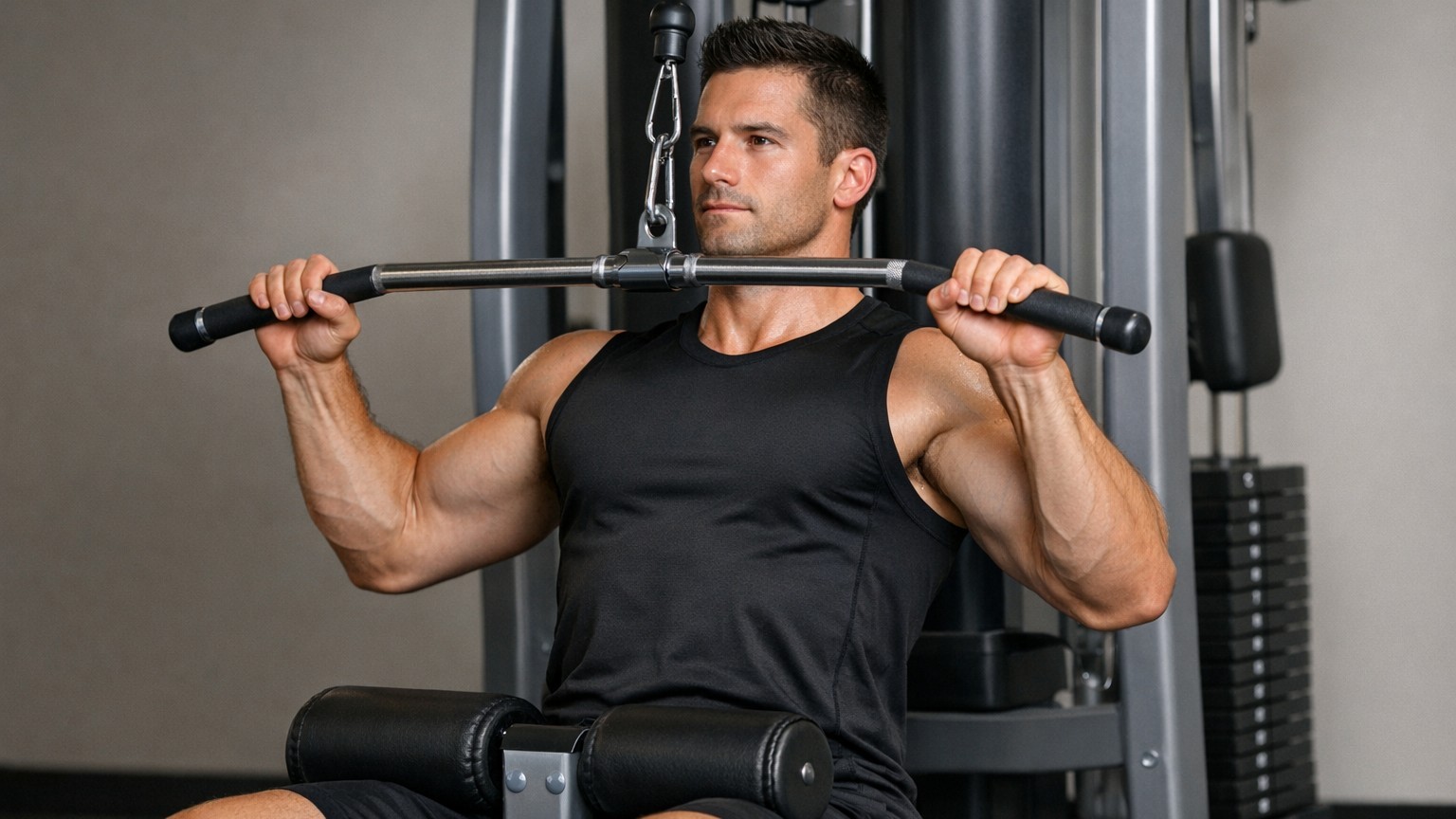
The lat pulldown is one of the most misused machines in any gym. For years, pulling the bar behind the neck felt more intense, more “complete” somehow, as if the greater range of motion meant greater results. The reality is rather less flattering: that movement is a well-documented path to cumulative shoulder and cervical damage, and most people who do it have no idea until something starts to hurt.
Key takeaways
- The behind-the-neck position forces your shoulder into extreme external rotation and your neck into dangerous compression, compressing tendons in the subacromial space
- Switching to front-of-chest pulldowns keeps your shoulder safe while actually improving lat engagement and scapular mechanics
- Grip width, elbow path, and eccentric control matter just as much as bar position—but nobody talks about them
What actually happens when the bar goes behind your head
The shoulder joint is a ball-and-socket structure with an extraordinarily wide range of motion, which is precisely what makes it vulnerable. When you pull a loaded bar behind your neck, the humerus moves into a position of extreme external rotation combined with horizontal abduction. At the same time, the cervical spine is forced into flexion as you duck your head forward to clear the bar. Both things happen simultaneously, under load, repeatedly.
The rotator cuff muscles, which are responsible for stabilising the head of the humerus within the socket, are placed under significant strain in this position. The subacromial space, the narrow channel between the top of the humerus and the acromion bone, becomes compressed. Over time, this compression irritates the tendons running through that space, particularly the supraspinatus. Physiotherapists have a name for this pattern: subacromial impingement syndrome. It rarely announces itself dramatically. Instead, it builds quietly, a dull ache after training that you dismiss, stiffness in the morning that you attribute to sleeping awkwardly, until one day lifting your arm to reach a shelf becomes genuinely uncomfortable.
The cervical component is equally worth understanding. Pulling the bar down behind the head forces you to flex the neck sharply forward at the C4-C7 level, which are the vertebrae most commonly affected by degenerative disc changes in adults. Applying repeated compressive load to already-vulnerable structures is not a strategy that tends to age well.
Why the front pulldown is mechanically superior
When the bar travels to your upper chest rather than behind your head, the movement changes completely. The shoulder remains in a position of controlled, comfortable external rotation without the extreme end-range stress. The lats, which are the primary target of the exercise, are actually better loaded in this position because the torso can hinge back slightly at around 20 to 30 degrees, allowing the lat fibres to work through a more mechanically advantageous range.
The scapulae (shoulder blades) can also depress and retract naturally as the bar comes down, which is exactly what the lats are designed to produce. Behind-the-neck variations actively inhibit this movement because the bar’s trajectory doesn’t allow the shoulders to move as freely. You end up recruiting the upper traps and levator scapulae to compensate, which ironically means you’re working less of the muscle you’re actually trying to develop.
There is also a proprioceptive benefit that gets little attention. With the bar coming to your chest, you can see it, feel it make contact, and use that tactile feedback to anchor the movement. This improves consistency of form across sets, particularly as fatigue accumulates in later sets when technique tends to drift.
The grip and elbow path matter just as much
Switching from behind-neck to front-of-chest is the single most impactful change, but it isn’t the whole story. A surprisingly common mistake is gripping the bar far too wide and flaring the elbows out to the sides. This recreates some of the same impingement risk in a slightly different way, because the shoulder is again being loaded in an abducted, externally rotated position under tension.
A grip roughly shoulder-width, or just slightly outside it, allows the elbows to travel downward and slightly back as the bar descends. Think of trying to put your elbows into your back pockets: that cue consistently produces better lat engagement and takes unnecessary stress off the anterior capsule of the shoulder. The bar should end its descent at around collarbone height, not yanked all the way to the sternum, which tends to cause the lower back to arch excessively as the ribcage flares up.
The controlled eccentric phase, the part where you allow the bar to rise back up, is where a lot of the actual muscle development occurs and where most people leave gains on the table. A slow, deliberate return of three to four seconds, maintaining scapular depression for as long as possible before letting the arms fully extend, trains the lat through its full length under load. That is a meaningfully different stimulus from simply letting the bar fly back up.
When to take shoulder pain seriously
Correcting your technique on the lat pulldown will almost certainly reduce the mechanical stress accumulating in your shoulder. But if you’ve been pulling behind the neck for years and have already developed persistent discomfort, changing your form is not the same as treating an injury. A physiotherapist can assess whether there is existing rotator cuff irritation, impingement, or any cervical involvement that needs specific rehabilitation work. Carrying on training through shoulder pain without understanding its source is how minor, manageable problems become structural ones.
One thing worth knowing: the NHS recommends seeing a GP or physiotherapist for shoulder pain that persists beyond a few weeks, particularly if it disrupts sleep or limits overhead movement. That threshold is lower than most regular gym-goers apply to themselves.
A detail that surprises many people is that the behind-the-neck pulldown was originally popularised in bodybuilding culture during an era when overhead pressing and gymnastics-style shoulder mobility work was far more common in training programmes. Those athletes had, in many cases, genuinely exceptional shoulder flexibility that allowed them to tolerate the position. Training that movement in isolation, without that context of surrounding mobility and stability work, was always a different proposition entirely.