
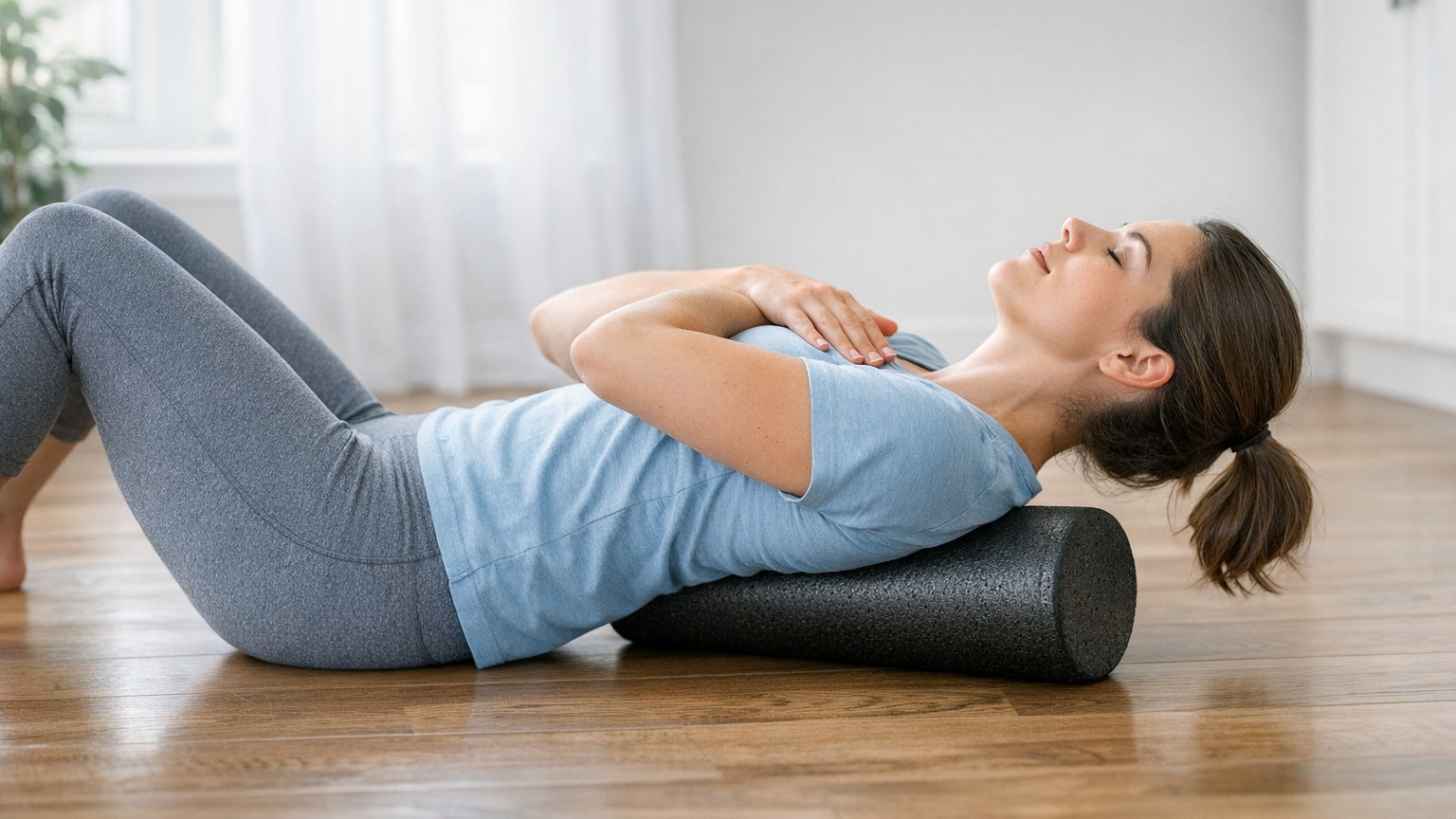
Foam rolling the lower back feels instinctively right. You’re tight, you’re sore, you drop down onto the roller and work your way up and down the lumbar spine with a sense of satisfying release. Millions of people do it. Fitness influencers demonstrate it. Gym instructors recommend it. The problem is that for Your Lower Back specifically, that rolling sensation is not the relief it feels like, and by the time I understood why, I’d spent months reinforcing the very pattern causing my pain.
Key takeaways
- The lumbar spine’s anatomy makes it uniquely vulnerable to compression from foam rolling
- A five-month habit reinforced the exact pain pattern it was supposed to ease
- The timing and technique matter more than you’d think—and might be making things worse
Why the lumbar spine is not built for foam rolling
The thoracic spine, the mid and upper back, is designed for rotation and extension. It has ribs anchoring it, facet joints angled to allow movement in multiple directions, and a relative tolerance for the compressive pressure a foam roller creates. The lumbar spine is built entirely differently. Its facet joints are oriented to permit flexion and extension, not rotation, and the vertebrae themselves sit close together with comparatively little muscular protection on the posterior side. When you roll directly along the lumbar region, you are applying load to a structure that has no good mechanism for distributing it.
A physiotherapist I eventually saw explained it with an analogy I’ve never forgotten: rolling the lumbar spine is a bit like trying to loosen a door hinge by pressing sideways on it. The joint isn’t built to receive force in that direction, so nothing productive happens structurally, but the surrounding soft tissue responds as if something useful is occurring, which is why it temporarily feels better. That neurological relief (a brief reduction in pain signals following mechanical input) gets mistaken for actual tissue release or structural benefit. There isn’t one.
What can happen instead, particularly with repeated rolling over weeks and months, is that you compress the intervertebral discs in a way that irritates them without addressing any underlying tension. If your lower back pain originates from disc irritation, nerve compression, or hypermobility in the lumbar joints, this is the last thing you want to be doing. The muscles directly surrounding the lumbar spine, the multifidus and the erector spinae at that level, are deep stabilisers. Aggressively mobilising over them doesn’t release them, it often triggers a protective guarding response that makes them contract harder.
The specific error I kept making
My particular mistake was positioning. I was rolling with my arms crossed over my chest, leaning back into full lumbar extension over the roller, then moving it slowly downward toward the sacrum. This extended the spine directly into the foam roller at the point of maximum curvature. A physiotherapist, watching me demonstrate the movement during an appointment, stopped me within about four seconds. The extension plus compression combination, she said, was loading the posterior elements of my facet joints at exactly the angle most likely to aggravate them.
She also pointed out that I was doing it daily, first thing in the morning, which is the worst time. Intervertebral discs are at their most hydrated and therefore most vulnerable to compressive forces in the morning, they rehydrate overnight through a process called imbibition, absorbing fluid while you’re recumbent. By rolling immediately after waking, I was loading a disc at near-maximum fluid pressure. Research published in journals covering spinal biomechanics has consistently supported the guidance that high-load spinal movements are best avoided in the first 30 to 60 minutes after rising.
The “too late” in my case wasn’t catastrophic. I hadn’t herniated anything. But I had spent roughly five months aggravating what turned out to be mild facet joint irritation, persuading myself I was managing it, when I was actively prolonging it. The physiotherapist’s assessment took 40 minutes. The foam rolling had taken about three minutes per day. The asymmetry there still bothers me.
What actually helps lower back pain instead
The evidence for lower back pain management has shifted considerably over the past decade, away from passive treatments toward active, movement-based approaches. Walking remains one of the most consistently supported interventions, it loads the spine in a controlled, cyclical way that promotes disc nutrition without imposing shear forces. Even 20 to 30 minutes of brisk walking most days has shown benefit in multiple large studies examining non-specific low back pain.
If you want to use a foam roller productively without ditching it entirely, use it on the thoracic spine (mid-back), the glutes, the hip flexors, and the hamstrings. Tightness in any of these areas contributes to altered load patterns that the lumbar spine then compensates for. Rolling your thoracic spine in particular, staying above the lowest ribs, can genuinely improve extension mobility and take pressure off the lumbar region indirectly. That’s where the tool earns its place.
Targeted strengthening of the deep core, specifically the transverse abdominis and lumbar multifidus, addresses the root cause of a great deal of persistent lower back discomfort. These muscles don’t strengthen through rolling. They strengthen through controlled, progressive loading, movements like bird-dogs, dead bugs, and pallof press variations, done consistently over weeks. A physiotherapist or chartered exercise professional can prescribe these to your specific presentation, which matters enormously since lower back pain is not a single condition but a broad category covering very different structural problems.
One thing worth knowing: the foam roller industry has expanded to include vibrating devices and contoured designs specifically marketed as “safe for the lower back.” The marketing is compelling and the products are often expensive. The biomechanical concern about the lumbar spine isn’t about the hardness or texture of the foam, it’s about applying compressive rolling force to that region of the spine at all. A softer roller with more features doesn’t resolve the underlying issue with the technique.
This article is for informational purposes only and does not constitute medical advice. If you are experiencing lower back pain, please consult your GP or a registered physiotherapist.