
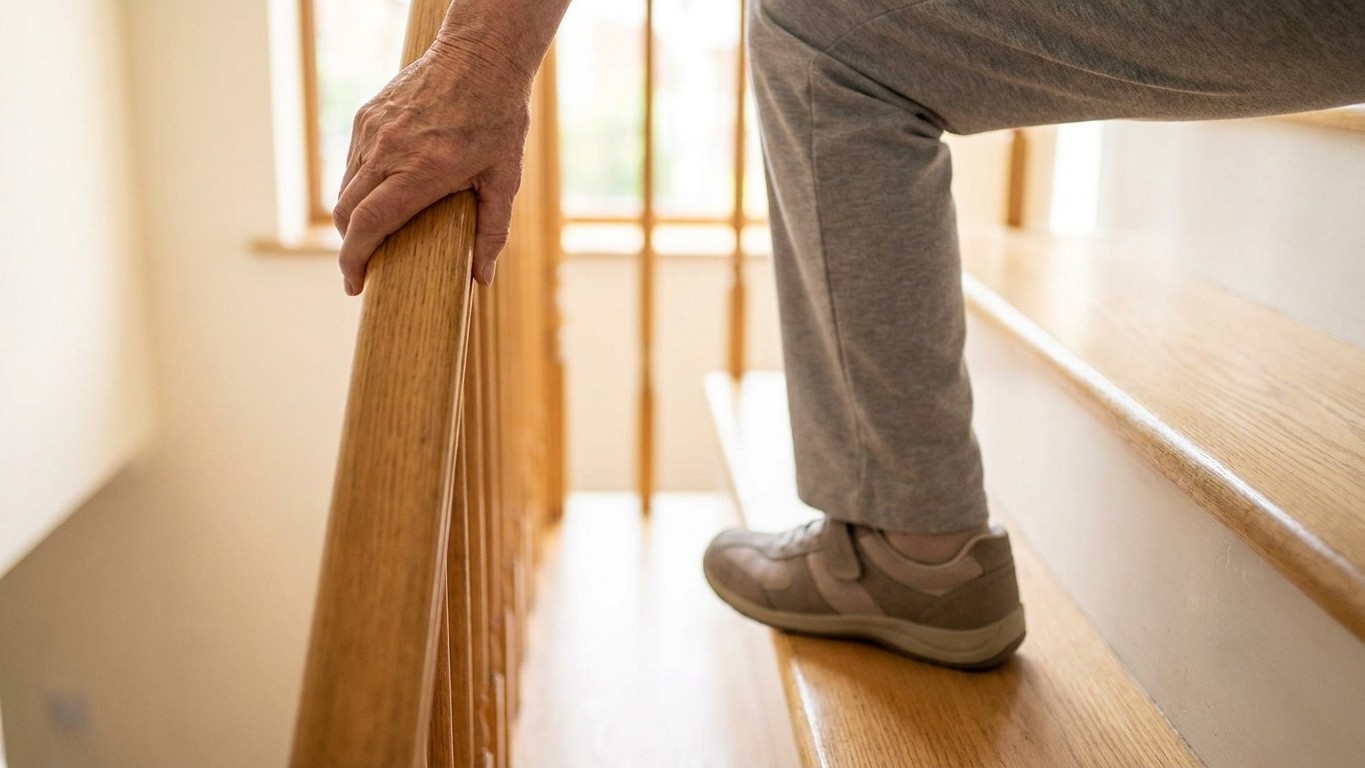
Forget the leisurely flat loop around the park. If you’re over 80 and want thighs that still carry you up the garden steps or out of an armchair without a wobble, the humble staircase does more for you in ten minutes than a jog or a flat stroll manages in an hour. The research on this is surprisingly consistent, and it comes down to one simple mechanical trick: going down beats going up, and both beat walking on the flat.
Key takeaways
- Why flat walking fails to protect the muscles that matter most after 80
- The surprising physics of why going down stairs beats going up (and jogging)
- How ten minutes of stairs can deliver results that an hour of flat ground cannot
Why a flat walk stops being enough after 80
Muscle loss after 80 isn’t gentle. people lose roughly 3 to 8 percent of their muscle mass each decade after age 30, and after age 65 that rate increases to between 6 and 15 percent. That decline hits the thighs particularly hard, and weak leg muscles can affect balance, fall response, and the ability to perform basic, everyday tasks. A flat walk, even a brisk one, asks very little of the quadriceps because there’s no real resistance to push against beyond your own forward momentum. Your heart and lungs benefit, certainly, but the muscle fibres that stop you crumpling when you misjudge a kerb barely get a workout.
Jogging doesn’t fully solve this either, particularly for anyone in their eighties or beyond, where impact on knees and hips often makes running impractical or simply unwise. What the thigh actually needs is load applied through a full range of motion, ideally including the lengthening, braking type of contraction that happens when a muscle works while Stretching under weight. That’s exactly what stairs provide, and what flat ground can’t.
The eccentric secret: going down beats going up
Researchers studying older women found something that surprised even them. Walking down stairs, with the front thigh muscles undergoing eccentric contractions, increased leg muscle strength and balance in older women more than walking up stairs. That’s the opposite of what most people assume, since climbing up feels like the harder, more breathless task. But when climbing stairs, the front thigh muscles undergo concentric contractions, with the muscles shortening, whereas descending forces the quadriceps to lengthen while resisting gravity, a much more effective stimulus for building strength.
The numbers from a related study comparing traditional exercise against this eccentric, downward-focused training are striking. The eccentric group had a 38 per cent improvement in leg strength, compared to just an 8 per cent improvement in the traditional exercise group. Look specifically at stair direction and the gap widens further: the group doing what would be considered the easier task improved their muscle strength by 34 per cent, twice as much as those who had to walk up the stairs each time. Balance improved too, with the group walking down showing greater improvements in a balance test, which would lead to a reduced risk of falls and injury. There were knock-on benefits beyond the muscle itself as well, including greater improvement in resting heart rate, better insulin sensitivity, improved blood fat levels, and increased bone density among the downstairs walkers compared with those who only climbed up.
Short bursts, real results
You don’t need a Victorian townhouse with a grand staircase to see benefits. A trial published in the Journal of Strength & Conditioning Research recruited adults aged 65 to 80 and had them work through a progressive stair programme rather than an endless flat route. The stair group performed four slow sets of step-ups on a box about a foot high for the first four weeks, then progressed from week five to four fast sets of climbing up two flights of six stairs, resting 45 seconds on a landing in between, with a weighted vest added in the final weeks. Some participants doubted a routine lasting barely ten minutes could count as proper exercise, yet the leg strength and power gains held up against more conventional gym-based training.
For those whose knees or hips make stairs genuinely unsuitable, there’s a close substitute that produces comparable thigh activation: rising repeatedly from a chair. A twelve-week programme involving frail adults aged 75 to 88 had them perform sit-to-stand repetitions three times a week, and this short-term conditioning programme proved effective in increasing knee extensor strength and reducing the muscular effort required for lowering and raising the body. The training itself was unglamorous, just 48 repetitions per session, three sessions a week, yet it delivered measurable gains in exactly the muscle group that keeps people independent.
Making it a habit without risking a tumble
None of this means abandoning your flat walk, which still matters for heart health, joint lubrication and simply getting you out of the house. Rather, think of stairs (or sit-to-stands if stairs feel too risky) as the strength-training top-up that walking alone can’t provide. A few practical starting points:
- Use a banister or wall for balance at first, especially on the descent, which is where the real muscle benefit lies
- Start with a single flight once or twice a day rather than attempting long sessions
- If stairs aren’t accessible or safe, practise standing up from a firm chair without using your hands, building up gradually to several sets
- Stop and rest if you feel unsteady, and never attempt fast descents without a handrail nearby
None of this is about ditching your GP’s advice for your own routine, particularly if you have existing joint problems, dizziness, or a history of falls, in which case a conversation with your doctor or a physiotherapist before starting should come first. What’s worth remembering, though, is that the staircase you’ve perhaps been avoiding since your knees started complaining might be doing your thighs more good than any amount of flat pavement ever could, provided you take it slowly and use the descent to your advantage.
Sources : body-works.ca | ncbi.nlm.nih.gov