
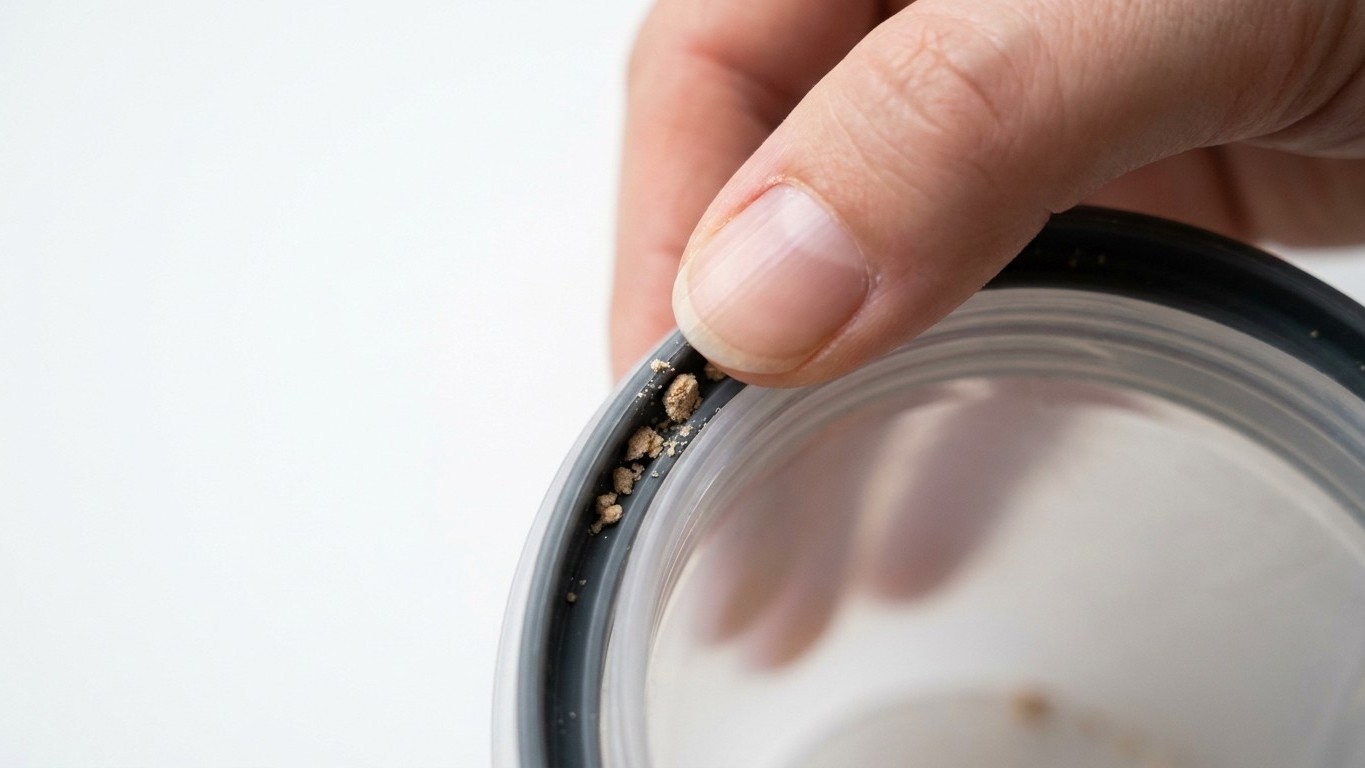
Pull the rubber seal out of your shaker lid, run a fingernail along the groove underneath, and there’s a good chance you’ll drag out a pale, slightly gritty paste that no dishwasher cycle ever quite reached. That paste is dried protein powder mixed with saliva, moisture and whatever bacteria found the warm, damp crevice hospitable. Environmental health officers use almost this exact move on commercial kitchen equipment, prising back gaskets and seals to check what’s hiding underneath rather than trusting a shiny, wiped-down surface. The habit translates surprisingly well to the gym bag.
Shaker bottles look clean because the outside gets a quick rinse under the tap. The lid rarely gets the same treatment, and that’s precisely where the trouble concentrates. One of the most overlooked parts of reusable bottle hygiene is how poorly many people clean the lids themselves, with bottles rinsed quickly while the lid receives only superficial attention, even though it often carries the highest concentration of bacteria because of direct contact with saliva and hands. Straw openings, sliding covers, silicone valves and rubber seals create tiny spaces where moisture stays trapped and airflow is limited, turning them into ideal environments for microbial growth.
Key takeaways
- What’s actually living in that groove under your shaker lid seal?
- Why one study found 90% of gym bottles contaminated with dangerous pathogens
- The five-minute inspection technique food safety officers use on commercial kitchens
Why the groove matters more than the bottle
A 2018 microbiological study gives some sense of scale. Researchers analysed used and unused shaker bottles from fitness centre members, testing 30 used and 30 non-used bottles; every non-used bottle showed zero contamination, while 90 per cent of the used ones tested positive, yielding Staphylococcus aureus, Pseudomonas and E. coli. Other testing on reusable bottles more broadly has produced figures that sound almost implausible until you remember how rarely a lid gets fully dismantled: after just a week without cleaning, a shaker cup can contain 300,000 bacteria cells per square centimetre.
The seal itself is the main offender, not laziness with the sponge. Rubber and silicone gaskets create tight seals, but they also create tiny crevices where moisture gets trapped, and over time bacteria and mould colonise these spaces. Threaded collars behave the same way. Fine whey powder settles into the screw grooves, resists a casual rinse, and sits there feeding whatever’s already growing. It’s a similar mechanism to what researchers found when they swabbed something rather less glamorous: household dishwasher door seals. All 30 dishwashers investigated in one study were colonised by various bacteria, with cultivation approaches yielding 632 bacterial isolates across 74 species, the majority Gram-positive and dominated by the Bacillus cereus group. Gammaproteobacteria included Stenotrophomonas maltophilia, Pseudomonas aeruginosa and Escherichia coli. Different appliance, same principle: wherever rubber meets moisture and food residue, biofilm builds a home.
What inspectors are actually trained to spot
In a commercial kitchen, gasket checks aren’t an afterthought, they’re routine. Cracked, torn or missing door gaskets on fridges are something inspectors check by habit, since damaged seals let warm air in, push food into temperature danger zones, and the resulting condensation promotes mould that can drip onto stored food, all from one small rubber gasket. The contamination risk isn’t theoretical either. A damaged gasket can trap debris, moisture and bacteria in its crevices, and staff who touch the seal repeatedly during a shift can transfer pathogens onto prep surfaces or directly into meals.
In England, Wales and Northern Ireland this kind of scrutiny feeds directly into the number displayed in a restaurant window. At inspection, officers check how hygienically food is handled through preparation, cooking, cooling and storage; the physical condition of the business including cleanliness and facilities; and how management keeps food safe through processes, training and systems. A gunked-up gasket sits right at the intersection of the first two categories. It’s a small detail, but it’s exactly the sort of small detail that separates a five from a three.
Running the same test at home
You don’t need training to replicate the check. Pop the seal free with a fingernail, or a cuticle stick if your nails won’t do it, and look at what’s sitting in the groove that held it in place. One home cleaning method involves prying the gasket out of the lid with a cuticle cutter, then soaking it in a solution of hydrogen peroxide, baking soda and dish soap before rinsing and drying. A soft-bristled brush or an old toothbrush handles the threaded collar underneath the seal, where powder residue tends to cake on hardest.
Frequency matters more than intensity. Rinsing the second you’ve finished drinking removes the bulk of the residue before it dries into something stubborn; a proper strip-down wash once or twice a week catches whatever the daily rinse misses. If the seal has gone cloudy, developed a permanent tacky feel, or the groove keeps producing black or green flecks after cleaning, that’s mould rather than residue, and replacement is cheaper than repeated deep-cleans that never quite finish the job. Most manufacturers sell replacement gaskets separately for this reason.
None of this means shaker bottles are uniquely dangerous, and there’s no need to bin yours over a bit of dried protein powder. But if you’ve never actually removed that little ring of rubber since the day you bought the thing, it’s worth five minutes tonight, if only to see what’s really living under there. Consult your GP if you ever suspect food poisoning symptoms that don’t settle within a day or two, particularly persistent vomiting, fever or blood in stools.
Sources : foodpoisoningnews.com | thekitchn.com