
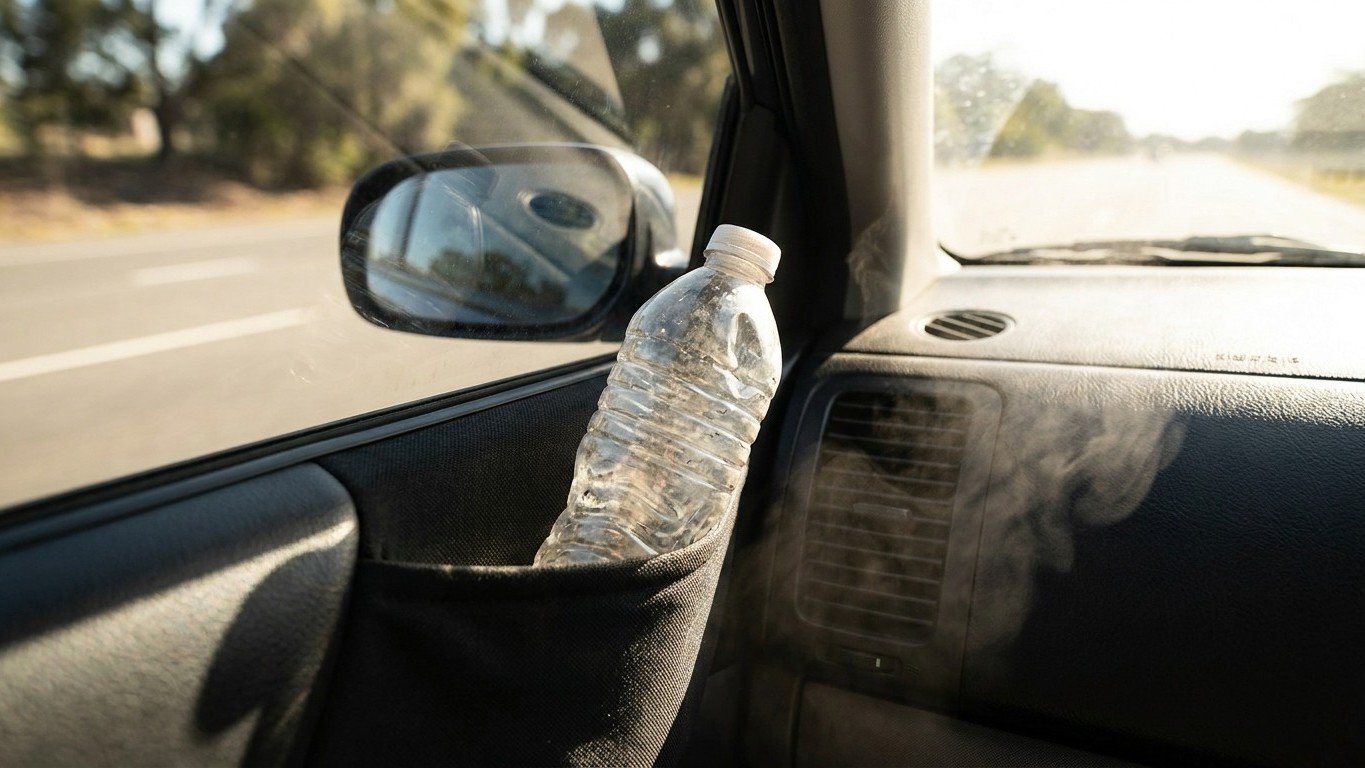
Passengers who mock a stainless steel bottle rattling in the cupholder might want to look again at the numbers. On a 38°C day, the air inside a parked car in direct sun can climb to 60–70°C, cabin temperature on a 30–35°C day, with dashboards climbing higher still. Door pockets sit right against the glass, one of the warmest spots in the cabin alongside the dashboard, and that is precisely where millions of us wedge a supermarket bottle of water without a second thought. The plastic laughed at for being disposable turns out to be the one quietly cooking in the heat, while the “boring” metal bottle sits there completely unaffected.
Key takeaways
- Every 5°C increase in temperature roughly halves the time before chemical leaching reaches unsafe levels
- Microplastics add another invisible concern: heat physically weakens plastic, shedding particles into your water
- The viral dioxin scare is debunked, but the temperature-time relationship holds up under scrutiny
What the heat actually does to the plastic
PET, the clear plastic used in almost every single-use water bottle, is not an inert material once temperatures rise. When PET-containing bottles sit in the heat, the polymer chains in the plastic can start to break down and cause the release of various chemicals, including trace amounts of phenol, like bisphenol A (BPA) and phthalates, into the water. The mechanism has been studied for close to two decades now, and the results are consistent: warmth speeds up a chemical process that barely happens at room temperature.
The clearest data comes from a 2007 Arizona State University study that specifically looked at car interiors. Summertime temperatures inside of cars, garages, and enclosed storage areas can exceed 65 °C in Arizona, and thus could promote antimony leaching from PET bottled waters. Antimony is a metalloid used as a catalyst when the plastic is manufactured, and it stays trapped in the polymer at low levels until heat gives it a way out. The researchers modelled exactly how fast this happens at different temperatures, and the pattern is striking: for exposure temperatures of 60, 65, 70, 75, 80, and 85 °C, the exposure durations necessary to exceed the 6 ppb MCL are 176, 38, 12, 4.7, 2.3, and 1.3 days, respectively. Every extra five degrees roughly halves the time it takes to reach the safety threshold set by the US Environmental Protection Agency. A door pocket baking at 65°C for a few weeks over a warm summer, forgotten bottle after forgotten bottle, is not a hypothetical scenario.
A separate piece of research from the University of Florida pushed the conditions further to see what a genuine worst case looked like. UF soil and water science professor Lena Ma led a research team that studied chemicals released in 16 brands of bottled water kept at 158 degrees Fahrenheit for four weeks, what researchers deemed a “worst-case scenario” for human consumption. The reassuring part of that study was that of the 16 brands, only one exceeded the EPA standard for antimony and BPA. The less reassuring part: Ma’s study found that as bottles warmed over the four-week period, antimony and BPA levels increased. Direction of travel matters here, even if a single warm afternoon in the car is unlikely to tip anyone into dangerous territory.
Microplastics add another layer
Chemical leaching isn’t the only concern. Heat doesn’t just release trapped molecules, it also physically weakens the plastic structure, encouraging tiny fragments to break off into the water. Bottled water already carries a surprising baseline load of these particles regardless of temperature: a 2024 Columbia University analysis using an advanced laser imaging technique found that one liter of water, the equivalent of two standard-size bottled waters, contained an average of 240,000 plastic particles from seven types of plastics, of which 90% were identified as nanoplastics and the rest were microplastics. Heat and repeated squeezing or reopening only accelerate that shedding process, which is why reusing a single-use bottle for weeks in a hot car is worse than drinking from a fresh, unopened one.
What’s exaggerated, and what genuinely deserves caution
Not every scare story stacks up. The viral warning that hot cars cause plastic bottles to release cancer-causing dioxins has circulated for years, usually traced back to a chain email, and it simply isn’t supported by the chemistry. Claims that dioxins, known carcinogens, are released when plastic bottles are left in hot cars have been debunked by scientists. Freezing a bottle doesn’t create dioxins either; it does the opposite of heating, slowing any migration down rather than speeding it up.
What genuinely holds up is the temperature-time relationship: hotter and longer both push leaching upward, and a car door pocket in a UK heatwave gives you both. The industry’s position, voiced through the International Bottled Water Association, maintains that regulated PET containers remain safe under normal conditions, and for a single bottle drunk within a day, that’s a fair point. The science stops being reassuring only when the same bottle sits there sun after sun, refilled and reused, week after week.
None of this means panic every time you spot a bottle rolling around in the door pocket after a school run. It does mean treating any bottle that’s clearly baked for days, gone cloudy, or picked up a plastic taste as one to tip out rather than finish. A stainless steel or glass bottle sidesteps the whole issue, since the bottom line is that glass is better than plastic, wherever possible, according to University of Missouri plastics researcher Julia Taylor. Next time the mockery starts over your metal bottle clanking in the cupholder, you’ll have the numbers to hand it right back. If you’re ever worried about symptoms you think might be linked to what you’ve been drinking, your GP remains the right person to talk to rather than a search engine.
Sources : plasticpollutioncoalition.org | theberkey.com