
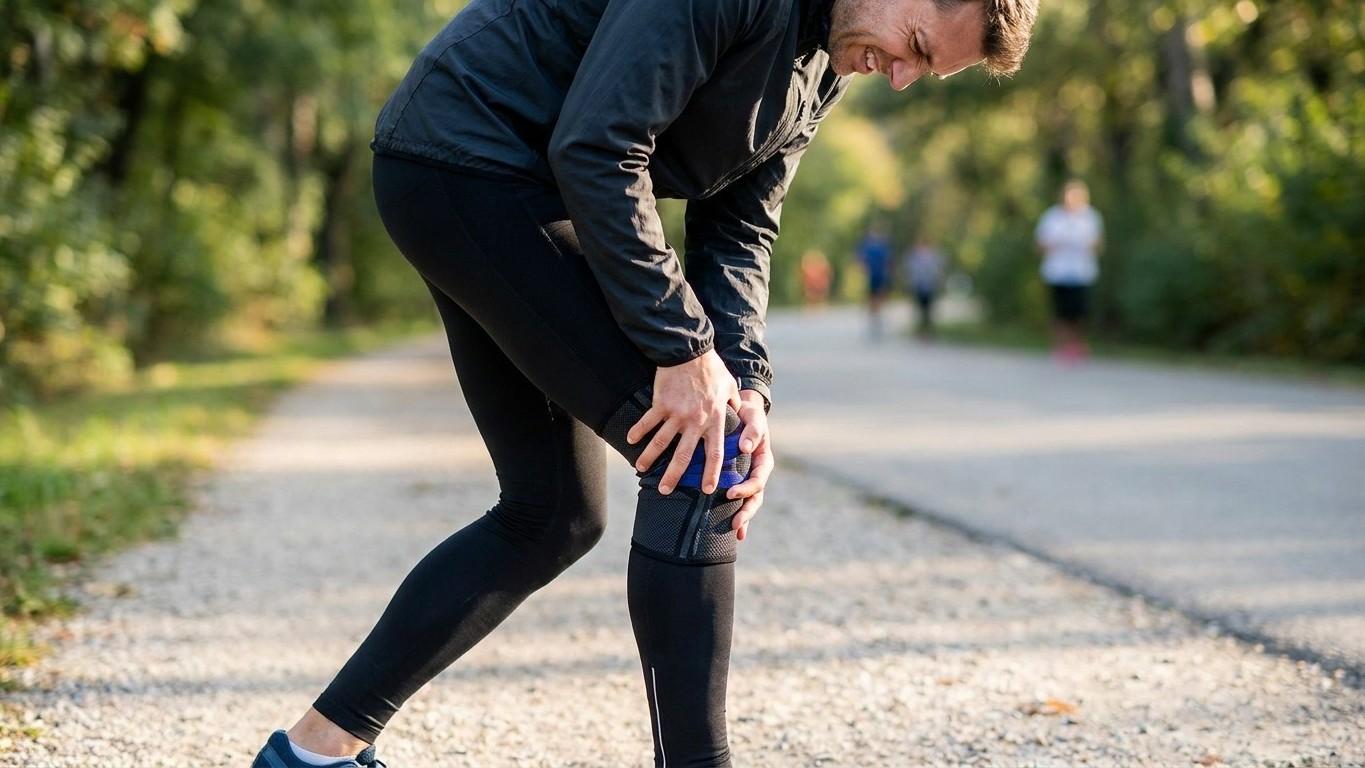
Foam rolling the IT band is one of those pieces of gym advice that has taken on the status of received wisdom. Tight hips? Roll it out. Knee pain after running? Roll that IT band. The logic feels intuitive, compression relieves tension, tension causes pain, so compress away. The problem is that the logic is almost entirely wrong, and spending five minutes grinding a foam roller along the outside of your thigh may actually be making things considerably worse.
Key takeaways
- You’ve been foam rolling the wrong structure for the wrong reason—and it might be making things worse
- The IT band isn’t a muscle, so mechanical pressure can’t lengthen it like you think
- Your knee pain is downstream; the real dysfunction is hiding in your hips
What the IT band actually is (and why rolling it is a questionable idea)
The iliotibial band is not a muscle. This distinction matters enormously. It is a thick strip of connective tissue, fascia, running from the hip down to the shin, and unlike muscle, it has almost no capacity to stretch or lengthen under mechanical pressure. Research published in the Journal of Anatomy has measured the IT band’s tensile stiffness and found it to be extraordinarily resistant to deformation. You would need forces far beyond anything a foam roller can generate to meaningfully change its length or structure.
So what are you actually doing when you roll it? You’re compressing the soft tissue beneath the band, including the small bursa (fluid-filled sacs that cushion friction) and the lateral knee fat pad. Compress an already irritated bursa night after night, and you’re not releasing tension, you’re adding more inflammation to a structure that’s already struggling. That was, in retrospect, precisely what I was doing.
The real source of IT band syndrome
Here’s where the science becomes genuinely useful. Iliotibial band syndrome, the condition characterised by sharp or burning pain on the outside of the knee during running, is now understood by sports medicine researchers to be primarily a compression problem, not a friction problem. For years, the dominant theory held that the IT band “rubbed” against the lateral femoral epicondyle (the bony bump on the outside of the knee), causing irritation. More recent biomechanical research has shifted this understanding: the band compresses the fat pad and connective tissue beneath it, particularly in a specific range of knee flexion around 30 degrees, which happens to be exactly the angle your knee passes through during running, going up stairs, and cycling.
The implication is significant. If compression is the mechanism of injury, then applying more compression with a foam roller directly to that area is, at best, pointless and, at worst, provocative. A 2016 review in the Journal of Orthopaedic & Sports Physical Therapy found no high-quality evidence that foam rolling reduces IT band-related knee pain. What does have evidence behind it is addressing the muscular weaknesses and movement patterns that load the IT band in the first place.
What actually works
The IT band becomes Excessively loaded when the hip abductors, chiefly the gluteus medius, are weak or poorly coordinated. When these muscles don’t fire effectively, the pelvis drops slightly on each stride, pulling the IT band taut and increasing compression at the knee. This is why IT band syndrome is so common in runners who have suddenly increased mileage: the hip stabilisers fatigue faster than the legs, and the knee pays the price.
Strengthening the gluteus medius through exercises like clamshells, lateral band walks, and single-leg squats has considerably stronger evidence behind it than any amount of rolling. Running gait analysis can also reveal whether you overstride or have an excessive hip drop, both of which dramatically increase IT band load. Reducing weekly mileage by around 30 to 40 percent during a flare-up, while maintaining hip strength work, tends to be the approach that sports physiotherapists recommend most consistently.
There is a role for foam rolling in this picture, but it’s not where most people apply it. Rolling the tensor fasciae latae (TFL), the muscle at the top of the hip that feeds into the IT band, and the lateral quadriceps can genuinely help reduce tissue stiffness further up the chain. Rolling the lateral knee itself, however, the bit that hurts, is the equivalent of rubbing an angry bruise to make it feel better. The short-term sensation of pressure can feel satisfying, which is precisely why it’s so easy to keep doing it.
The broader lesson about pain and self-treatment
There’s a pattern worth recognising here. When something hurts, the instinct is to work directly on the site of pain. A tight neck gets rubbed. A sore lower back gets stretched. A painful knee gets rolled. But pain is often referred, it appears downstream of the actual dysfunction. The knee is the victim, not the criminal, in most IT band presentations.
This is why a proper assessment from a physiotherapist or sports medicine practitioner is worth considerably more than months of self-directed foam rolling. They can identify whether your pain is genuinely IT band syndrome or whether it’s something else entirely, including lateral meniscus irritation or patellofemoral syndrome, both of which can present similarly but require different management. Please do consult your GP or a qualified physiotherapist if you’re dealing with persistent knee pain rather than self-treating in the dark.
One final detail that rarely makes it into the standard advice: the IT band has a small fatty tissue pocket embedded within it called the subIT band fat pad, and this structure has been shown in cadaveric studies to be richly innervated with nerve endings. This may explain why IT band syndrome can feel so searingly sharp, you’re not just irritating collagen fibres, you’re aggravating highly sensitive neural tissue. Which makes aggressive compression not just unhelpful, but a fairly spectacular way to keep yourself in pain for longer.