
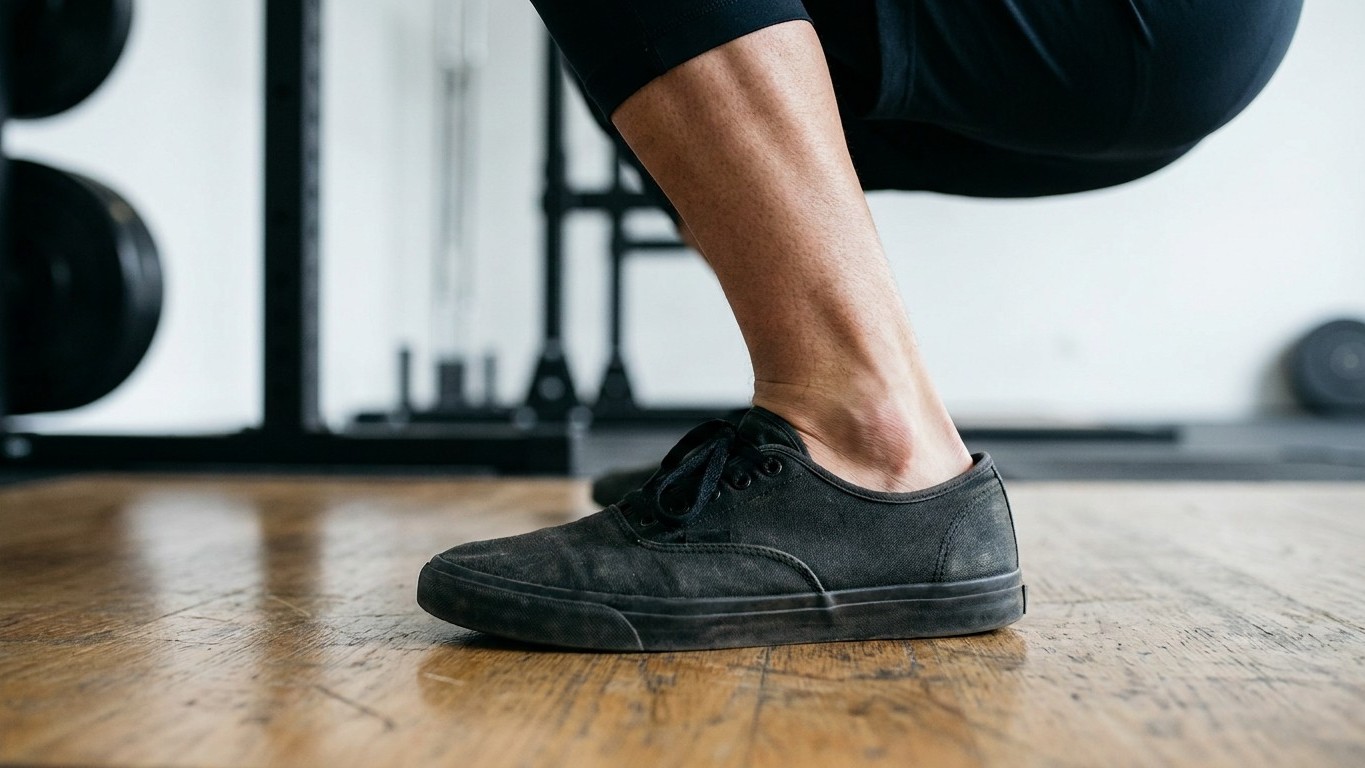
Thick-soled trainers have become the default footwear for gym-goers across the UK, and almost nobody questions them. They feel comfortable, they look the part, and the cushioning seems like straightforward protection. The problem is that when you load a barbell across your back and descend into a squat, that soft, compressible foam is doing something to your mechanics that your knees will eventually notice.
Key takeaways
- Your cushioned trainers’ heel raise shifts your centre of mass forward, forcing your knees to absorb forces they weren’t designed to handle repeatedly
- The soft, compressible foam creates an unstable base that allows foot collapse and internal tibia rotation—triggering valgus collapse and medial knee loading
- Olympic weightlifters have solved this problem for decades; flat, rigid soles and proper form eliminate the knee damage that cushioning creates
What the heel raise is actually doing to your squat
Standard running trainers typically have a heel-to-toe drop of anywhere between 8mm and 12mm. When you squat in them, that elevated heel changes the geometry of the movement in ways that seem subtle but compound over thousands of repetitions. The raised heel shifts your centre of mass forward, which encourages the knee to travel well beyond the toe and increases the shear force through the patellofemoral joint, the junction between your kneecap and the femur. Research published in the Journal of Strength and Conditioning Research has confirmed that heel elevation during squatting meaningfully increases anterior knee stress compared to flat or minimalist footwear conditions.
There is an irony worth sitting with here. The heel raise that makes squatting feel easier, because it compensates for limited ankle dorsiflexion, is simultaneously masking a mobility deficit that your knees are quietly paying for. Your ankle isn’t getting the stimulus to improve. Your knee is absorbing forces it wasn’t designed to handle repeatedly. And the cushioning compounds the problem by making the whole experience feel perfectly fine right up until it isn’t.
Compressible foam beneath your foot also creates an unstable base. When you are holding significant load overhead or across your back, your feet are the only contact point with the ground. A squishy sole means force transmission is inconsistent and the small stabilising muscles of the foot and ankle are partially switched off, borrowing work from the knee. Olympic weightlifters have understood this for decades, which is why their shoes have a rigid, incompressible sole and a modest but fixed heel elevation specifically calibrated for the sport, typically around 19mm to 25mm of solid wood or hard plastic, not foam.
The specific mechanics of knee stress under load
Patellofemoral pain syndrome is one of the most common complaints in recreational lifters. It presents as an aching or grinding sensation around or behind the kneecap, often worse after squatting or climbing stairs. The condition is strongly associated with repetitive loading in a mechanically disadvantaged position, exactly what you reproduce when you squat heavy in soft-soled trainers week after week.
The knee also takes on additional strain because soft soles allow a degree of pronation and foot collapse that a firmer shoe would resist. When the arch drops inward under load, the tibia internally rotates, dragging the knee out of optimal alignment with the hip and foot. This is sometimes called the valgus collapse pattern, and it is far more likely to appear when the foot has no stable platform to push against. A 2022 analysis in the British Journal of Sports Medicine noted that surface instability during resistance training exercises consistently increased medial knee loading compared to stable surfaces, a finding that extends logically to footwear with highly compliant midsoles.
None of this means cushioned trainers are inherently dangerous for walking or running, where the mechanics are entirely different. The concern is specific to bilateral loaded squatting, deadlifting, and overhead pressing, movements where ground stability matters enormously and heel cushioning becomes a liability rather than a feature.
What to wear instead, and how to make the transition
The most practical swap for most people is flat, firm-soled footwear. Canvas plimsolls have been a staple of strength training for generations precisely because they are cheap, stiff at the sole, and put your foot in direct communication with the floor. Dedicated powerlifting shoes offer the same flat platform with a more structured upper. If your ankle mobility genuinely limits your squat depth, a proper weightlifting shoe with a fixed heel is a more honest solution than a cushioned trainer, because the elevation is rigid and controlled rather than variable and compressible.
Transitioning matters. If you have been training in thick-soled shoes for years, your ankles, calves, and feet are adapted to that environment. Switching abruptly to barefoot or minimal footwear and immediately loading heavy is a reliable way to develop a different set of problems. A sensible approach is to use your new footwear for lighter technique work and accessory movements first, gradually increasing load over six to eight weeks as your foot and ankle structures adapt. Adding specific ankle mobility work, calf stretching, and single-leg balance exercises during this period will speed the process considerably.
It is also worth auditing your squat form independently of footwear. If your heels rise off the floor, your torso collapses forward excessively, or your knees cave inward even in flat shoes, those are mobility and technique issues that no footwear choice will fix on its own. A session with a qualified strength coach can identify whether your problems stem from the shoes, the ankles, the hips, or somewhere else entirely. Please do speak with your GP or a physiotherapist if you are already experiencing knee pain, as this article is not a substitute for professional medical assessment.
One detail that surprises many lifters: even standing on a rubber gym mat rather than a hard floor can reintroduce some of the instability that firm shoes eliminate. If you have the choice, squatting on a hard, flat surface is preferable to squatting on thick rubber flooring, particularly with heavy loads. The ground itself is part of your equipment, and most people never give it a second thought.