
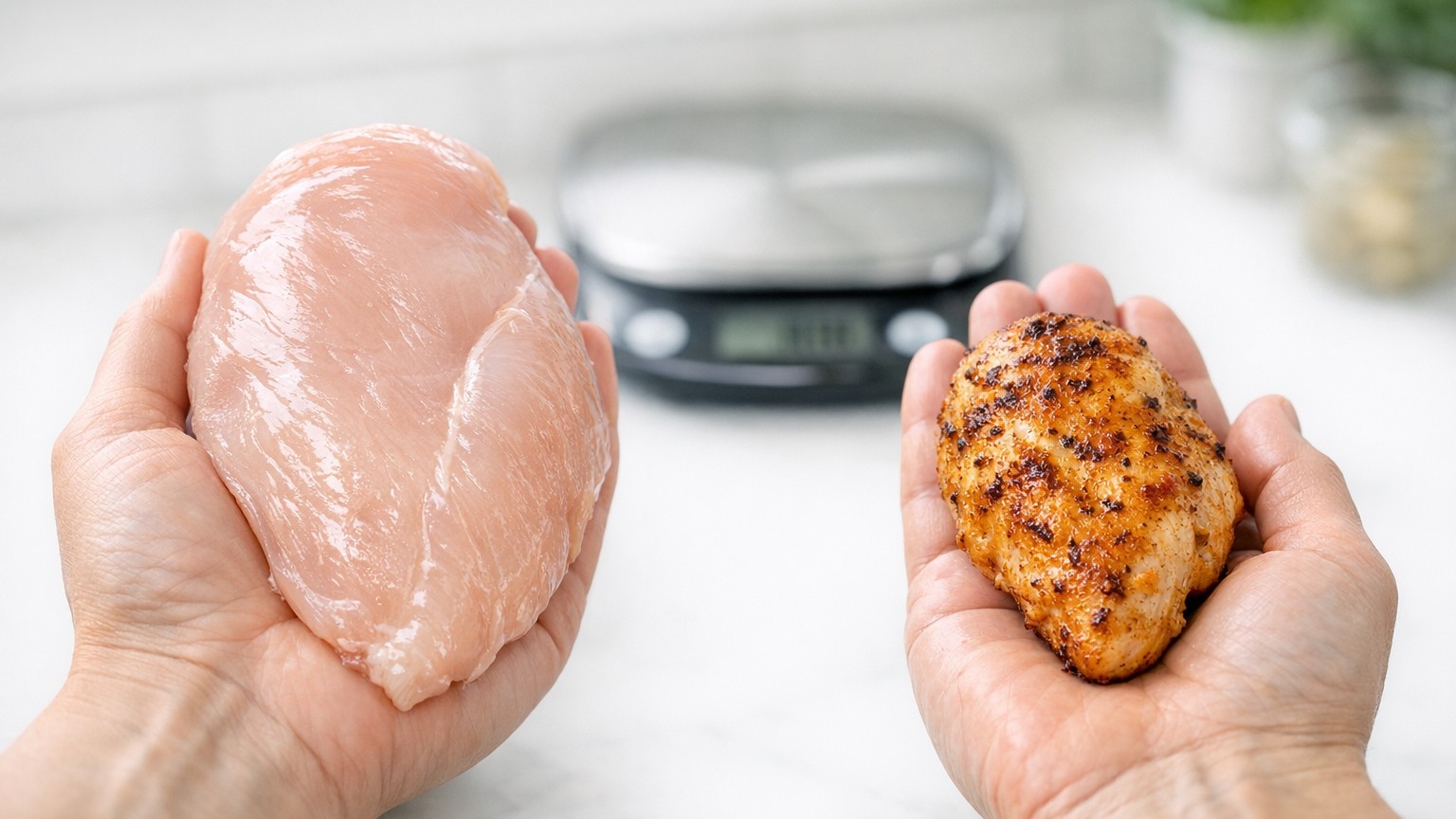
Six weeks of logging every calorie from an air fryer sounds straightforward, almost reassuring in its tidiness. A lean machine, a food scale, a tracking app, what could possibly go wrong? Quite a lot, as it turns out. By week four, the numbers started contradicting themselves: the same air-fried chicken breast logged on different days showed wildly different figures, the scale readings after cooking stopped matching the database entries, and the whole enterprise began to feel more like guesswork wrapped in false precision. This is not a failure of dedication. It is a collision with how calorie tracking actually works — and what the air fryer quietly does to your data.
Key takeaways
- A single tracking error with cooked versus raw weight compounds into 400+ calorie discrepancies over six weeks
- Nutrition apps claim precision they don’t possess—error rates between 20-25% are standard across the industry
- Week four is when the obsession with perfect logging starts damaging your mental health more than it helps your fitness
Why Air Frying Scrambles Your Calorie Database
The air fryer’s chief selling point is also its biggest tracking headache. Air frying can help reduce calories by 70–80% compared to frying in oil, which sounds like clean, simple maths. The problem is that most food databases weren’t built around air-fried entries, they reference raw weights, deep-fried values, or oven-roasted equivalents, and none of these translate perfectly.
The core confusion comes down to moisture. Cooking changes weight, meat loses about 20–25% in the air fryer, vegetables lose water — but because air frying adds almost no fat, cooked nutrition is very close to the raw totals, just concentrated into a smaller cooked weight. This is the silent source of chaos. Confusing raw and cooked weight is the most common and most impactful calorie tracking error. Cooking changes the weight of food dramatically, but it does not change the calories. A chicken breast contains the same total calories whether it is raw or cooked.
So if you weigh your chicken after it comes out of the air fryer basket and log it against a raw-weight entry in your app, you have already introduced a significant miscalculation, without realising it. After cooking, meat may only weigh about 75% of its original mass. If you track that cooked portion as if it were a raw portion of the same weight, you will underestimate your calorie intake. Over six weeks of daily logging, this single error compounds into a substantial gap between what you think you ate and what you actually consumed.
The oil question adds another layer. The air fryer is lauded for using minimal fat, and rightly so. Many air fryer recipes call for less than a tablespoon of oil, which is about 120 kcal and roughly 14g of fat in the case of olive oil. That spray of oil you applied before forgetting about it? Generic food entries may omit preparation methods, sauces, or added fats entirely, meaning an honest cooking habit can vanish from your data without a trace.
The App Problem: Precision That Isn’t
Nutrition tracking apps project a confidence that their underlying data rarely supports. Studies evaluating commercial nutrition apps show calorie discrepancies ranging from –13% to +7% depending on the app and food type. That margin may sound acceptable, but on a 2,000-calorie daily diet, it represents a swing of up to 400 calories, enough to explain why a supposedly perfect week on paper can produce entirely unexpected results on the scale.
On average, across all meal types, app error rates tend to fall between 20–25%. On a 2,000-calorie daily diet, a 10–40% error equates to a discrepancy of 200–600 calories. The apps are not lying to you, exactly. They are doing their best with databases that were never designed to capture the texture of your specific air fryer at 180°C with one light spray of rapeseed oil and a 22-minute cook time.
The crowdsourced nature of many popular apps makes things worse. Even within apps that have separate raw and cooked entries, a listing labelled simply “chicken breast” without specifying raw or cooked creates genuine ambiguity. Multiply that uncertainty across every ingredient in a bowl of air-fried vegetables and protein, and the figure in the app becomes an estimate dressed as a fact. Validation studies show that systematic underreporting of energy intake is common, even among motivated and educated participants, including nutrition students and health Professionals. The tools are imperfect, and the humans using them are equally so, that combination is not a personal failing, it is a structural one.
Week Four: When the Numbers Lose Their Meaning
There is a specific moment in any sustained tracking effort when the discipline starts to curdle into something less healthy. Week four seems to be a common tipping point. Most people who try strict weighing burn out within 2–4 weeks. The obsessive cross-referencing of database entries, the re-weighing of food that has already gone cold, the mild anxiety when you can’t find the exact “air fryer salmon fillet, skin on, 180g” entry, these are signs that the tool has started working against you.
Research has found that some users develop a fixation on numbers fuelled by app quantification, which changes their relationship with food. Having used the apps so intensively, many participants reported already knowing the calorie content of every food they ate before logging it, and tended to eat the same foods each day because they knew the calorie content and could mitigate any unknowns. Eating the same three air-fryer meals on rotation for safety is not health; it is a form of food anxiety dressed up as discipline.
Too much focus on cutting calories can result in feelings of guilt, stress, and anxiety surrounding eating and food. This matters because those feelings are themselves physiologically disruptive, chronic stress affects cortisol, appetite hormones, and sleep quality, all of which influence body composition independently of what the app says. You can be meticulous with your logging and still find the data working against your actual goals. Please consult your GP if food tracking is causing you significant distress.
How to Track Without Losing Your Mind
The air fryer, as a cooking tool, is genuinely useful for managing fat intake. The tracking problem is not a reason to abandon it, it is a reason to use data more intelligently. Most food labels refer to the uncooked product, and cooking causes a loss of moisture that concentrates the calories into a lighter piece of meat, so weighing your meat in its raw form is the recommended method for accuracy. Weigh before the basket, log before cooking, and you immediately eliminate the biggest single source of error.
For the oil, precision matters more than you might expect. Cooking oils contain about 120 calories per tablespoon, so even a small amount of absorption can add up. A pump sprayer with a known volume per spray removes the guesswork, and it takes five seconds.
The broader mindset shift, though, is perhaps more valuable than any tactical fix. Accepting that food tracking has an inherent margin of error and aiming for consistency rather than perfection is not giving up, it is working with the evidence rather than against it. Consistency beats precision. A 90% accurate log every day produces better results than a perfect log three days a week.
One thing that rarely appears in the calorie-counting conversation: the Atwater system, which underpins every calorie figure in every app you have ever used, was developed in the 1890s. It assigns fixed values of 4 kcal/g to carbohydrates and protein, and 9 kcal/g to fat, values that don’t account for food matrix, fibre fermentation, or individual gut microbiome variation. The number on your screen was always an approximation. The air fryer simply made that approximation visible.
Sources : nutrition-research-review.com | restore-mentalhealth.com