
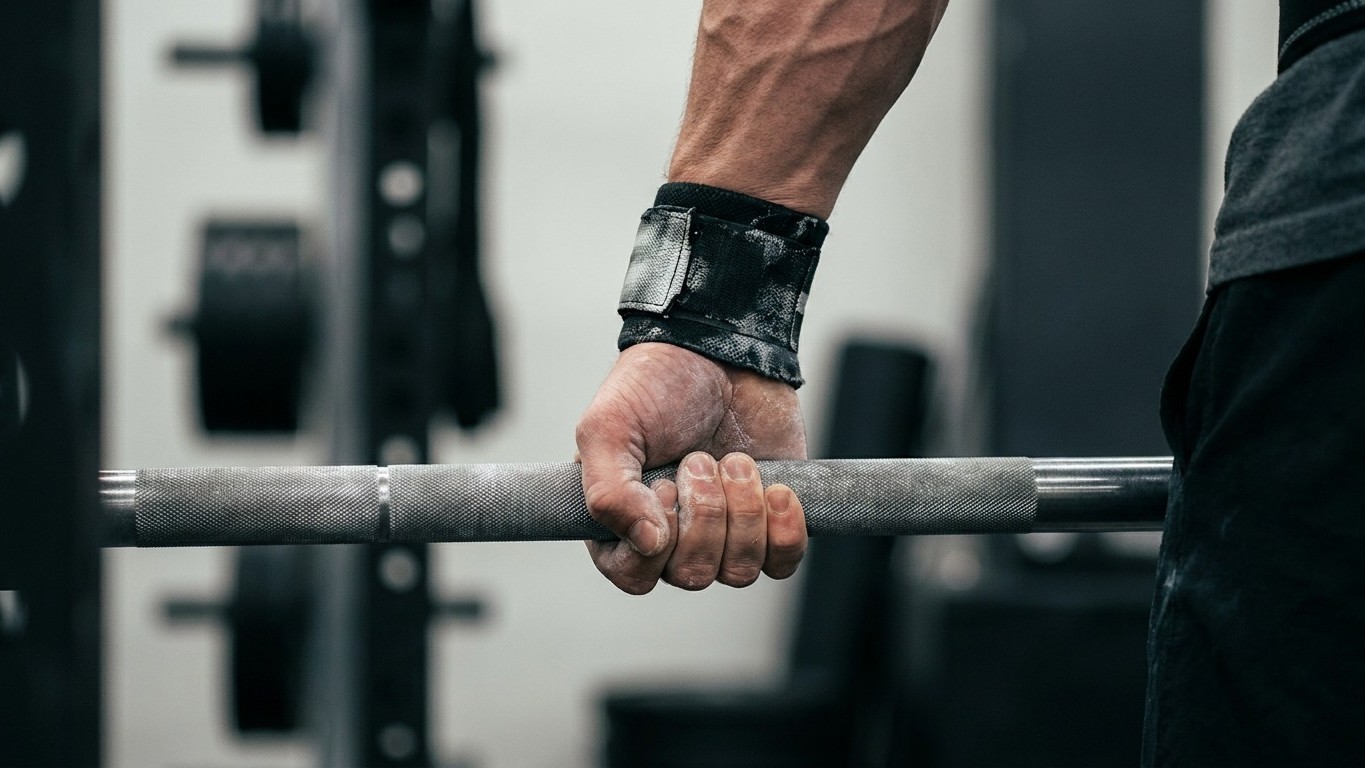
Wrist wraps feel like insurance. Wrap them tight, feel supported, lift more confidently, that’s the logic most people follow, and it’s not entirely wrong. But there’s a specific, under-discussed consequence of cranking wraps as tight as possible on every single set of bench press: over time, and sometimes within the same session, your grip strength quietly deteriorates. By the third or fourth set, the bar starts feeling unstable in your hands, your fingers fatigue faster than they should, and you assume it’s just accumulated tiredness. Often, it isn’t.
Key takeaways
- Extremely tight wrist wraps restrict blood flow to the forearm tendons responsible for grip strength, causing progressive grip failure across sets
- Aggressive wrap compression can temporarily alter nerve conduction in your hands, making fine motor control feel sluggish without causing permanent damage
- Grip strength directly impacts shoulder stability and force transfer through your entire pressing chain—weak grip = weaker bench
What tight wraps actually do to your forearm
The mechanism is fairly straightforward once you understand the anatomy involved. Wrist wraps, when applied very tightly, create compressive pressure around the distal forearm and wrist joint. This compression can restrict blood flow to the structures that serve the hand, including the tendons of the flexor digitorum superficialis and profundus muscles, which are responsible for finger flexion and grip strength. Reduce circulation to those tendons and their surrounding tissues, and you reduce the speed at which they can recover between sets.
There’s also a neurological component that gets far less airtime in gym conversations. The radial and ulnar nerves travel through the wrist area, and sustained, aggressive compression can cause temporary nerve conduction changes, producing that familiar sensation of fingers feeling slightly numb or clumsy mid-session. This isn’t permanent nerve damage, it’s transient and resolves quickly once the wraps come off, but it does explain why fine motor control in the hands can feel oddly compromised during a heavy bench session where wraps stay on between sets.
The grip is not a passive bystander on the bench press
A common misconception is that grip doesn’t really matter on the Bench Press the way it does on deadlifts or rows. The bar is in a rack, after all, it’s not going anywhere. But grip quality has a direct upstream effect on shoulder stability and force transfer through the pressing chain. Squeezing the bar hard activates a phenomenon known as irradiation, where muscular tension radiates outward from the point of greatest effort, stiffening the surrounding musculature. Squeeze harder, and your triceps, shoulders and chest recruit more effectively. Let grip weaken, and the whole kinetic chain becomes slightly looser than it should be.
This is why advanced coaches often cue “break the bar” or “try to bend the bar outward” during the bench press. These cues are specifically designed to encourage maximal grip engagement. If your wraps are restricting blood flow to your hands by set three, those cues become physically harder to execute, not because your technique is failing, but because your hands simply can’t generate the same tension they could on set one.
How to use wraps more intelligently
The good news is that wrist wraps used correctly are genuinely useful, particularly for heavy pressing movements. The problem isn’t the wraps themselves, it’s leaving them on between sets at full tension, and applying maximum tightness regardless of the load or the purpose of the set.
A more considered approach involves a few adjustments. Wrap only for your working sets, not your warm-up sets. Loosen or remove the wraps entirely during rest periods so circulation can normalise. On submaximal sets, consider wrapping slightly less aggressively, the support you actually need for 70% of your one-rep maximum is considerably less than what you need at 95%. The wrap should support the wrist, not act as a tourniquet.
Wrap tension also interacts with wrap length and stiffness. Stiffer, longer wraps (the kind powerlifters use for maximum support in competition) behave very differently from shorter, more flexible training wraps. Using competition-grade stiff wraps for every session, including moderate-intensity training, is the equivalent of wearing a full knee brace on a gentle jog, the support becomes counterproductive, and in the case of wraps, it can actively impair the grip you’re relying on.
Building grip strength independent of wraps
There’s a longer-term consideration here that goes beyond bench day logistics. Grip strength is genuinely predictive of broader health outcomes, research published in The Lancet found that handgrip strength was a stronger predictor of cardiovascular mortality than systolic blood pressure across a large multi-country study. That’s not an argument against ever using wraps, it’s an argument for not letting them substitute for grip development entirely.
Farmers’ carries, dead hangs, plate pinches and simple bar holds at the end of a session are all low-tech ways to address grip as a trainable quality rather than a limitation to work around. Towel pull-ups, where a thick towel is draped over a bar, are particularly effective for building the kind of hand endurance that stops failing at set three. None of this requires specialist equipment, and none of it takes more than ten minutes added to an existing session.
One detail that often surprises people: the dominant hand isn’t always the stronger grip. Studies on handedness and grip asymmetry show the non-dominant hand frequently lags behind by a meaningful margin, and that imbalance can quietly affect bar path and shoulder symmetry during pressing, something worth testing with a simple dynamometer squeeze, available cheaply in most sports shops, before assuming your bench technique is the problem. Sometimes the answer is in your hands, quite literally.
This article is for informational purposes only. Please consult your GP or a qualified healthcare professional for personalised medical advice.