
Running shoes don’t announce their retirement. There’s no warning light, no sudden collapse, no obvious moment when the cushioning gives up. The upper still looks fine, the laces hold, and the grip appears decent enough. But inside the midsole, where the real protective work happens, the foam has often been structurally compromised long before the shoe looks worn out. A podiatrist I spoke with put it bluntly: most recreational runners are training on dead shoes.
Key takeaways
- EVA foam in shoe midsoles gradually loses cushioning through compression set, but the damage is invisible from the outside
- Runners who rotated two pairs of shoes had 39% fewer injuries than those wearing the same pair daily
- Most recreational runners have no idea how many miles their shoes have covered—and it matters far more than the shoes looking worn
What actually happens inside a midsole
The cushioning in most running shoes relies on EVA foam (ethylene-vinyl acetate) or similar compressed foam compounds. Under repeated impact, these materials undergo a process called compression set, where the foam cells gradually lose their ability to rebound. Each footstrike delivers a force of roughly two to three times your body weight through the shoe. Over hundreds of miles, those cells stop bouncing back. The surface you’re running on effectively becomes harder, even though the shoe looks identical from the outside.
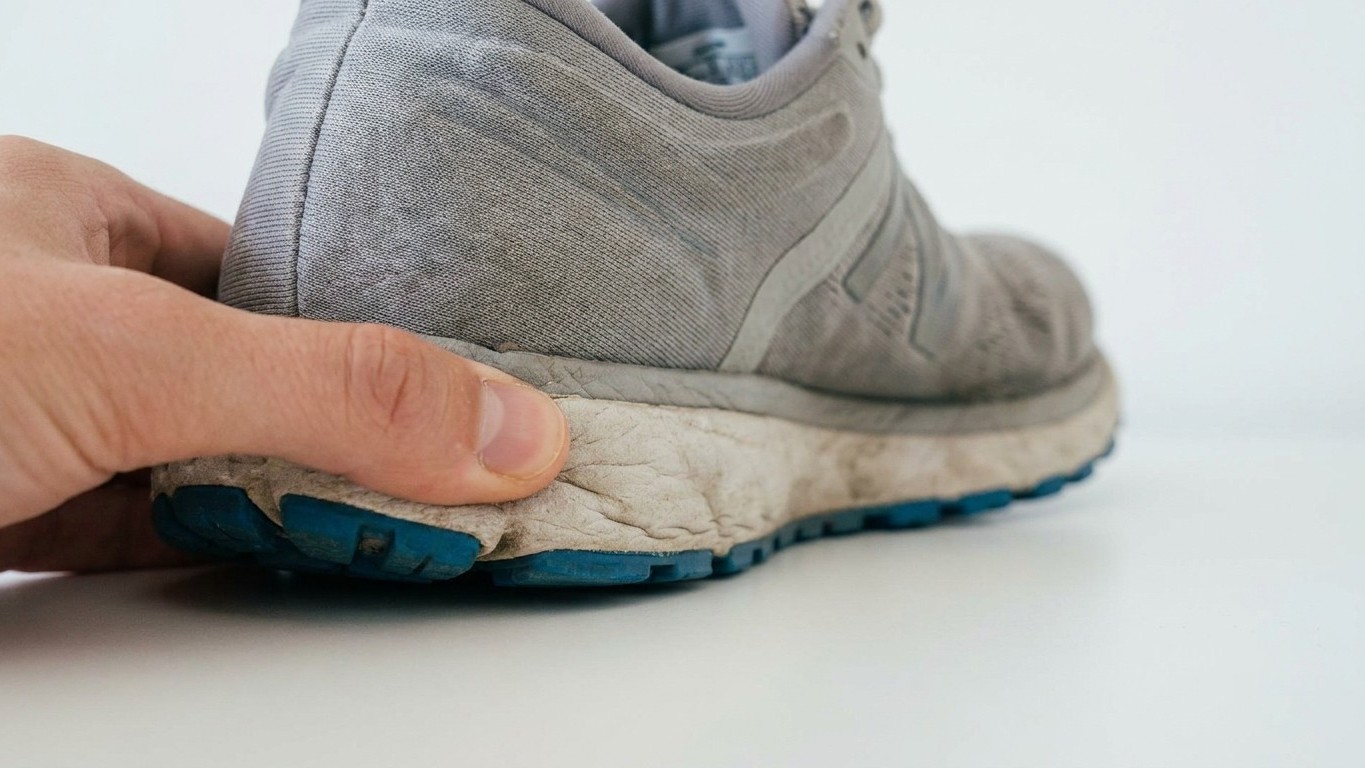
What makes this genuinely tricky is that the degradation isn’t uniform. Depending on your gait, one area of the midsole, typically under the heel or the lateral forefoot, takes disproportionate punishment. A podiatrist can spot this by pressing a thumb firmly into the midsole in different zones and comparing the resistance. On a well-worn shoe, there’s an obvious difference between the compressed areas and the fresher foam, a difference your body has been quietly absorbing with every single run without you realising.
The conventional guidance from sports medicine circles is to replace running shoes every 300 to 500 miles, though this range is broad for good reason. Heavier runners, those who run on hard surfaces like tarmac, or people with biomechanical quirks (overpronation, supination) tend to reach that threshold on the lower end. A lighter runner logging gentle trail miles might get closer to 500. The problem is that most recreational runners have absolutely no idea how many miles their shoes have covered.
The case for rotating your footwear
Wearing the same pair every single day accelerates that compression set significantly. Foam needs time to decompress between sessions, a process that takes approximately 24 hours after a demanding run. A 2020 study published in the Journal of Science and Medicine in Sport found that runners who rotated between two pairs of shoes had a 39% lower risk of running-related injury compared with those who ran exclusively in one pair. That figure is striking, but the reasoning behind it is straightforward: alternating shoes allows the foam to partially recover, and it also varies the minor mechanical stresses on your joints and tendons with each session.
There’s a secondary benefit that often goes unmentioned. Owning two pairs extends the total lifespan of each, which means the cost per mile improves. A single pair worn daily might last six months; two pairs rotated could collectively last eighteen. The maths make a reasonable argument for what might otherwise seem like an indulgence.
How to tell if your shoes have passed their peak
Visual inspection alone is unreliable, but there are physical tests worth doing. Press your thumb hard into the midsole in the heel and forefoot zones separately. Healthy EVA foam should feel springy and resist compression. If it feels dense, unyielding, or if you can see permanent creasing in the midsole walls, the foam has set. On the outsole, uneven tread wear, particularly when you place the shoe on a flat surface and it rocks or tilts, signals that the geometry has shifted, which carries upstream consequences for your ankle, knee and hip alignment.
A subtler signal is new or shifting discomfort. If shin splints reappear, or your knees feel unusually heavy after runs that previously felt easy, the shoe is a reasonable first suspect before anything else. The body registers the change in impact before the conscious mind does.
Checking the heel counter is also worth doing. This is the firm structure at the back of the shoe that cradles the heel. Compress it between your fingers: it should resist firmly. A collapsed or softened heel counter can contribute to rearfoot instability, something that becomes relevant particularly for runners with any tendency towards overpronation.
Making a practical replacement plan
The simplest intervention is a fitness tracker or running app that logs mileage per shoe. Most GPS watches allow you to assign gear to activities. Once you’ve set that up, the mileage accumulates automatically and the guesswork disappears. Set an alert at 400 miles and reassess from there.
If you run three or four times a week, you likely cover somewhere between 15 and 25 miles. That puts a single pair’s lifespan at roughly four to six months of consistent use, perhaps less on pavement-heavy routes. Buying a replacement pair slightly before the current ones are finished means you can break in the new shoes gradually, alternating them with the old pair during the transition period rather than making an abrupt swap that your body notices.
Storing your shoes correctly also matters more than most people assume. Leaving them in a hot car boot or near a radiator accelerates foam degradation even when the shoes aren’t being worn. Heat breaks down the polymer structure in EVA foam over time, which is one reason shoes stored in warm conditions seem to age faster than their mileage would suggest. A cool, dry spot away from direct sunlight is the low-effort choice that genuinely extends their useful life.
As a reminder, if you’re experiencing persistent pain or discomfort related to your feet or gait, it’s worth speaking to your GP or a qualified podiatrist who can assess you properly rather than relying on footwear changes alone.