
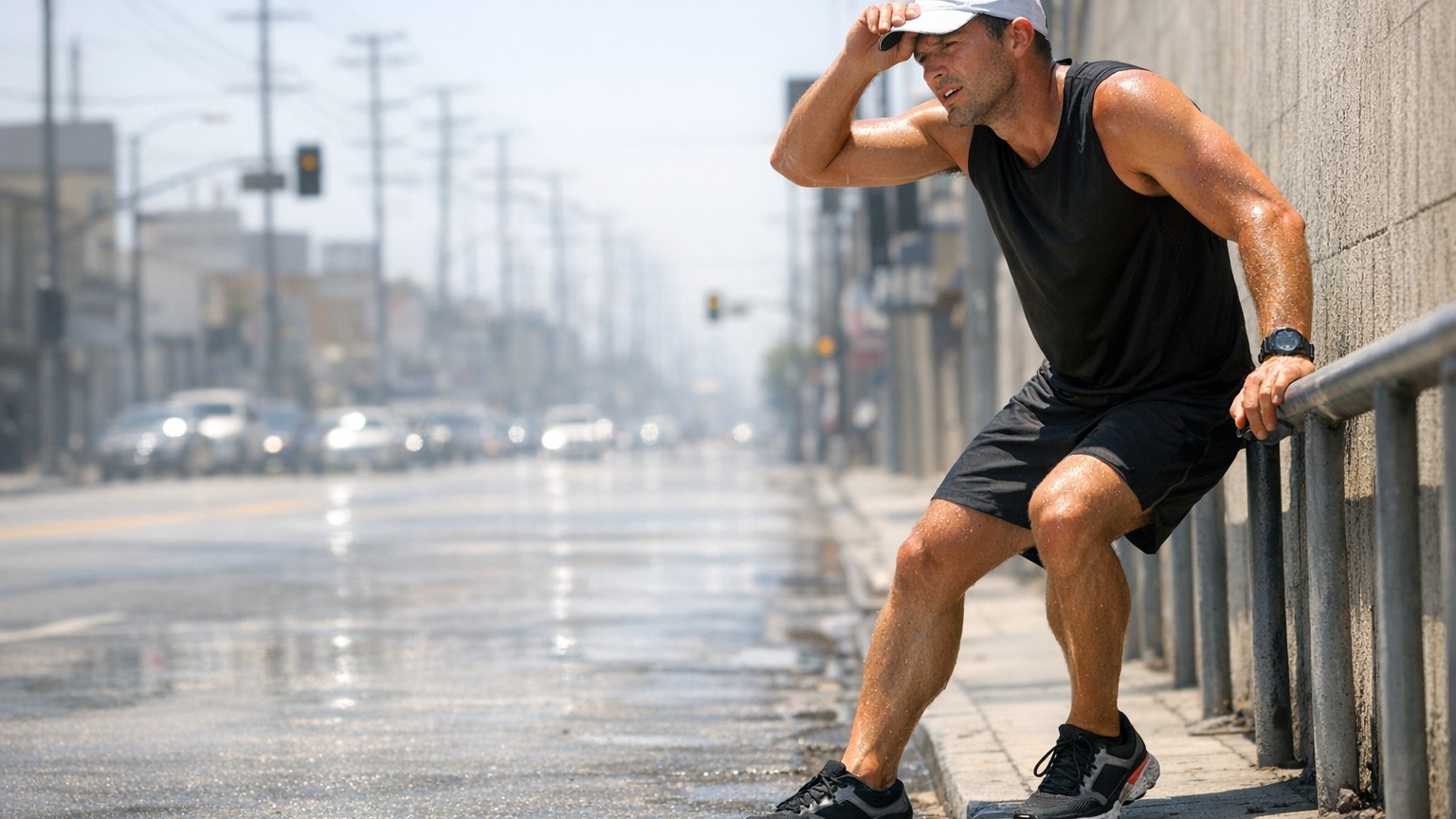
Every June, like clockwork, the same ritual: trainers on, door open, out into the midday glare. Same route, same pace, same hour. It felt like discipline. For years, nothing went wrong, until the day the legs simply refused to carry on, the pavement tilted sideways, and a GP appointment produced a phrase that landed hard: you’ve been running in the most dangerous window of the day. That window is 10am to 3pm, and The Science Behind it is more sobering than most British runners appreciate.
Key takeaways
- A consistent daily running routine at the same midday hour led to sudden physical collapse—and a shocking medical discovery
- The 10am-3pm window combines heat, solar radiation, and humidity in ways that defeat even fit runners’ bodies
- Heat-associated deaths in England spiked during ‘low alert’ periods that most runners completely ignored
Why the midday hours are not what they seem
There’s a persistent British assumption that heat is something that happens to other people, in other countries. Heat doesn’t have to be record-breaking to be dangerous for some. That framing, from the UK Health Security Agency, should give every runner pause. The UK climate is changing fast, and summer 2025 was one of the warmest on record. Running at noon in July is no longer the eccentric-but-harmless habit it once was.
Midday hours between 10am and 3pm are when heat levels typically peak in UK summertime. The problem isn’t just air temperature; it’s the compound effect of solar radiation bearing down on the body while it is simultaneously generating its own heat through muscular effort. When you run in the heat, your body works harder to cool itself through thermoregulation, diverting blood flow from your working muscles to your skin to release heat through sweat, meaning less oxygenated blood reaches your muscles, causing your heart rate to increase and your pace to naturally slow. The body is essentially fighting on two fronts at once, and one of them always wins eventually.
Humidity adds another layer of treachery that temperature readings alone never capture. The heat index, combining temperature and humidity, is a better guide than temperature alone. When humidity is high, a moderately warm day can feel far hotter, preventing sweat from evaporating and dramatically increasing overheating risk. A runner checking the thermometer and seeing 22°C might feel reassured. A runner checking the heat index might not.
What actually happens when you collapse
Heat exhaustion is an illness that happens when your body gets too hot and can’t cool itself, a response to losing too much water and salt, usually because of too much sweating. The progression is deceptive: it rarely announces itself with drama. The first thing you might notice is muscle cramping or spasms, known as exercise-associated muscle cramps, or heat cramps, which usually occur in the muscle group you’re using most heavily, like your legs. Legs that simply give out, are frequently the body’s opening argument.
Signs of heat exhaustion and heat stroke include heavy sweating, cold, pale, and clammy skin, a fast, weak pulse, nausea, vomiting, muscle cramps, tiredness, weakness, dizziness, headaches, and fainting. The alarming part is that since confusion is one of the symptoms, a runner with heat stroke may not make the right decision to stop. The body’s cooling system is compromised at precisely the moment sound judgement is needed most.
The scale of the problem in England is larger than most realise. During four periods of heat in 2024, there were 1,311 heat-associated deaths in England : 282 more deaths than predicted, based on observed temperatures and historic temperature-mortality trends. More striking still: significant heat-associated deaths were observed in 3 out of the 4 heat episodes, even though only yellow Heat-Health Alerts, the lowest alert threshold, were issued during those periods. If you’re waiting for a red alert before adjusting your training, you are waiting too long.
One detail worth knowing: fitness does not make you immune. It is a myth that only beginning runners are affected by the heat. Going faster generates more heat, so elite athletes are especially at risk.
The safer windows, and how to use them
The coolest part of the day typically occurs around sunrise, so rising before dawn to run works as an ideal solution to beat the heat. Early morning running also carries a secondary benefit: the pollen count is often lowest in the morning, which matters for the substantial portion of runners who also manage hay fever. If sunrise starts are genuinely impossible, the evening is the other viable option, the evening is often a good time to run in the summer because the sun has set, the air temperature begins to drop, and humidity tends to be lower. The caveat is that after very warm nights, evening temperatures may not drop as reliably as mornings cool before dawn.
Route choice matters as much as timing. Pavement absorbs heat, making streets and pavements behave like a heated surface. Shifting runs away from these surfaces to park trails, where natural track awaits beneath a cool, leafy canopy, can meaningfully reduce thermal load. In cities, running near water, by trees, and in shade from buildings helps diffuse some of the heat.
Pace needs recalibrating too. For every 5°F rise in temperature above 60°F, your running pace will slow by as much as 20 to 30 seconds per mile. This isn’t underperformance, it’s physiology doing its job. Resisting it is exactly how the legs give out on a Tuesday lunchtime in July.
What your body needs before, during and after
Hydration strategy for summer running requires more thought than simply carrying a bottle. You can lose up to 350ml of fluid and electrolytes in 20 minutes while running in hot weather. This leads to rapid loss of hydration and electrolytes, making it essential to increase fluid intake consciously and proactively, before, during and after exercise, especially on harder training days. Plain water handles hydration; electrolytes handle the sodium depletion that turns fatigue into collapse.
Acclimatisation is the factor most recreational runners ignore entirely. Over time, your body will acclimate, and research shows this takes roughly 10 to 14 days, sometimes longer. Transitioning from months of cool-weather training to a sudden July heatwave without any adaptation period is, physiologically speaking, an ambush. Running in the heat without proper acclimation can be dangerous. The practical solution is to start with shorter, easier efforts during cooler parts of warm days, gradually increasing duration as the body adjusts.
One thing worth knowing that rarely appears in standard summer running advice: the risk doesn’t reset the moment you stop. There is a time-dependent suppression of the body’s physiological ability to dissipate heat, and this delay in the restoration of post-exercise thermoregulation has been associated with disturbances in cardiovascular function, most commonly as post-exercise hypotension. Feeling lightheaded after stopping in the heat is not simply tiredness, it’s a sign the body is still struggling to regulate, and it warrants rest, shade, and fluids rather than a rapid shower and a return to desk work.
This article is for informational purposes only. Always consult your GP or a qualified healthcare professional before making changes to your exercise routine, particularly if you have underlying health conditions or have experienced heat-related illness.
Sources : ukhsa.blog.gov.uk | ukhsa.blog.gov.uk