
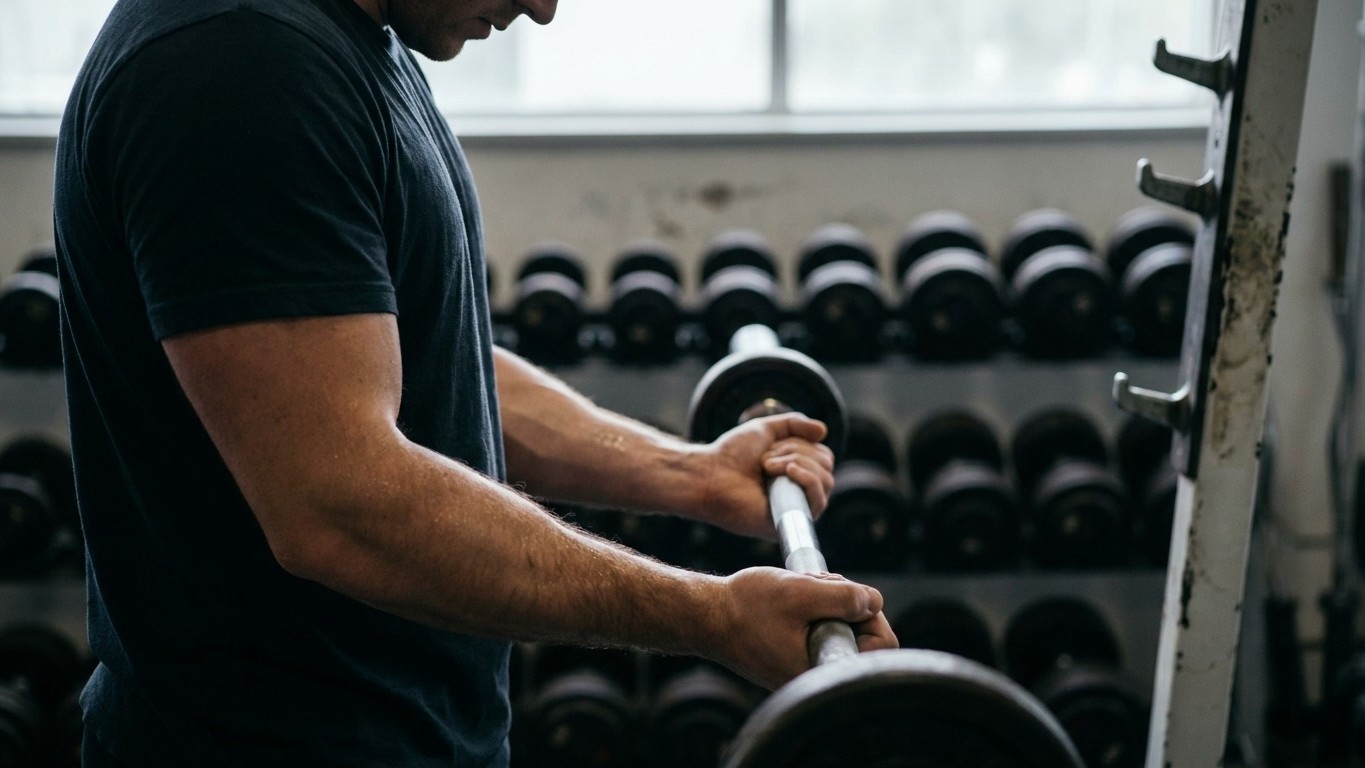
The mixed grip is one of lifting’s most practical shortcuts. One hand pronated (palm facing you), one supinated (palm facing away), and suddenly the bar stays put, your fingers stop failing before your back does, and you can pull heavier. Most lifters adopt it without a second thought. The problem is what happens when you always, without exception, keep the same hand facing up.
Key takeaways
- Your ‘safe’ grip is creating invisible muscle imbalances that compound over years of training
- The supinated arm’s biceps is being loaded in the exact position where ruptures happen most
- One simple fix costs nothing—but most lifters never think to do it
The asymmetry you’re building, rep by rep
Every time the supinated hand grips the bar, that bicep tendon is placed under a different mechanical load than its counterpart on the other side. The supinated forearm creates a slight elbow flexion torque, the biceps is engaged in a way it isn’t when pronated. Over thousands of repetitions across months and years, this repeated asymmetric loading quietly reshapes how your muscles develop, how your tendons adapt, and how your shoulder sits in its socket.
Muscle imbalances are rarely dramatic at first. You might notice your dominant pulling arm looks slightly fuller, or that one shoulder sits marginally lower. What’s harder to see is what’s happening at the tissue level. The biceps on the supinated side is consistently being recruited in a stretched, loaded position, a mechanical scenario associated with a higher risk of biceps tendon tears at the proximal attachment near the shoulder. This isn’t a theoretical concern. Proximal biceps tendon ruptures during heavy deadlifts are well-documented in sports medicine literature, and the supinated arm is almost always the one involved.
The shoulder girdle is also quietly affected. Chronic asymmetric loading at the shoulder can influence the positioning of the scapula over time. One side is pulled through a slightly different arc on every rep, and if your upper back mobility or rotator cuff activation isn’t compensating, that pattern solidifies into a postural default you carry everywhere, not just under the bar.
Why the biceps is the most vulnerable structure here
The biceps brachii has two attachment points at the shoulder (long and short head) and one at the elbow. During a heavy deadlift with a supinated grip, the muscle is both elongated (because you’re hinging forward with a straight arm) and under significant tensile load. That combination, stretch plus load, is precisely the condition under which muscle and tendon fibres are most prone to micro-tearing and, in severe cases, acute rupture.
A proximal biceps rupture, when it happens, is unmistakable. There’s usually a loud pop, immediate pain in the shoulder region, and within a day or two, the classic “Popeye” deformity appears: the biceps muscle bunches towards the elbow because its upper attachment has let go. Surgical repair is possible but not always necessary, depending on age and functional demands. Recovery, either way, takes months. And the precipitating event is often not the heaviest lift of someone’s career, it’s a moderately heavy set on a day when fatigue, rushing, or overconfidence lowered the margin for error.
Gym lore tends to blame ego lifting for these injuries, but the reality is more nuanced. Cumulative fatigue in connective tissue builds slowly, invisibly, until a threshold is crossed. The lifter who has pulled with the same supinated hand for three years without incident isn’t necessarily fine, they may simply not have reached that threshold yet.
Practical ways to protect yourself without abandoning the mixed grip
The simplest fix costs nothing: swap which hand faces up on alternating sets or alternating sessions. If your right hand is currently always supinated, run your next deadlift block with your left hand supinated instead. Yes, it will feel awkward initially. Your grip on the new side may feel weaker and your bar path slightly different. That discomfort is your nervous system adjusting, it passes within a few sessions, and the long-term symmetry gains are worth every uncomfortable rep.
A second option is to use the mixed grip only on your heaviest sets and revert to a double-overhand grip (both palms facing you) for warm-ups and submaximal work. Double-overhand is significantly harder to hold at high loads, which is precisely why it builds grip strength as a useful by-product. Chalk helps considerably, and most gyms that allow deadlifting allow chalk too. Some lifters go further and train double-overhand for months at a time, switching to mixed grip only when testing a true maximum.
A lifting strap is another tool worth considering, though it occupies a different philosophical position. Straps remove grip from the equation entirely, which can be useful for volume work where grip fatigue might otherwise cut a session short. The trade-off is that you’re no longer developing grip strength. For most recreational lifters, a sensible blend of all three approaches, mixed grip with rotation, double-overhand for submaximal sets, and occasional straps for high-rep work — Eliminates the asymmetry problem while preserving the training effect.
One thing worth adding to your routine regardless: specific biceps tendon loading work. Slow, controlled supinated curls with a pause at the stretched position (arm fully extended) gradually build tendon resilience. This isn’t glamorous programming, but tendons adapt to load more slowly than muscles do, and giving them deliberate attention reduces the gap between what your muscles can produce and what your connective tissue can safely transmit.
There’s an irony buried in all of this. The mixed grip feels like the safe, sensible choice, and in many ways it is, because losing grip mid-pull carries its own injury risks. The danger isn’t the technique itself. It’s the uncritical, unvarying repetition of it on one side only, session after session, until the body quietly runs out of tolerance. Rotate the grip. It’s genuinely that straightforward.
If you’re experiencing shoulder pain, a snapping sensation near the upper arm, or any sudden weakness during pulling movements, please consult your GP or a sports medicine professional before continuing to train.