
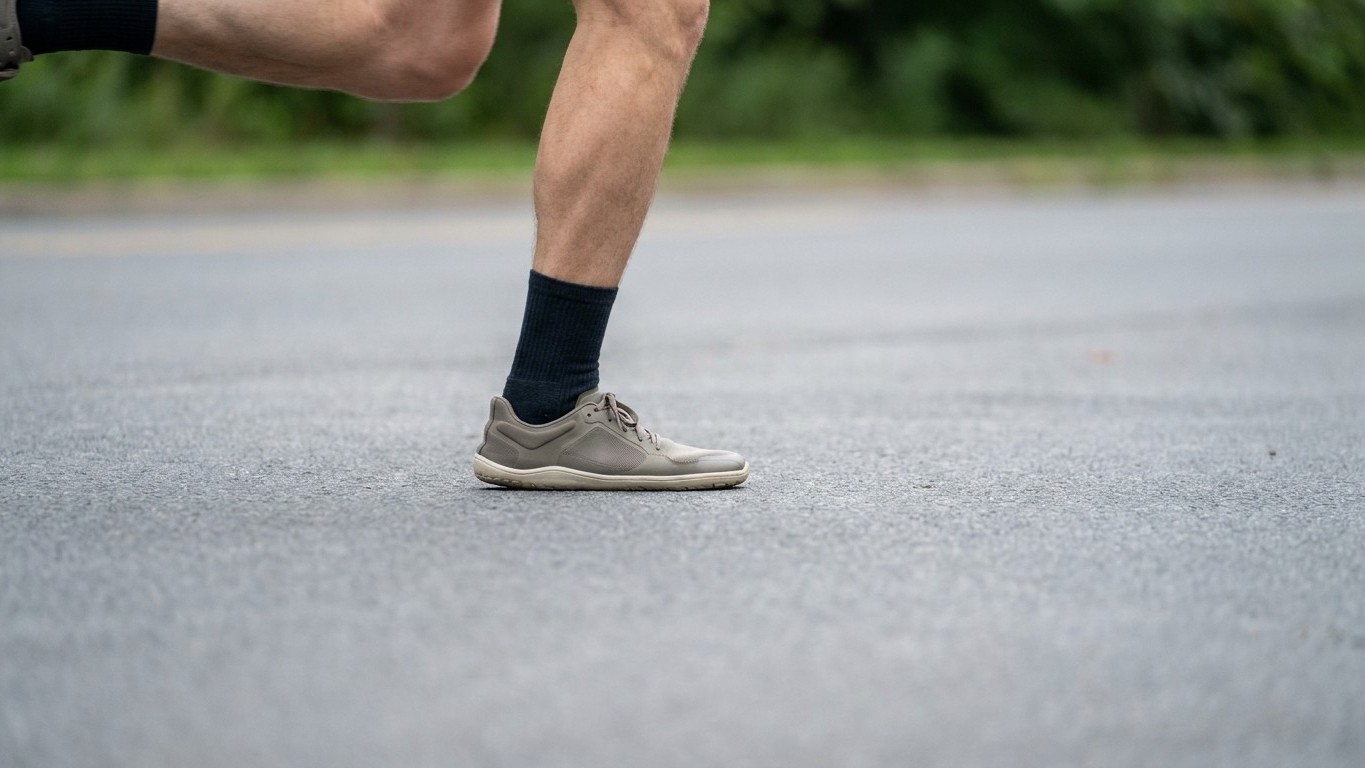
A “long, smooth stride” is rarely as effortless as it feels. What most overstriding runners are actually doing is landing with the heel well ahead of the hip, knee locked out, ankle cocked upward. The foot lands in front of the knee and hip, with a relatively extended knee, and with a dorsiflexed, slightly inverted and abducted ankle. That single moment, repeated a thousand times a mile, is what turns a stride you thought was elegant into a shin that throbs by mile four.
Key takeaways
- A heel landing several centimeters ahead of the knee can look ‘smooth’ to the naked eye—but it’s redirecting all impact force straight up your shin
- Overstriding is linked to shin splints, runner’s knee, stress fractures, and IT band syndrome—often developing silently over weeks of training
- Switching to a forefoot strike isn’t the answer; the real solution is much simpler and backed by research showing dramatic injury reduction
Why the impact has nowhere else to go
When the heel strikes the ground out in front of the body’s centre of mass, the leg is essentially a straight pole at the moment of contact. There’s no bent knee to absorb the shock, no springy ankle to soften it. Different strike patterns generate contrasting kinetics, especially at impact, with rearfoot strike landings typically generating a rapid, high-impact peak in the ground reaction force during the first part of stance. That force has to travel somewhere, and with the leg extended and the ankle pulled up towards the shin, it travels straight up the tibia.
The dorsiflexed position (toes lifted, heel down) makes things worse rather than better. Heel strikers have their toes lifted as their foot comes into contact with the ground, causing the soft tissue surrounding the tibia to experience additional strain. Physiotherapists sometimes call the resulting foot slap a “checkmark” landing, and the description fits: overstriding and excessive heel striking causes a greatly enhanced impact quotient, while a dorsiflexed toes-up, heel-down position causes excess shin muscle strain. Two mechanisms, one shin, and neither one is doing you any favours.
What surprises a lot of runners I speak to is how small the visual difference can be. A stride that looks fine from the side, even to a trained eye, can hide a heel landing several centimetres ahead of the knee. One rough guide used in gait analysis clinics: measuring the angle between the shin and the ground at initial contact, angles greater than 20 degrees often indicate overstriding regardless of strike pattern. It’s a crude proxy, not a diagnosis, but it explains why “smooth” and “safe” aren’t always the same thing.
Shin splints are just the start of the list
Medial tibial stress syndrome, the proper name for shin splints, is far from rare. Estimates vary by population, but medial tibial stress syndrome has been reported to affect between 13.6% and 20% of runners, with prevalence reaching as high as 35% in military personnel. That’s not a niche complaint reserved for unlucky beginners. It’s one of the most common reasons runners end up icing their legs on the sofa instead of training.
The knock-on effects rarely stop at the shin, either. Overstriding is linked to shin splints, where the extended leg and heavy heel strike transmit excessive shock through the tibia; runner’s knee, where the straightened knee at contact increases load on the kneecap and surrounding structures; stress fractures, where repeated high-impact loading accumulates microdamage faster than the body can repair it; and IT band syndrome, where the resulting compensation patterns place extra strain on the iliotibial band. A stride fault that starts at the heel can quietly work its way up through the knee and hip over a training block.
None of this means heel striking itself is the villain. Plenty of elite marathoners land on their heels and never get injured, largely because the foot lands close to underneath them rather than reaching out ahead. The research bears this out: reviews comparing strike patterns note that with higher loading rates, rearfoot strikers may be more susceptible to injuries such as tibial stress fractures and plantar fasciitis, but the loading rate, not the heel contact per se, is the variable that matters. Overstriding is what turns an ordinary heel strike into a problematic one.
The fix isn’t changing your foot strike
Here’s where a lot of well-meaning advice goes wrong. Switching deliberately to a forefoot strike sounds like the obvious solution, but it simply relocates the load rather than removing it. Research shows the forefoot strike pattern decreases patellofemoral joint loading but increases mechanical demand on the Achilles tendon, whereas the rearfoot strike pattern produces the opposite effect. Swap one injury risk for another and you haven’t actually solved anything.
A more reliable adjustment, backed by a reasonable body of evidence, is simply shortening the stride by increasing cadence. Rather than reaching further with each step, taking slightly quicker, more compact steps pulls the landing point back underneath the hip automatically. Increasing cadence by 5–10% reduces hip and knee loading by 20–34% without the injury risk of changing foot strike. It’s a modest tweak, not a technical overhaul, and it tends to feel more natural within a few weeks rather than requiring you to consciously police every footfall.
If you want to check your own stride, a slow-motion phone video from the side, foot level, tells you more than staring down at your feet mid-run ever will. Watch specifically for the heel landing noticeably ahead of the knee with the leg locked straight; that’s the pattern worth addressing gradually, over several weeks, alongside calf and hip strengthening work. Persistent shin pain that doesn’t ease with rest, or that sharpens along one specific point of bone rather than a general ache, is worth having assessed by a GP or physiotherapist rather than self-diagnosed from a video clip. Bone doesn’t always announce a problem with obvious symptoms until the stress has already accumulated, which is precisely why the biomechanics behind that “smooth” stride are worth a second look.
Sources : frontiersin.org | runnersconnect.net