
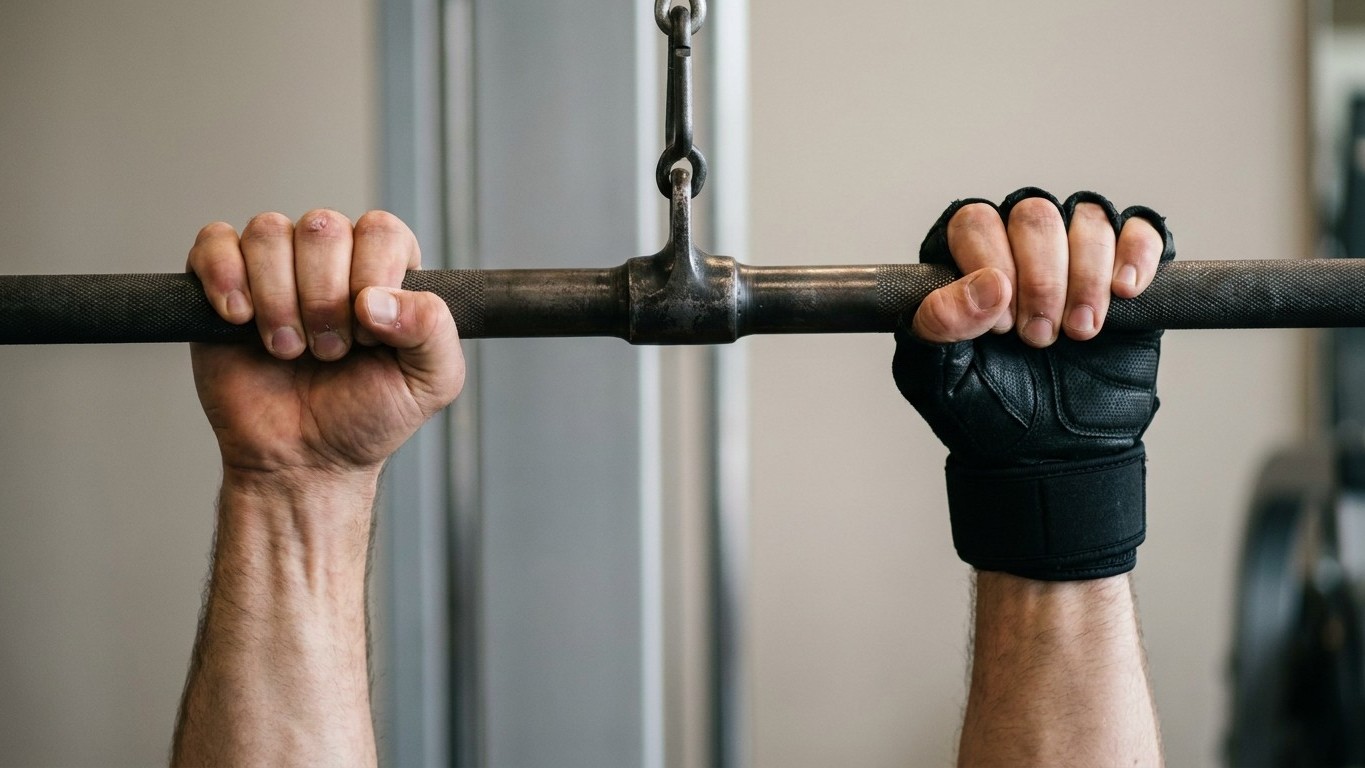
Your forearms give up long before your lats do on a pulldown, and if you train in gloves, that failure point arrives even sooner. The padding sitting between your palm and the bar isn’t a neutral accessory. It changes how much force your hand can actually transmit, which means the “back workout” you think you’re doing is often quietly capped by a few millimetres of foam.
This isn’t really about willpower or how strong your lats are. It’s mechanics. A cable pulldown is an open-chain movement, so the moment your hand starts to slip, you don’t fall, you just lose tension. During a lat pulldown, weakening grip just means the handles drift a bit in your palms. You keep pulling. That sounds harmless, except drifting grip means declining force transfer, which means your lats stop receiving the Resistance they need to keep working near failure. The set “ends” mentally and neurologically at the hand, well before the muscle you’re targeting has had enough.
Key takeaways
- A single millimeter of glove padding reduces grip strength by 3.61kg—and most gym gloves pack 3-6mm
- Your forearms fail before your lats do on pulldowns, and padded gloves make this worse by adding thickness to the bar
- Competitive powerlifters and Olympic lifters avoid gloves in serious training for this exact reason
Why grip quietly hijacks the set
Forearm involvement in pulldowns isn’t a training flaw, it’s baked into the exercise. Your grip on the bar can significantly impact how your forearms are recruited during the exercise, and a tight grip can cause the forearm muscles to fatigue prematurely. Grip width makes this worse or better depending on how you hold the bar. Grip fatigue hits wide grips harder, with wider variations limiting 6-rep-max loads by roughly 15 to 20 percent compared with a closer, more stable hold. That’s not a trivial gap. It’s the difference between a genuinely challenging back set and one that’s secretly a forearm-endurance test with a side of lats.
Interestingly, this is precisely why the machine version of the movement can, in theory, build more back muscle than a bodyweight pull-up despite lower measured activation in some studies. If your grip consistently quits before your lats reach meaningful fatigue during pull-ups, you’re primarily training forearm endurance with some back work as a bonus, and the lat pulldown might deliver superior results not from greater activation, but because it removes a limiting factor. The catch is that the pulldown only delivers on that promise if something isn’t already Sabotaging-your-muscle-growth/”>Sabotaging your grip before you’ve even loaded the bar. Which brings us to the gloves.
The padding problem, in numbers
A 2023 study published in Heliyon, involving seventeen healthy adults tested across several glove types with a bulb dynamometer, found something that should worry anyone training in padded gloves. The glove thickness was the only variable that affected power grip strength, so that a 1mm increase in glove thickness resulted in a 3.61kg decrease in power grip strength. That’s not a rounding error. Most gym gloves carry palm padding somewhere between 3 and 6mm once you factor in the foam plus the stitched seams, which on paper could translate to a double-digit kilogram loss in raw pulling force before you’ve even touched the stack.
The researchers also found that structural firefighting gloves were significantly different in terms of dexterity, while there was no significant difference between general protective gloves, though general protective gloves were significantly different in terms of hand grip strength. In plain terms: thin, general-purpose padding still dented raw grip strength even when it barely affected fine motor control. That’s exactly the category most gym gloves fall into, thin foam palms designed for comfort, not performance.
There’s a second, less obvious mechanism at play beyond raw strength loss. Padding effectively increases the diameter of whatever you’re holding. Gloves can increase the bar’s diameter in your hand, making it harder to maintain a secure hold, and this is precisely why the majority of competitive lifters, including powerlifters, Olympic lifters and CrossFit competitors, avoid wearing gloves in serious training. A thicker effective grip diameter forces your finger flexors to work at a mechanical disadvantage, closing around a shape they’re not built to squeeze efficiently. Add the loss of direct sensory feedback from the bar, and your brain has less information to fine-tune grip force in real time, which tends to make people over-grip out of caution, burning out the forearms even faster.
What to do instead of quietly capping your own sets
None of this means gloves are the enemy in every context. If you’re newer to lifting, deal with joint discomfort, or simply hate calluses, the trade-off between slightly reduced grip and improved comfort might be perfectly reasonable. They may be useful if you’re a beginner still building hand strength and confidence. But if your goal on pulldowns, rows, or pull-ups is genuinely working the back, gloves are working against that specific aim.
A few adjustments make a real difference. Narrowing your grip on pulldowns shifts load away from the forearms and towards the mid-back, since close grip lat pulldowns use a shoulder-width hand placement that reduces grip strain by allowing a stronger, more stable hold. Lifting straps solve the problem more directly on pulling movements where grip genuinely limits the target muscle, particularly on rows and shrugs, because straps help isolate your back muscles by reducing forearm fatigue, and your traps can handle much more weight than your grip alone will allow. Chalk is the low-tech alternative competitive lifters reach for instead of gloves, since it improves friction without adding bulk between skin and steel.
One detail worth flagging for anyone who alternates between gloves and bare hands week to week: because grip strength responds to glove thickness in a near-linear, measurable way, switching your equipment mid-programme effectively changes your training load without you touching the weight stack. If you’ve plateaued on pulldowns for no obvious reason, check your gloves before you blame your lats. Consult your GP if you experience persistent hand pain, numbness or joint discomfort during grip-heavy training, since these can sometimes point to issues beyond simple fatigue.
Sources : pmc.ncbi.nlm.nih.gov | ncbi.nlm.nih.gov