
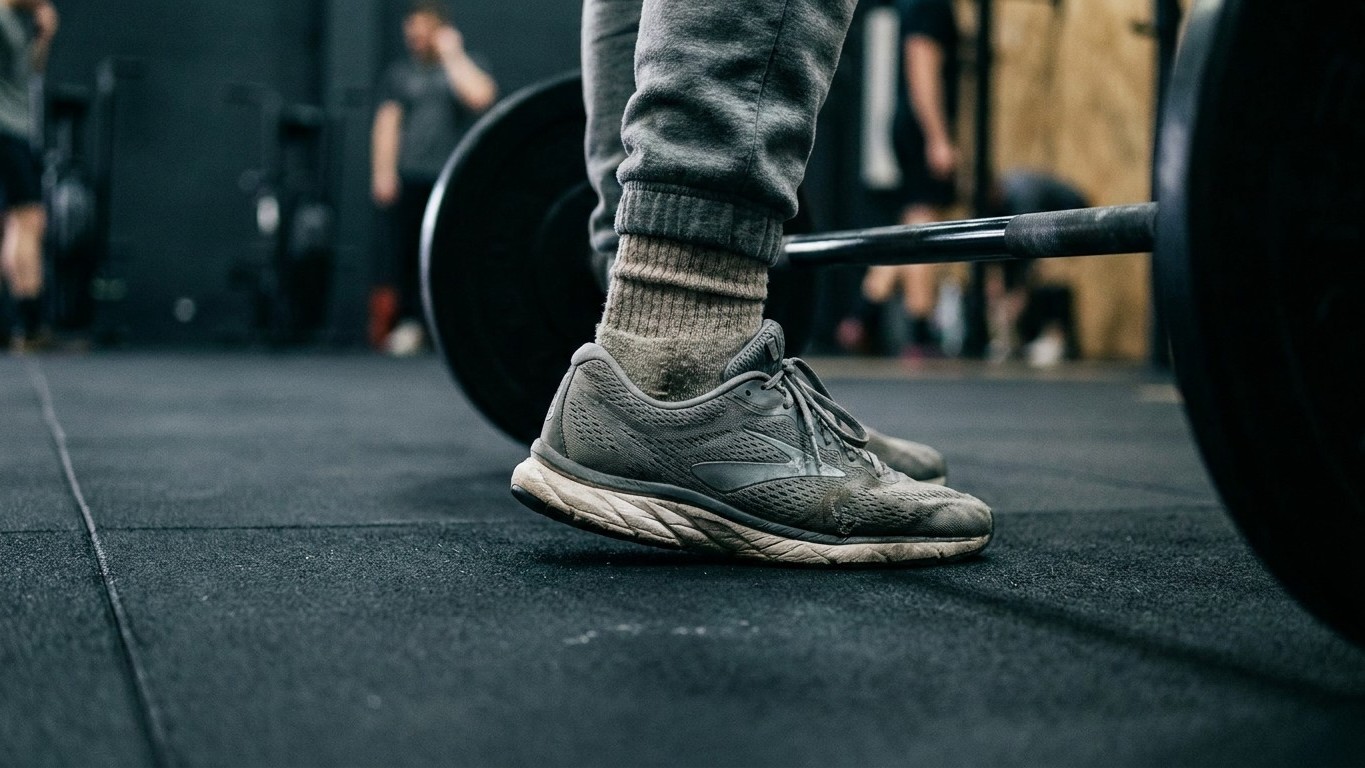
Under a heavy squat or deadlift, a soft trainer sole does not just feel plush. It sinks unevenly beneath your heel, tips your weight a few millimetres one way or the other, and forces your hips, knees and lower back to scramble for a stability that the ground should have provided in the first place. That “extra comfort” you noticed is actually a small, constantly shifting cushion of foam absorbing force that was meant to travel straight down into the platform.
Key takeaways
- Your favorite running shoes are actively destabilizing your squat and deadlift, losing you 7-10% of force output
- Soft midsoles force your ankles and knees to work differently, pushing stabilization demands higher up the chain—straight into your lower back
- Research shows how your body compensates for unstable footing, and where that compensation pressure actually lands
The physics under your heel
A barbell doesn’t care how nice your trainers feel. It only cares about a stable base of support. Your shoes are the only thing between you and the floor on every squat and every deadlift, and getting them wrong means pressing force into foam rather than into the bar. Running shoes were never built with this in mind. Running shoes are built to compress, because their job is to absorb impact and soften every step. That’s brilliant for a 10K. Under a loaded barbell, it becomes a liability, because under a heavy squat that cushioning becomes instability, the sole squashes unevenly, your weight shifts, your knees track inconsistently, and your force disappears into the midsole instead of moving the bar.
This isn’t marketing speak from a shoe brand trying to sell you flat trainers. Researchers have actually measured it. Squatting on a compliant surface, rather than a firm one, produces a measurable drop in output. One study found that squatting on a foam pad led to a decrease of force production of 7-10%. A second study went further and looked at technique itself: squatting on an unstable platform was found to be detrimental to the kinetics and technique of the squat. That’s not a trivial finding for anyone chasing progressive overload. Losing a tenth of your force output because of what’s on your feet is the equivalent of leaving reps on the table for no reason at all.
Why your ankles and knees move differently, too
The instability doesn’t stop at the foot. It travels upward through the kinetic chain, changing how your joints behave mid-lift. A frequently cited piece of research on this exact question found that wearing running shoes for exercises like squats can change how your ankle and knee joints move. Academics writing for The Conversation, reviewing the footwear-and-lifting literature, note that this cushioned sole may absorb the force you create when lifting weights, making you feel less stable, strong, and powerful, which is likely why some people say you shouldn’t lift weights in running shoes. They’re careful to add a caveat worth respecting: there is no peer-reviewed evidence directly linking these joint movement changes to injury. So this isn’t a case of “soft shoes will definitely wreck your spine.” It’s more that they change your mechanics in a direction most coaches would rather avoid, and the knock-on effects land somewhere.
That somewhere tends to be further up the chain, in the hips and lower back, because the body is remarkably good at finding stability from wherever it can get it. When the ankle and knee can’t provide a firm, predictable platform (because the surface beneath them keeps giving), the trunk often takes on more of the stabilising workload to keep the bar path controlled. Broader research on unstable surfaces during loaded squatting supports this pattern of compensation: lifting a load on an unstable surface significantly altered centre-of-pressure displacement, and holding the load on the unstable surface increased the demands placed on postural control. Put a barbell on your back and add a compressible heel underneath you, and you’ve essentially built a milder version of that same unstable-surface challenge, rep after rep, set after set.
Firm soles, not necessarily raised heels
The fix isn’t complicated, and it isn’t expensive. For squats and deadlifts, a flat, firm sole gives you full foot contact with the floor, a stable base that does not compress under load, and consistent balance from rep to rep, for most lifters. This is precisely why so many experienced lifters end up training in things like Converse or Vans, which weren’t designed for the gym at all. Flat sneakers designed for casual wear, such as Vans or Converse, have thin soles without cushioning, which may make them a better choice for lifting weights because they’re more stable than running shoes.
Dedicated weightlifting shoes go a step further, adding a raised, incompressible heel made of dense wood or hard plastic. Weightlifting shoes are designed to improve gym performance, typically featuring a raised heel and a solid, stiff sole without any give, which helps you stay stable at the bottom of a deep squat, particularly for movements such as squats, cleans and snatches. I’d flag that the raised heel is a different tool solving a different problem, usually limited ankle mobility on a high-bar or Olympic-style squat, rather than a replacement for firmness. If your ankles move through a decent range already, a flat, hard sole is often all you need. Flat soles suit low bar squats, deadlifts and general strength work, and under a squat you want your whole foot planted, big toe, little toe, heel.
One nuance worth remembering before you bin your trainers: the cushioning research on running itself is genuinely mixed, with some large trials actually linking softer midsoles to lower injury rates in runners, not higher ones. That tells you the “soft equals bad” rule doesn’t hold everywhere. It just doesn’t hold under a loaded barbell, where a stable, unyielding platform is doing a completely different job than shock absorption on a five-mile run. If you’re currently managing lower back discomfort, it’s worth having a physiotherapist or your GP look at your squat and deadlift set-up directly, since footwear is only one piece of a much bigger technical picture.
Sources : ncbi.nlm.nih.gov | theconversation.com