
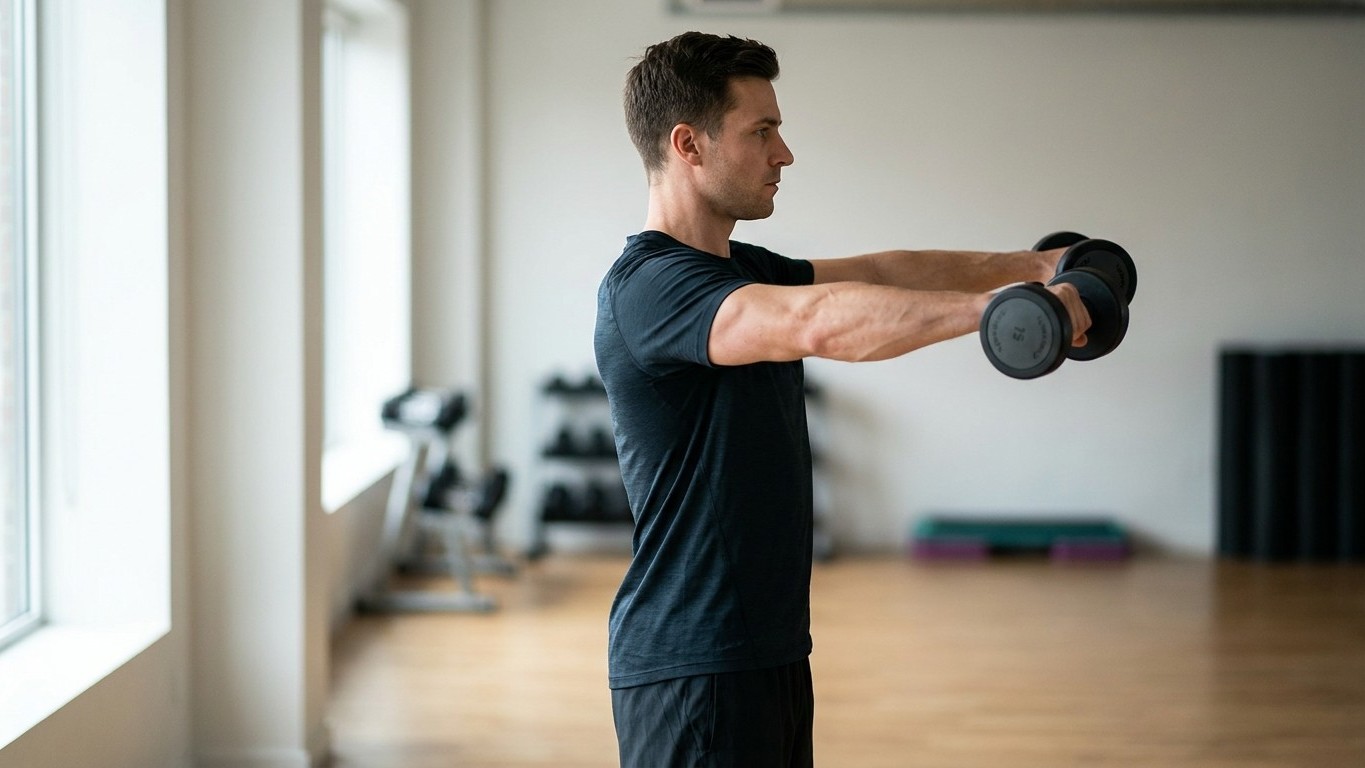
Turning your thumbs towards the floor halfway through a set of lateral raises is one of the oldest cues in gym folklore, the “empty the can” trick passed from training partner to training partner for decades. There is genuine physiology behind why it feels like it works: research on competitive bodybuilders and a wider systematic review of deltoid training both found that lateral raises performed with internal rotation produced the greatest middle deltoid activation compared with other abduction variations. The burn you chase by rolling your thumbs down is not imaginary. But that same twist is also the exact position that squeezes your rotator cuff against the underside of your shoulder blade, and that is where the sharp catch comes from.
Key takeaways
- A simple thumb position change can increase shoulder impingement force by up to seven times
- The exact moment the pain hits reveals why this popular cue is biomechanically risky
- You can keep most of the deltoid burn while eliminating the injury risk with three small adjustments
Why That Thumbs-Down Twist Feels Like It’s Working Harder
In a controlled EMG study of ten competitive bodybuilders, researchers compared lateral raises performed with the humerus externally rotated, neutral, internally rotated, and with a flexed elbow. The anterior and posterior deltoid showed greater activation in lateral raises with internal rotation compared with all other exercises, while medial deltoid activation was greater in the neutral position than in external rotation, frontal raise, or the flexed variation. So the picture is not perfectly clean; internal rotation recruits more of the front and rear deltoid fibres, but it also drags in muscles you were not trying to train. Upper trapezius and triceps brachii activation were both greater during lateral raises with internal rotation than during every other version tested. You are not isolating the side delt more effectively, you are turning a single-joint isolation move into a messier, multi-muscle effort, with your neck and traps quietly picking up slack you never intended to give them.
The Anatomy Behind That First Sharp Catch
Your shoulder joint has a bony roof called the acromion, and running beneath it sit the supraspinatus tendon and the subacromial bursa. Cadaver research has demonstrated that forcible internal rotation combined with either glenohumeral elevation or cross-body adduction results in impingement of the rotator cuff at the coracoacromial ligament. Later in vivo work put an actual number on that squeeze. The impingement force at 90 degrees of abduction combined with maximum internal rotation averaged 21.3 newtons, and the Hawkins test position averaged 18.3 newtons, both significantly greater than the forces measured in neutral or externally rotated positions, which stayed at or below roughly 3 newtons. That is roughly a sevenfold jump in compressive force from turning your thumbs down at shoulder height. The researchers were clear about the takeaway: for young, asymptomatic shoulders, it is not arm abduction alone that triggers impingement, but abduction combined with a large degree of internal rotation.
There is also a timing element that makes shoulder height the worst place to be sloppy. Movement scientist Dr Michael Yessis has pointed out that the shoulder is most vulnerable to impingement when the arm sits at 90 degrees of abduction and the shoulder blade has not rotated sufficiently to keep pace, since the shoulder blade should rotate upward roughly one degree for every two degrees of arm movement to keep the joint clear. Add a thumbs-down twist right at that same 90-degree point, where your scapula is already working hardest to stay synchronised, and you have stacked two risk factors on top of each other at precisely the moment your shoulder has the least room to spare.
Keeping the Burn Without the Grind
None of this means lateral raises deserve to be dropped from your programme; the fix is smaller than that. A few adjustments preserve most of the deltoid stimulus while taking the twist out of the equation:
- Keep a neutral, hammer-style grip, or let your thumbs stay level or lift slightly higher than your pinkies as you reach shoulder height, rather than rolling them down.
- Stop the raise at roughly shoulder level instead of pushing higher, since that is where the scapula struggles most to keep rotating in sync with the arm.
- Move slightly slower and more deliberately through both the lifting and lowering phase, since EMG data shows the same muscle recruitment issues appear during the eccentric portion of internally rotated raises as during the concentric lift.
Clinical guidance from orthopaedic specialists lines up with this. A thumbs-down position may increase compression of the rotator cuff against the bony surface of the shoulder, so maintaining a thumbs-up position is recommended to reduce that risk. Fitness certification body ACE offers a middle path used by many coaches: rather than fighting the rotation entirely, allowing a slight external rotation as the arms pass roughly the 60 to 70 degree mark, rather than internal rotation, may reduce the potential for impingement in the shoulder joint. Either approach steers you away from the exact position the force studies flagged as risky.
When the Catch Won’t Go Away
A single sharp pinch during a set is your shoulder’s way of telling you the geometry has gone wrong for that rep, not necessarily that you have torn anything. But if that catch keeps recurring, if it lingers as an ache overnight, or if certain angles now feel weak or unstable, that pattern is worth taking to a physiotherapist or your GP rather than working around it with lighter weights and hoping it settles on its own. Worth remembering too that this is not a rare or niche complaint picked up only by lifters who overdo the pouring motion. Subacromial impingement syndrome is recognised as the most common disorder of the shoulder, causing functional loss and disability in the people it affects. Your shoulder was giving you information well before that first sharp catch. It was just easier to ignore when the burn felt like progress.
Sources : ncbi.nlm.nih.gov | ncbi.nlm.nih.gov