
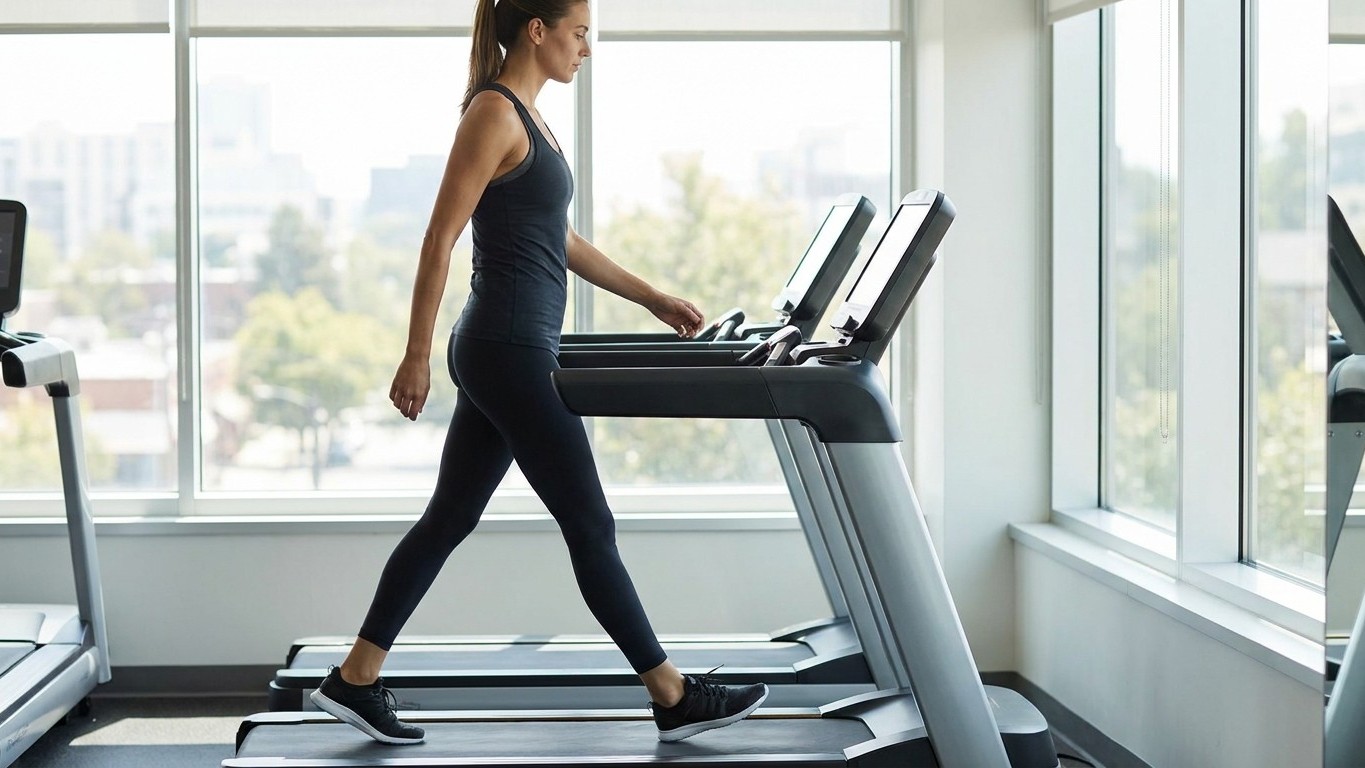
Holding onto handrails while walking or running on a treadmill can cut your calorie burn by up to 30%, even though your legs appear to be working exactly as hard. It’s one of the most common misunderstandings in the gym, and it explains why so many people plateau despite clocking up the miles week after week.
The confusion is understandable. Those central bars feel like they’re simply there for safety, a sensible precaution while you find your footing. But using the handrails to lean backward while walking reduces the calorie burn of your workout by 31.8%, despite it feeling like more work to hold on and lean back at a higher incline. Your brain registers the extra effort of gripping and bracing as “harder”, when in reality you’ve just handed part of the job to the machine.
Key takeaways
- Leaning on treadmill handrails transfers your body weight to the machine, forcing your muscles to work less while feeling like more effort
- Your arms lose their natural swing pattern entirely, eliminating a significant portion of your total calorie expenditure
- A 10% incline with handrails burns roughly the same calories as a 5% incline without them—effectively halving your intensity gains
What actually happens when you grip the handles
The mechanics are straightforward once you break them down. Holding onto the treadmill handrails fundamentally alters your gait and posture, and by leaning on the handrails, you are essentially transferring some of your body weight to the machine, meaning your legs and core muscles have to exert less effort to propel you forward and maintain balance. The belt still moves at the same speed, your legs still cycle through the same motion, but a chunk of the workload has simply been outsourced to your arms and the frame of the machine.
There’s a knock-on effect on your arm swing too. One of the primary effects of holding onto the treadmill while walking or running is reduced arm movement, and when you hold onto the handrails, your arms are unable to swing naturally, resulting in less overall movement and potentially a decrease in calorie burn. Normal arm swing isn’t decorative. It contributes to the total energy cost of the movement, and locking your arms onto a static bar removes that contribution entirely.
The research behind this isn’t new. A 2014 study conducted by Cybex and researchers at the University of Massachusetts : Lowell, published in the International Journal of Exercise Science, examined how factors like incline, posture and handrail use all impacted calorie burning power for treadmill users. One of the more striking findings was practical rather than purely academic: walking at a 10% incline and using the handrails burns about the same number of calories as walking at a 5% incline without using the handrails. gripping the rails doesn’t just shave off a percentage, it can effectively halve the intensity benefit you thought you were getting from that incline setting.
Older research backs this up too. Studies show that gripping the treadmill can reduce calorie burn by 20-25%, a figure that has been cited repeatedly since Collette and colleagues first investigated the phenomenon in the mid-1990s. The exact percentage shifts depending on your bodyweight, walking speed and incline, but the direction of the effect is remarkably consistent across the literature.
It’s not just treadmills
The same principle applies to ellipticals and stair climbers, machines built around moving handlebars that many users grip out of habit rather than necessity. On an elliptical, holding the bars isn’t automatically a bad thing, since the handles are designed to move with your stride and genuinely engage your upper body. You can hold the handlebars during an elliptical workout, which engages more muscle groups and ultimately burns more calories when used properly, swinging in time with the pedals rather than being used as a static crutch.
Stair climbers tell a slightly different story, largely because the vertical, weight-bearing nature of the movement makes handrail leaning far more consequential. The whole point of a stepper is demanding repeated vertical force production, lifting your body weight continuously with every step. The instant you rest your forearms on the console rails and take even a modest amount of weight through them, you’re undermining the exact mechanism that makes the machine so effective for burning calories in the first place. Fitness calculators built specifically for stair climbers now factor in handrail use as a separate variable precisely because it changes the numbers so significantly.
Why your legs don’t feel the difference
This is the part that trips most people up. Your quads, glutes and calves are still moving through the same range of motion at the same cadence, so subjectively the workout doesn’t feel any different. But calorie burn isn’t determined by how a muscle feels, it’s determined by the total mechanical and metabolic work your body performs, and that includes maintaining balance, stabilising your core and swinging your arms freely. When you normally walk or run, your arms swing at your sides, causing the muscles in your back and arms to burn calories as they contract and relax with each movement, and by holding onto the handrail, you greatly reduce the amount you are working these muscles. Your legs aren’t lying to you. They’re simply not the whole story.
None of this means handrails are the enemy. If you have a balance condition, joint pain, or you’re recovering from injury, holding on safely matters far more than squeezing out an extra few calories, and no fitness statistic should override that. For most healthy gym-goers, though, the fix is simple: keep your posture upright, let your arms move naturally, and reserve the handrails for mounting the machine or catching yourself if you genuinely stumble. If balance is a genuine concern rather than a habit, dropping the speed or incline slightly and walking unassisted will nearly always serve you better than holding on at a faster pace.
One detail worth remembering next time you’re tempted to grip the console: it’s specifically the backward lean that does the damage. Standing upright while lightly touching the rails for reassurance doesn’t carry anywhere near the same penalty as hanging back with locked arms, so if you do need the reassurance, posture is what determines whether you’re cheating your workout or simply steadying yourself.
Sources : ncbi.nlm.nih.gov | harisonusa.com