
The lat pulldown is one of the most popular exercises in any gym, and for years, the behind-the-neck variation was considered the gold standard for building a wide back. Then sports physiotherapists started seeing a pattern in their clinics: shoulder impingement, cervical spine compression, rotator cuff tears. The movement feels powerful. The anatomy suggests otherwise.
Key takeaways
- One movement. Eight years of repetition. Zero warning signs until the moment of collapse
- Your shoulder didn’t fail because of that single rep—it failed because of what came before it
- The safe alternative exists, produces the same results, and keeps your shoulder functional for life
Why the behind-the-neck pulldown looks effective but isn’t
The appeal is understandable. Pulling the bar down behind your head creates the sensation of a deep stretch through the lats, and in the short term, the muscle activation feels intense. The problem is that this perceived intensity comes partly from the shoulder joint being forced into a position it was never designed to sustain under load: extreme external rotation combined with horizontal abduction, with a weighted bar driving the neck forward at the bottom of the movement.
The subacromial space, the narrow gap between the top of the humerus and the acromion bone of the shoulder blade, gets compressed each time the bar descends behind the head. Do that once, no drama. Do it 150 times a week across eight years, and the cumulative mechanical stress on the rotator cuff tendons, the bursa, and the cervical vertebrae becomes substantial. Physiotherapists often describe this as a “silent injury” because the tissue damage accumulates slowly, with no single moment of crisis until, one day, there is.
The cervical spine takes a particular hit. To get the bar behind the head, most people jut their neck forward to make clearance. That forward neck flexion under load stresses the C5-C7 vertebrae and the muscles of the posterior neck. Over time, this can contribute to cervical disc irritation, postural changes, and referred pain into the shoulder and upper arm that is easily mistaken for a muscle strain.
The day the shoulder gives way is rarely the day the damage began
This is the part that surprises most people who’ve experienced a sudden shoulder injury in the gym. The acute pop or sharp pain feels like the cause. A good physiotherapist will usually explain that it’s the consequence, the final straw in a much longer story.
Rotator cuff tendons don’t snap without warning. They fray. Tendinopathy, the breakdown of tendon tissue under repetitive load, progresses through stages: the tendon becomes reactive, then disorganised, then partially torn. At each earlier stage, the body compensates. Other muscles pick up slack. Movement patterns shift slightly. You might notice occasional stiffness, a vague ache the morning after training, or a click that you’ve been cheerfully ignoring for two years. None of it feels urgent.
Then comes the set where the tissue finally can’t compensate any further. The pop you hear might be a bursa, a tendon slipping, or partial tissue failure. By that point, imaging often shows changes that took years to develop. This timeline is one reason why dismissing minor shoulder Discomfort as “just DOMS” or “a bit of tightness” is worth reconsidering, especially if it consistently appears after the same movement.
There’s also a proprioceptive element worth understanding. The shoulder joint relies heavily on the surrounding muscles and tendons to provide stability feedback to the brain. When those tendons are chronically irritated, their ability to signal position and load accurately is compromised. The joint becomes subtly less stable over time, which is why long-term improper loading patterns tend to create a compounding vulnerability rather than a plateau.
What to do instead, and how to rebuild if the damage is already done
The front-of-chest lat pulldown, with the bar brought to the upper sternum and the torso leaning back slightly at around 20 to 30 degrees, is considerably safer for the shoulder and produces comparable lat activation. The shoulder stays in a more neutral position throughout the movement, the rotator cuff isn’t grinding under load, and the cervical spine isn’t being driven forward. Cable rows, single-arm dumbbell rows, and chest-supported rows are also excellent alternatives that load the back muscles without compromising shoulder position.
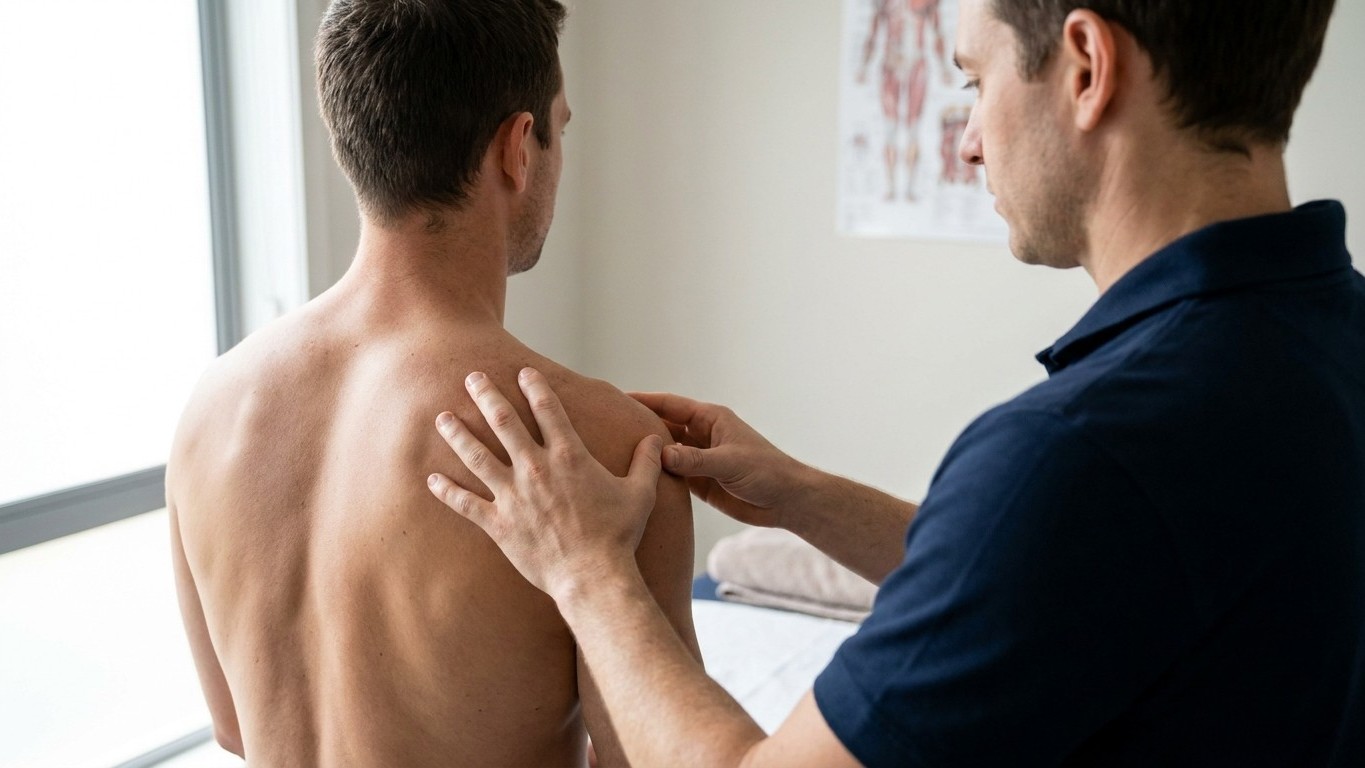
If you’ve already noticed symptoms, the standard advice to “train through it” is one to ignore. The NHS advises seeking assessment for shoulder pain that persists beyond a few weeks, especially if it disturbs sleep or limits overhead movement. A physiotherapist can identify whether the issue involves the rotator cuff, the acromioclavicular joint, the biceps tendon, or cervical referral, all of which require different rehabilitation approaches.
Rehabilitation for rotator cuff tendinopathy typically involves progressive loading, not rest. Research over the past decade has shifted away from complete immobilisation toward carefully graded exercise that encourages tendon remodelling. Exercises targeting the external rotators and lower trapezius are commonly prescribed, since weakness in these areas is a consistent finding in people with shoulder impingement. This kind of targeted strengthening work isn’t glamorous, but it’s the mechanism through which tendons actually recover their structural integrity.
One thing that often goes unaddressed in gym culture is thoracic mobility. The thoracic spine, the mid-back, needs to extend adequately for the shoulder to reach overhead without the joint compensating. People with chronically stiff thoracic spines will often show excessive shoulder elevation and forward head posture during pulling movements, which concentrates stress precisely where it shouldn’t be. Spending five minutes on thoracic extension work before a back session is one of the more consistently useful adjustments a physio might recommend.
The behind-the-neck pulldown hasn’t completely disappeared from gyms, and in clinical settings, adapted versions are occasionally used in specific rehabilitation contexts under supervision. But for general training, the risk-to-benefit ratio is unfavourable enough that most exercise science Professionals stopped recommending it years ago. The lat bar belongs in front of your chest. Your shoulder will still get its workout. It’ll just still be functioning in twenty years.
This article is for informational purposes only. Please consult your GP or a qualified physiotherapist for medical advice regarding shoulder pain or injury.