
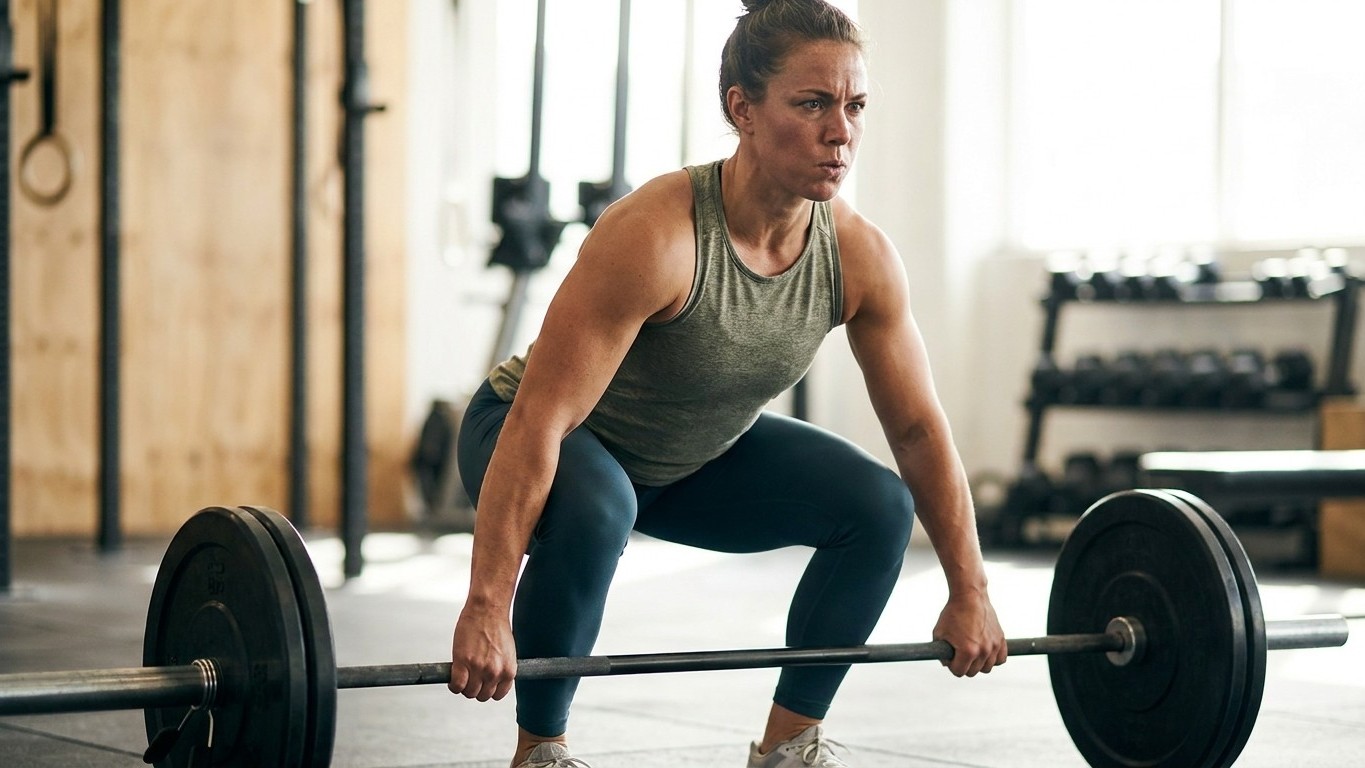
Relying on a lifting belt for every single set, warm-up included, is one of the most common habits in commercial gyms, and one of the least examined. The belt feels reassuring, so it stays on. Simple as that. But strapping up from your very first empty-bar squat quietly trains your nervous system to outsource a job it should be doing itself, and the moment you try to brace without it, that gap becomes impossible to ignore.
Key takeaways
- Your lifting belt isn’t doing the bracing for you—it’s just amplifying what your muscles should already be capable of
- Wearing one during warm-ups trains your nervous system to become dependent on external support instead of learning to stabilize under load
- Elite powerlifters use belts strategically only at 80%+ intensity, not on every rep—and they have unbelted bracing skill you might not
What a lifting belt actually does (and what it doesn’t)
A weightlifting belt works by giving your abdominal muscles something to push against. When you brace properly, intra-abdominal pressure rises, creating a rigid cylinder of support around your spine. The belt doesn’t do the bracing for you; it amplifies the pressure your muscles can generate by providing external resistance. Research in the Journal of Strength and Conditioning Research has consistently shown that belted lifting increases intra-abdominal pressure beyond what unbelted bracing alone achieves, which is why belts have a legitimate place in maximal or near-maximal efforts.
The problem arises when the belt becomes a substitute rather than a supplement. If your core muscles aren’t actively working to push outward into the belt, you’re not getting the benefit anyway. And if you never practise bracing without one, your ability to generate that intra-abdominal pressure on your own, through deliberate muscular coordination, simply stays underdeveloped. It’s a skill. A surprisingly trainable one. But only if you actually practise it.
The warm-up set problem nobody talks about
Warm-up sets are not just about raising your heart rate. They’re motor rehearsal. Every rep at 40%, 50%, or 60% of your working weight is a chance to groove the exact movement pattern you’ll use when the bar gets heavy. If you spend those reps relying on a belt to stabilise your trunk, your nervous system doesn’t learn to recruit the deep stabilisers, the transversus abdominis and the multifidus in particular, under genuine load. It learns to wait for external support instead.
Coaches who work with powerlifters often describe this as “passive bracing”, where the lifter goes through the motions of a brace but lacks the motor control to sustain it without external cues or props. After months of belted warm-ups, many lifters can’t actually feel whether they’re bracing correctly on a moderate weight set because they’ve never had to find out. The proprioceptive feedback loop, your body’s sense of what its trunk muscles are doing in space, gets blunted.
Strip the belt off for a set of five at 60% of your squat max, and you may find the weight feels unstable in a way that’s genuinely surprising. Not because the load is too heavy, but because your trunk control has been quietly going unaddressed for months. That instability isn’t weakness exactly; it’s a coordination deficit. The muscles are there. The recruitment pattern is what’s missing.
Rebuilding the brace: what actually works
The most straightforward fix is structural: reserve your belt for sets at or above 80-85% of your one-rep max, or for competition attempts. Warm-up sets, accessory work, and anything below that threshold happen beltless. This gives you enough exposure to unassisted bracing that the skill stays sharp, without asking you to abandon the belt on genuinely demanding loads where the risk-reward calculation shifts.
Before that becomes productive, though, most people need a brief detour into deliberate bracing practice. The 360-degree brace, where you consciously expand pressure outward in all directions simultaneously, front, sides, and back, is the cue that tends to click for people who’ve been chest-breathing into their brace rather than using their full trunk. Practising it lying on the floor with one hand on your stomach and one on Your Lower Back removes the distraction of a moving load and lets you actually feel what you’re trying to achieve. It’s unglamorous. It works.
Dead bugs and Pallof presses are frequently recommended here, and the recommendation is earned. Both exercises demand active trunk stabilisation without allowing a belt to paper over poor co-contraction. A few weeks of treating this as real training, rather than throwaway filler between “actual” work, tends to produce noticeable improvements in unbelted squat and deadlift stability. Not because the exercises are magic, but because they accumulate the practice reps your warm-up sets were supposed to be providing all along.
The stronger case for selective belt use
None of this means the belt is bad. At maximal and near-maximal intensities, the additional intra-abdominal pressure a belt enables may genuinely reduce spinal loading, which is why experienced powerlifters use them strategically. The sport record books aren’t written by lifters who refused belts on principle. The distinction matters, though: those lifters overwhelmingly also possess excellent unbelted bracing ability. The belt enhances a skill they already own.
There’s also an argument that going beltless occasionally keeps your honest about your actual strength. A squat you can only hit with a belt, at a weight where you should theoretically not need one, is telling you something about your core development that’s worth hearing. The belt, in that case, is a useful diagnostic as much as a piece of kit.
One thing worth knowing: some elite-level coaches structure training cycles with deliberate “beltless blocks” lasting four to eight weeks, not as punishment, but as a corrective phase that often produces genuine strength gains once the belt goes back on. The mechanism appears to be improved motor unit recruitment in the trunk stabilisers, which translates directly to a better base for the belt to work with. You’re not weakening yourself by training without it. You may actually be building the foundation that makes it more effective when you choose to use it.
Always consult your GP or a qualified sports medicine professional before making changes to your training if you have any history of back pain or injury.