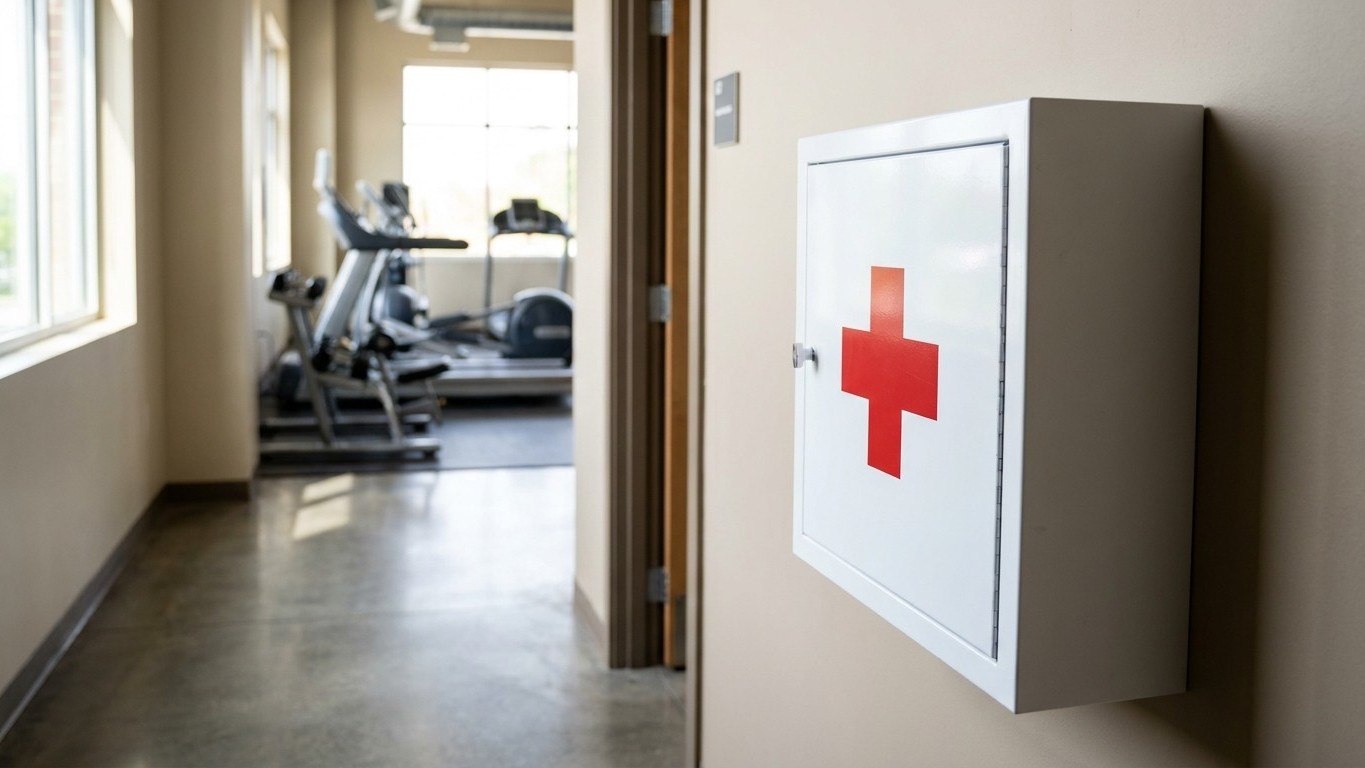
The man went down near the second row of treadmills at roughly 7.40 on a Tuesday morning, and for perhaps ninety seconds nobody quite understood what they were seeing. Then someone shouted for the defibrillator, and I watched three separate people turn towards that white cabinet on the corridor wall, the one I’d walked past for two years without ever really registering it, before someone finally worked out how to open it. Those three minutes, start to finish, are the reason I’m writing this.
Key takeaways
- A man collapsed at the gym, triggering a three-minute scramble to locate and open a defibrillator cabinet
- Every minute without defibrillation reduces survival chances by up to 10% — the math is unforgiving and well-documented
- Most people walk past these devices without registering them, yet emergency responders often arrive too late
What three minutes actually costs
The maths here is brutal and well documented. The British Heart Foundation states that every minute without CPR and a defibrillator reduces survival chances by up to 10%, while the Resuscitation Council UK states that defibrillation within 3–5 minutes of collapse may produce survival rates as high as 50–70% in some circumstances. Put another way: a shock delivered in the first sixty seconds after collapse can carry a survival rate as high as 90%, but for every minute that defibrillation is delayed, the chance of survival decreases substantially, and if delayed for longer than ten minutes, the chance of survival for an adult suffering a cardiac arrest is unfortunately lower than 5%. Three minutes sits right at the hinge point of that curve. Get there quickly and the odds tilt in your favour. Fumble with a locked cabinet, or spend that time asking whether someone else is going to deal with it, and you’ve likely tipped the odds the other way.
The national picture makes this more sobering, not less. Around 60,000 out-of-hospital cardiac arrests occur in the UK every year, and emergency services attempt resuscitation in about half of them. On average, only eight out of 100 people for whom resuscitation is attempted by emergency services in England survive to leave the hospital. Ambulances aren’t slow because paramedics are careless. The median EMS response time is 7.2 minutes, which sounds fast until you remember the survival curve I just described. By the time the ambulance arrives, the window for the highest-odds outcome has usually already closed. Whoever is standing in that corridor when someone collapses is, whether they like it or not, the actual first responder.
Why that cabinet was there at all
What surprised me, looking into this afterwards, is that the gym wasn’t legally obliged to have one. While automated external defibrillators are not currently a legal requirement in gyms or leisure facilities, expectations around emergency preparedness are changing rapidly, with the message for operators being that preparedness for sudden cardiac arrest is no longer viewed as optional best practice. Fitness settings carry an obvious risk profile: strenuous exertion, a wide spread of ages, and people who don’t always know they have an underlying heart condition until the moment it matters. Updated British Standards now specify that an AED should be available in workplaces with 5 or more people present, and that defibrillators should be accessible within 2 minutes, allowing one minute to locate the device and another to prepare and deliver treatment.
That two-minute benchmark is worth sitting with. It assumes you already know where the cabinet is. I didn’t, not really, despite walking past it several times a week. It also assumes the cabinet isn’t locked behind a code only staff know, which is a genuine failure point in some venues. Nationally, the shortfall runs the other way too: there are 110,000+ defibrillators registered on The Circuit, the national database used to direct emergency calls, and 58.6% are reported as 24/7 accessible, meaning a fair number sit inaccessible outside certain hours or behind locked doors, doing no good to anyone who needs them at the wrong moment.
What actually happens when someone opens that door
The device itself is designed so that hesitation shouldn’t be the bottleneck. Modern AEDs talk you through it, step by step, adjusting their instructions as they read the heart’s rhythm. They scan the heart to determine whether a shock is needed, and if a shock is required, the device will either deliver it automatically or prompt the user to press a button. You don’t need training to use one correctly, though training obviously helps with speed and confidence. Somebody without a first aid certificate who has never touched a defibrillator before can still follow its prompts and do this properly.
The legal fear that stops people acting is, frankly, unfounded. No one in the UK has ever been successfully sued for administering first aid to a casualty, not once, and the Social Action, Responsibility and Heroism Act 2015 specifically protects people who step in during emergencies. I think that single fact deserves wider circulation, because I suspect it’s the quiet reason so many of us hang back rather than grab the pads ourselves. CPR matters just as much as the device does; performing chest compressions while someone else fetches the AED keeps blood moving to the brain and heart during exactly the minutes that determine whether defibrillation, once it arrives, has anything left to work with.
The man by the treadmills is home now, recovering, according to the gym staff who’ve kept me updated. I still don’t know his name, and I probably never will. What I do know is that I’ve since found out where every defibrillator is in the three buildings I use regularly, work, gym, my daughter’s school, because the alternative, standing frozen while somebody else works out how to open a cabinet, isn’t a position I want to be in twice. If your gym, office or local hall has one of those white boxes on the wall, it’s worth thirty seconds of your next visit to actually look at it properly. Note the code if there is one. Read the sign. You may never need to remember it. But if you do, you won’t have three minutes to spare working it out from scratch.
This article is for general information and does not replace medical advice. If you have concerns about your heart health, please speak to your GP.
Sources : brainly.com | risk-assessment-products.co.uk