
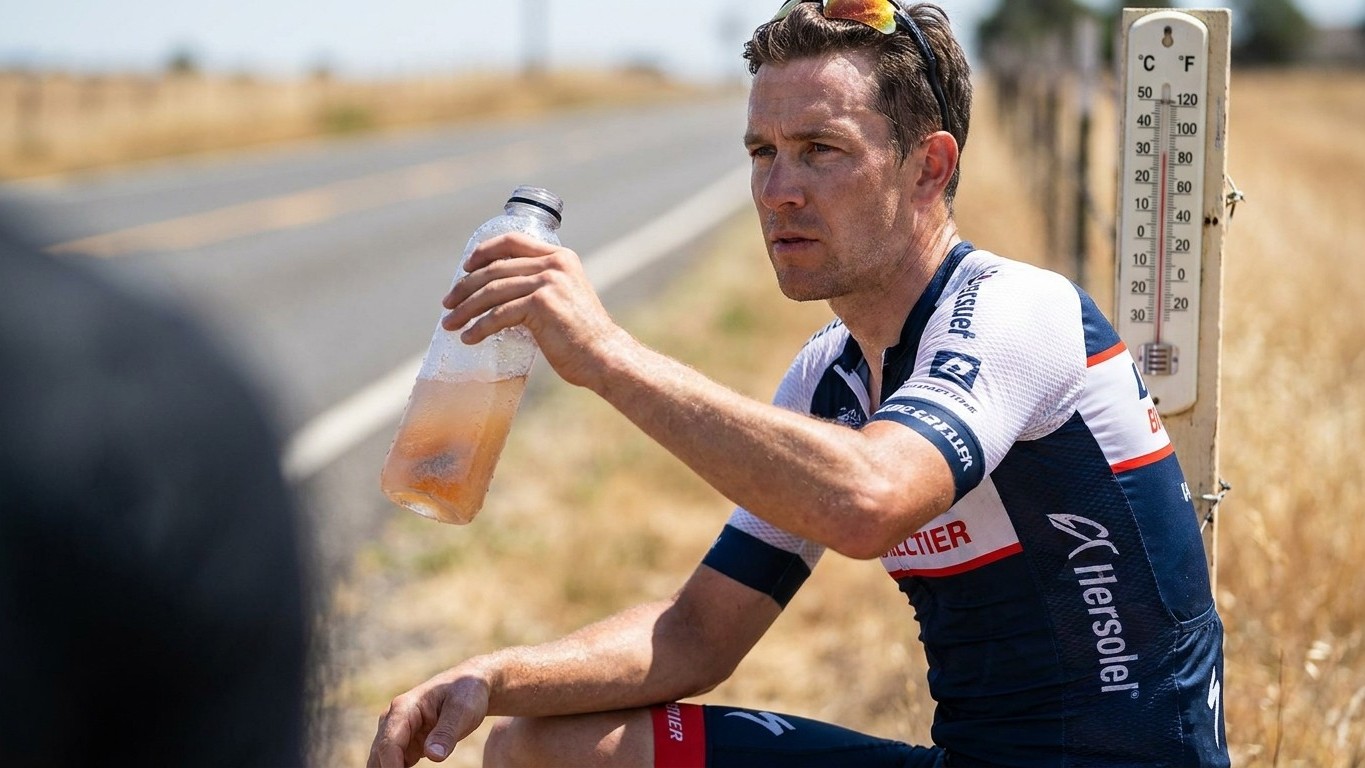
Cracking on a stinking-hot ride isn’t about how cold your water is. It’s about what’s dissolved in it, and what you did in the twenty minutes before you clipped in. I learned this the hard way on a training week in the Pyrenees, necking bidon after bidon of icy water straight from a cooler bag, convinced I was doing everything right. By the third climb my legs were leaden, my head was throbbing and I felt bloated rather than refreshed. A coach who’d spent years around a WorldTour team time trial squad watched me stagger off the bike and asked one question: “What’s in that bottle, sodium or just ice cubes?” That’s when the penny dropped.
Key takeaways
- Plain cold water on long hot rides can trigger dangerous hyponatremia and sap your power output by 6.5%
- Professional cyclists pre-cool their core temperature and soak their forearms in ice buckets before races—not just drink cold water
- The missing ingredient in most riders’ bottles above 40°C isn’t ice; it’s 500-800mg of sodium per litre
Why plain cold water was working against me
Cold water feels like relief, but on rides above 40°C it can quietly sabotage you. Replacing sodium matters because it drives fluid absorption and helps maintain blood volume; drinking large volumes of plain water on long, hot rides while losing heavy sodium is the route to hyponatremia. I was doing exactly that: chasing the sensation of cold rather than replacing what I was actually losing through sweat. Hyponatremia is dangerously low blood sodium concentration. In cyclists it is usually caused by drinking more fluid than you sweat, particularly plain water, over long events. Symptoms include nausea, bloating, headache, confusion and, in severe cases, seizures. Bloated and headachy halfway up a climb, exactly how I felt.
The numbers around sodium replacement surprised me too. Beyond 60-90 minutes, or in heat, you should target roughly 500-800mg of sodium per litre of fluid, pushing higher if you’re a salty sweater. Salty sweaters aren’t a myth, incidentally; white marks on a black jersey after a long ride are your body telling you something concrete about how much salt you’re shedding. And the performance cost of getting this wrong isn’t trivial. Studies show that cycling in 32°C heat reduces power output by 6.5 per cent due to dehydration, muscle cramps, and low blood sodium levels. That’s before you even factor in what the tarmac itself does to the air around you. Black tarmac absorbs heat so effectively that road surfaces can reach 50-80°C, heating the air above like a kettle, so a shaded 32-40°C reading can feel like 50°C or more to the rider.
What the coach actually showed me before rolling out
This is where things got interesting. Rather than a bidon, the first thing the coach produced was an ice vest. The WorldTour approach starts with pre-cooling for 15-20 minutes before the start using an ice vest or cold exposure, which lowers core temperature and extends time to heat exhaustion. Watching Ineos riders at a recent Tour de France time trial made the logic click further: forearms carry many blood vessels close to the skin’s surface, and submerging them in cold water around 8°C rapidly cools the blood and subsequently the core temperature, ready for it to shoot up again during effort. It looks faintly ridiculous, five grown adults with their arms in buckets behind a start ramp, but the physiology checks out.
The second surprise was about pacing, not plumbing. Reducing power targets by 5-8% for the first hour of a hot race is part of the combined approach, with the second half being where you can actually push. I’d been riding my usual numbers from the first pedal stroke, essentially racing my own body’s cooling system before it had a chance to settle. Add to that prior heat acclimatisation through a 10-14 day heat block, described as the single biggest Performance protection for hot races, and it became obvious why a lump of ice down the jersey wasn’t going to save me on its own. Sports scientists interviewed around this year’s race made a similar point about supplementation: tests have shown cyclists and runners who receive electrolyte supplementation can push much further without hitting their limits, which one expert described as a performance enhancement rooted purely in human physiology, not doping.
Building a routine that actually holds up above 40°C
None of this requires a team car or a soigneur, thankfully. A sensible framework looks something like this:
- Pre-cool for 15-20 minutes before setting off, using an ice vest, cold towels, or simply dunking your forearms in a bucket of iced water
- Drink 750ml-1 litre per hour, but make sure electrolytes are actually in the bottle rather than just ice
- Drop your effort by roughly 5-8% for the opening hour, saving your legs (and your core temperature) for later
- Reintroduce cold exposure mid-ride, pouring water over your head and neck rather than only drinking it
On that last point, external cooling matters as much as internal. In hot, humid conditions cold-water ingestion provides mechanistic benefits, whereas in hot, dry conditions cold-water pouring or dousing provides the mechanistic benefit, which explains why pros do both depending on the day’s climate rather than sticking to one trick regardless of conditions.
What changed for me wasn’t the temperature of my water; it was accepting that a bottle full of ice and nothing else is, in hot conditions, close to useless and occasionally counterproductive. Since adding a proper electrolyte mix and doing a short pre-cool before rolling out, I haven’t cracked on a 40°C ride since, though I’ll admit the ice-bucket forearm dunk still draws odd looks from dog walkers at the local park. If you’re planning long rides in serious heat this summer, it’s worth discussing sodium intake and any history of cramping or dizziness with your GP first, particularly if you’re on medication that affects fluid balance.
Sources : cyclingnews.com | ncbi.nlm.nih.gov