
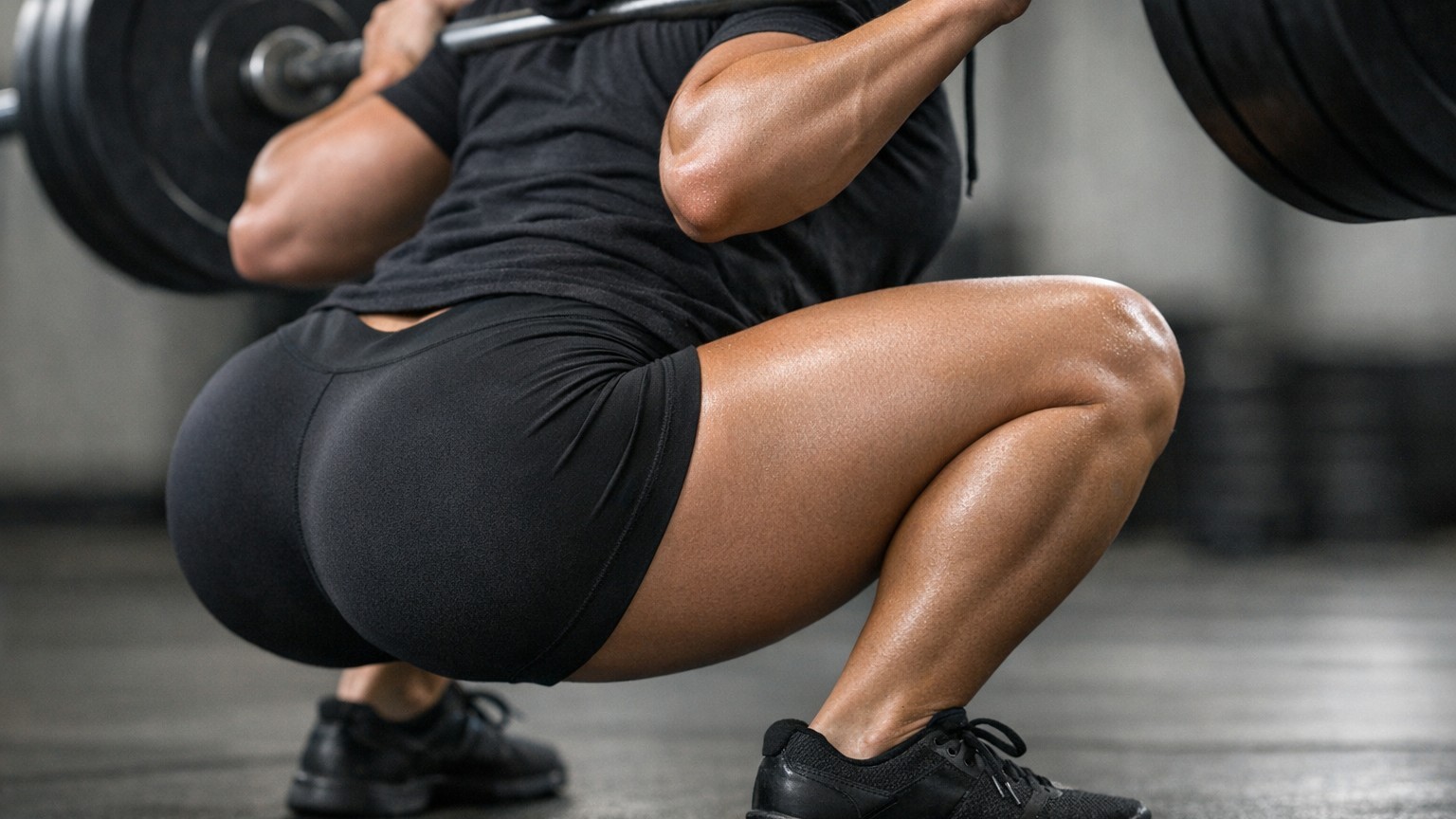
Knee valgus during squats, that inward collapse most gym-goers recognise but few truly understand, is one of the most reliable paths to a serious injury. The anterior cruciate ligament, the medial collateral ligament, the meniscus: all of them absorb the rotational stress that travels through the joint when the knees cave. For many people, the first sign that something has gone badly wrong is not a gradual ache but a sharp, definitive moment they remember for years.
That is precisely what happened to me. Three years ago, on a heavy back squat I had no business attempting without proper form, my left knee buckled inward at the bottom of the movement. The sound was unpleasant. The diagnosis, a partial MCL tear with some cartilage irritation, was worse. What followed was eight weeks off training, physiotherapy, and a fairly humbling conversation with a strength and conditioning coach who spent the first session not looking at my knees at all. She was watching my hips and my thighs.
Key takeaways
- A heavy squat gone wrong led to a partial MCL tear—but the real culprit wasn’t at the knee joint
- Your glutes and hip external rotators control whether your femur stays in line; weak activation means your knees will collapse inward under load
- A single coaching cue changed everything: ‘push the floor apart’ instead of ‘keep knees out’—and it trains the nervous system, not just muscle strength
The real culprit is higher up than you think
Knee valgus does not originate at the knee. This is the part that surprises most people. The collapse is a consequence, not a cause. The structures responsible are the hip abductors and external rotators, primarily the gluteus medius and gluteus maximus, which are supposed to keep the femur (the thigh bone) tracking in line with the foot throughout the full range of motion. When those muscles are weak, fatigued, or simply not being recruited properly, the femur rotates inward, the knee follows, and the entire joint is placed under a kind of shearing force it was never designed to handle.
Research published in the Journal of Orthopaedic & Sports Physical Therapy has linked reduced hip abductor and external rotator strength to increased knee valgus during dynamic movements like squatting and landing. The knee, in this context, is essentially a victim of what the hip is failing to do. My coach put it bluntly: “Your quads are strong enough. Your glutes are not doing their job.”
There is also a neurological dimension that often gets overlooked. Even when the muscles are technically strong enough, some people have poor motor recruitment, meaning the brain is not activating those hip muscles at the right moment during the squat. This is why simply “trying harder” to keep your knees out often fails on heavy sets. The movement pattern under load defaults to whatever the nervous system has rehearsed, and if that pattern involves collapsing inward, adding weight accelerates the problem rather than fixing it.
What your thighs should actually be doing
The cue my coach gave me changed everything: “Push the floor apart.” Rather than thinking about keeping your knees out (a reactive instruction), you think about actively screwing your feet into the ground and driving your thighs outward against the line of your feet. This engages the external rotators before the descent even begins, creating what coaches call “torque” at the hip joint. The knees track correctly almost as a byproduct.
She also introduced banded squats into my rehabilitation. A light resistance band placed just above the knees provides tactile feedback throughout the movement. The band pulls the knees inward, and resisting it forces the hip abductors to fire actively. Studies in sports rehabilitation have used this method precisely because it trains the neuromuscular connection, not just the muscle strength in isolation. Within a few weeks of consistent banded work, the correct pattern started to feel natural under load.
Box squats proved valuable too. Sitting back to a box at parallel slows the descent and gives you a moment to reset, which is useful when you are relearning a movement pattern. The reduced speed means you have more time to feel whether your knees are drifting before the load becomes unmanageable. Ego is the enemy here: the weights I used during that period were roughly 60% of what I had been lifting before the injury, and that was the point.
Rebuilding from the ground up (literally)
Foot position and ankle mobility deserve more credit than they typically receive in discussions about knee valgus. If the ankles are stiff, the body compensates by collapsing the arch of the foot and rotating the tibia inward, which drags the knee with it. A simple test: perform an air squat with your heels elevated slightly on a thin plate or wedge. If your knee tracking improves immediately, restricted ankle dorsiflexion is likely part of your problem.
Calf stretching, ankle mobility drills, and working barefoot or in flat-soled shoes are all practical interventions. My physiotherapist added targeted glute medius work: side-lying clamshells, lateral band walks, and single-leg glute bridges. None of these look impressive in a gym. All of them are directly relevant to what happens under a barbell.
One thing worth being clear about: if you have experienced a knee injury, the advice here is not a substitute for a proper clinical assessment. A physiotherapist or sports medicine consultant can identify which specific structures are involved and tailor a rehabilitation programme accordingly. Please do speak to your GP or a qualified clinician before returning to loaded movement after any joint injury.
A detail that took me longest to accept: the inward collapse often worsens as a set progresses, not because the technique changes but because fatigue reduces muscle activation in the hip stabilisers first. The last two reps of a heavy set of five are where most injuries happen. Ending a set one rep earlier, when the pattern starts to break down, is not weakness. It is the only sustainable approach to staying in the gym long enough to actually get strong.