
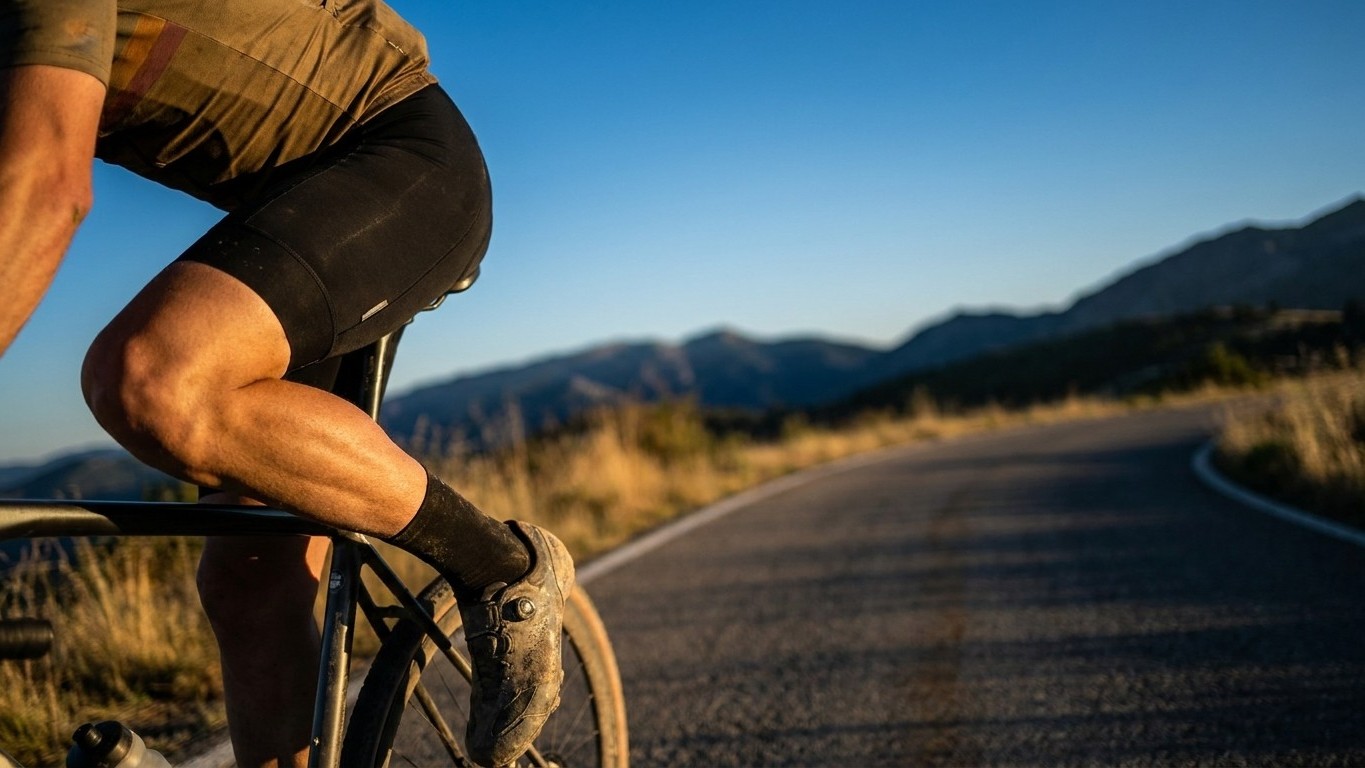
Grinding up a hill in a gear so heavy your knees feel like they’re pushing a wardrobe up a staircase does not build stronger legs. It builds more force through the patellofemoral joint, stroke after stroke, and the research on this is now fairly clear cut. When cyclists pedal at 70rpm rather than 90rpm at the same intensity, peak patellofemoral compressive force rises sharply. The 90-rpm condition was followed by a 29% smaller patellofemoral compressive force than the 70-rpm condition. That’s not a rounding error. That’s nearly a third more load on the joint behind your kneecap, every single revolution, for the entire climb.
The instinct to slam into the big ring and mash away at 55 or 60rpm feels powerful. It isn’t wrong exactly, it’s just solving the wrong problem. Legs don’t get stronger from grinding a big gear any more than a car engine gets more powerful by being stuck in third gear on a motorway. What actually happens is a straightforward trade: power equals torque multiplied by cadence, and you can produce the same power by pushing hard at low cadence (high torque) or spinning fast at high cadence (low torque). Choosing the low-cadence route doesn’t add strength to the equation. It simply shifts the burden from your cardiovascular system onto your muscles and joints, and specifically onto the knee.
Key takeaways
- A study found pedaling at 70rpm creates 29% more compressive force on the kneecap than pedaling at 90rpm at identical power output
- Your knees bear the brunt of low-cadence grinding, not your muscles—and they don’t know you’re ‘training hard’
- Elite riders deliberately train low-cadence work under supervision, but recreational riders grinding for 20 minutes at 55rpm are playing with patellofemoral pain
Why a slower pedal stroke means a heavier stroke
The knee joint has two main load pathways worth knowing about here: the patellofemoral joint (where the kneecap glides over the femur) and the tibiofemoral joint (the main hinge between shin and thigh bones). German researchers who implanted instrumented knee prostheses to measure forces directly during cycling found something that matches what physiotherapists have long suspected from clinical experience. Knee joint loading was found to be dependent on power, cadence, and seat height. To achieve a higher power output, either the force exerted on the pedals or the cadence had to be increased, so it is not surprising that the joint forces increased with increasing power and decreased when the cadence was increased.
A separate biomechanics study looked specifically at competitive cyclists riding at both 70 and 90rpm under matched effort levels. The pattern held for the patellofemoral joint but, interestingly, not for the tibiofemoral joint. Greater pedaling cadence resulted in reduced patellofemoral compressive force with no effect on the tibiofemoral joint forces. So it’s the kneecap, not the hinge itself, that bears the brunt of a low-cadence grind. That distinction matters clinically, because patellofemoral pain (the ache behind or around the kneecap, often worse going up stairs or hills) is exactly the complaint GPs and physios see most often in cyclists who favour big gears.
There’s a mechanical logic to this that has nothing to do with fitness or willpower. At a slower cadence you spend more time in each part of the pedal stroke where the crank arm and pedal force combine to create a large moment at the knee, particularly through the steepest part of the downstroke. Spin faster in an easier gear and each individual push requires less force, even though you’re asking the same total power output of your legs over the minute. Muscles fatigue differently to joints, and joints, frankly, don’t get the memo that you’re “training hard.”
Where the nuance actually sits
None of this means low cadence work is inherently dangerous or that every climb should be spun at 95rpm. Research shows the cadence effect on hip and knee joint contribution in cycling only really emerges from 60rpm and upward, and elite riders do plenty of structured low-cadence, high-torque training deliberately, often under supervision and built up gradually. Coaches who prescribe this kind of work tend to be careful about the details. One well-known strength and conditioning voice in the sport puts it plainly: athletes are told that if you do the big gear work and you start feeling pain in your knees, stop the session immediately.
The real-world risk isn’t the occasional big-gear interval done by a fit, well-conditioned cyclist. It’s the recreational rider who hits a 12% gradient, refuses to drop into an easier gear because it “feels like giving up,” and grinds at 55rpm for twenty minutes with knees that haven’t been conditioned for that kind of sustained torque. General guidance for everyday riders backs this up rather bluntly: higher cadence (85-95+ RPM) is generally easier on the knees because it reduces the force applied per pedal stroke, while low cadence grinding under 70 RPM significantly increases knee joint stress and can contribute to patellofemoral pain, IT band issues, and general knee discomfort.
What to actually do on your next climb
Shift down before the gradient bites, not after your legs have already started screaming. A cadence somewhere in the 70-85rpm range on sustained climbs gives most riders a sensible balance between muscular and cardiovascular load, and even professional riders tend to sit in a similar zone. Modern Tour de France winners cluster around 90 rpm in the flats and 70-80 on long climbs. If you notice yourself dropping below 60rpm and staying there, that’s usually the signal to swap to an easier gear, even if it means a slightly lower top speed up the hill.
If your knees ache after climbing, cadence is one of the first things worth adjusting before assuming it’s a saddle height or cleat alignment issue, though both are worth checking too. And if pain persists despite gearing changes, that’s a conversation for your GP or a chartered physiotherapist rather than something to pedal through. One detail that surprises a lot of riders: saddle height interacts with all of this too, since calculations have shown that patellofemoral forces increase by about 14% when cycling with a low seat height, so a bike fit check is often the cheapest fix of all before you even touch your gearing habits.
Sources : ncbi.nlm.nih.gov | evoq.bike