
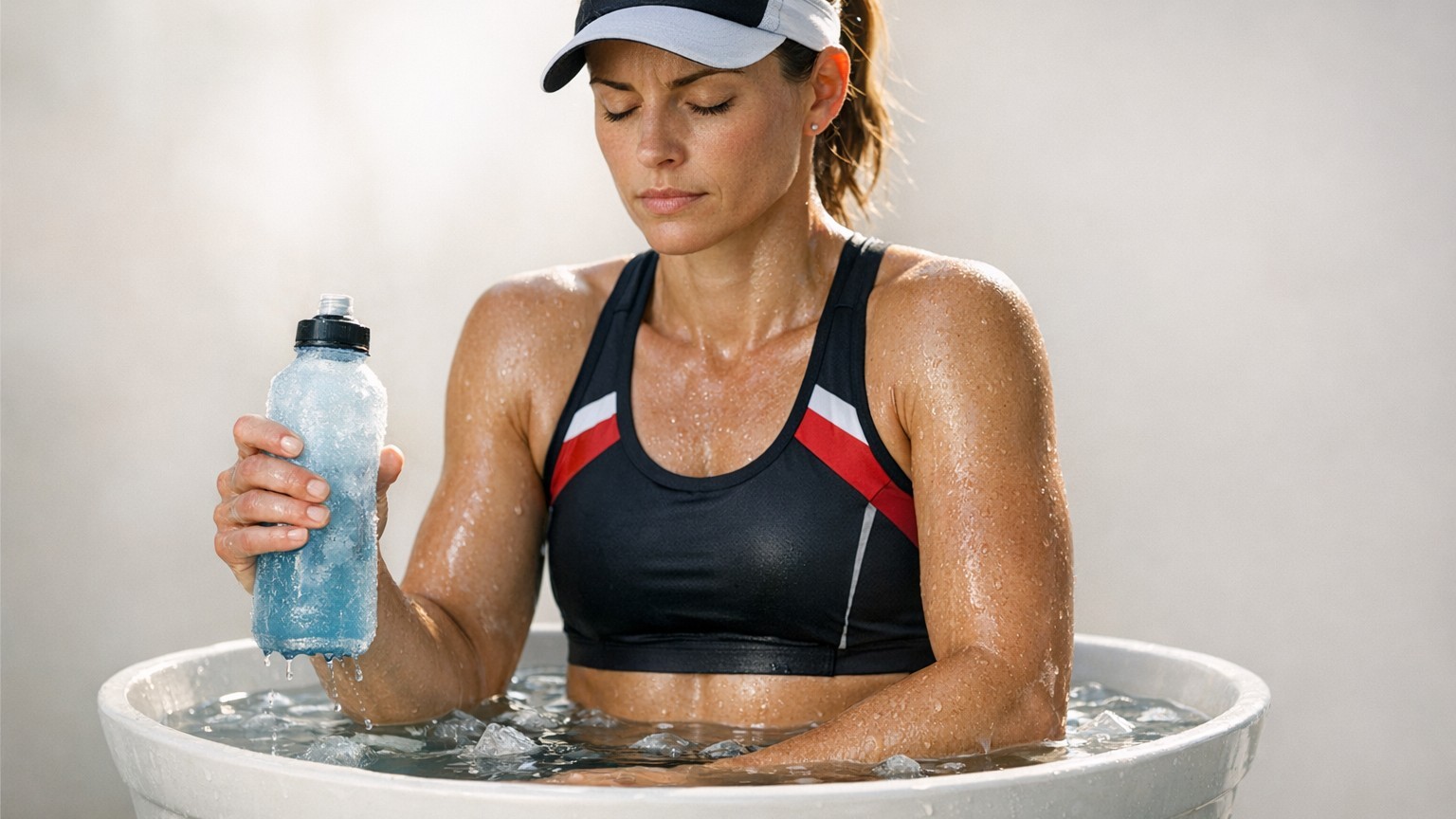
Japanese summers are brutal. Tokyo regularly hits 35°C in August, with humidity so thick it feels like running through warm soup. Japan’s long-distance runners, among the most competitive in the world, have had to solve a problem most European athletes rarely face: how do you start a race at near-optimal core temperature when the air itself is working against you? The answer turned out not to be an ice bath or a refrigerated tent, but something far simpler, a combination of pre-race ice slurry ingestion and forearm cooling that reliably buys athletes a critical thermal buffer before the gun goes off.
Key takeaways
- Japanese Olympians discovered a pre-race cooling method using only frozen sports drinks and cold water—no ice vests or specialized gear required
- Core temperature reduction of 2°C before the race start translates to measurable performance gains of up to 16% in endurance events
- The technique exploits your body’s natural heat-radiator points: the palms and forearms contain dense blood vessel networks that rapidly return cooled blood to your core
Why your starting temperature changes everything
The human body has a ceiling. Reducing initial temperature gives the body an increased capacity to store metabolic and environmental heat, and pre-cooling may produce a heat “sink” that allows an athlete to exercise for longer before reaching a core temperature associated with reduced performance or stopping altogether, around 40°C. Think of it like a car’s coolant reservoir: a fuller tank before a steep climb means the engine runs further before overheating.
Pre-cooling is a technique used to slightly lower a runner’s core body temperature before they start running, which in turn extends the amount of time they can run hard before hitting that critical temperature threshold. What surprised sports scientists is just how much this matters in practice. One study reported that pre-cooling can boost Performance by 16%, and a second showed a 2.6-degree average core temperature difference after a 5km race between subjects who pre-cooled with a vest and those who did not. That is a staggering margin for what is, at its core, a simple intervention.
The biggest environmental Performance killer for the runner is heat, you can dress for cold weather runs and still perform well, but just a slight increase in temperature causes performance to suffer. When the temperature rises from around 10°C to 16°C, marathoners slow by roughly 3 to 7%, meaning a 3:45:00 finisher could expect to slow by well over five minutes. Multiply that across the humid, punishing race calendar of a Japanese summer, and the motivation to find a smarter approach becomes obvious.
The ice slurry trick, cooling from the inside out
The ingestion of an ice slurry or crushed ice is a practical and effective method for lowering the core temperature to enhance endurance performance and reduce physiological strain in the heat. The reason this works without the bulk or logistics of an ice vest lies in basic thermodynamics. There are two mechanisms by which ice slurries decrease core temperature: the enthalpy of fusion and conductive cooling caused by the low temperature via thermodynamic characteristics. The stomach, sitting close to the body’s core, becomes a direct heat exchanger, no external apparatus required.
Ingestion of pre-exercise ice slurry (30 minutes before exercise, at -1°C to +1°C) in a dosage range of 7–14g per kg of body mass has a significant beneficial effect on thermoregulation and exercise performance. For a 65kg runner, that translates to roughly 450–900ml of slushy liquid consumed in the 30 minutes before the start. Ice slurry prepared from plain crushed ice, a sports drink, or carbohydrate and electrolyte drinks may have a similar effect on thermoregulation and exercise performance. a frozen sports drink from the night before, taken out of the freezer at the right moment, does the job.
Japanese athletes at the Tokyo 2020 Games took this further. In the blind marathon, pre-cooling was performed by combining ice slurry ingestion with forearm cooling, with the ice slurry using commercial packaged products from a Japanese pharmaceutical company. The individually packaged 100g portions made dose control simple, and forearm cooling was approached individually as a complementary strategy. The combination matters: ice ingestion targets core temperature directly, while forearm immersion exploits the hand and forearm’s dense network of blood vessels to return cooled blood to the body’s centre.
Forearm and palmar cooling, the hidden radiator
The palm is an area of the body with abundant arteriovenous anastomoses, cross-connections of blood vessels that transfer heat more rapidly than other areas of the body, along with the feet, head, and neck. By submerging the forearms and hands in cool (not ice-cold) water before a race, athletes essentially switch on a biological radiator. Cooling of the palmar region and forearm, which have an advantage in heat dissipation, may contribute to the return of a large amount of cool blood to the core region, alleviating heat stress and improving exercise performance.
One nuance here is worth knowing: temperature matters. Effective palm cooling requires moderation in temperature, between roughly 7°C and 16°C, not excessively cold like direct ice contact, which can constrict blood vessels. A bowl of cold tap water, not an ice bucket, is genuinely the sweet spot. The vasoconstriction caused by ice-cold water actually defeats the purpose, closing off the very vessels you want to use for heat exchange.
Research on head pre-cooling found that wearing a cold compress or bandana for 20 minutes before a race improved 5km run times, with subjects who received pre-race head cooling running faster than those sitting in the same ambient temperature without it. This suggests that even partial cooling, targeting one area of the body, can shift the outcome of a race. The full strategy, combining internal ice slurry ingestion with external forearm and head cooling, compounds these effects.
How to apply this before your next summer race
The good news is that none of this requires specialist equipment. The protocol used by Japanese endurance athletes, and validated in the broader literature, translates cleanly to any runner preparing for a summer event.
- Freeze a sports drink or electrolyte solution the evening before to create a slurry, not a solid block
- Consume it in the 30 minutes before your start, sipping gradually rather than in one go
- Submerge your forearms and hands in cool (not ice-cold) water for 10–15 minutes while you wait
- Apply a wet, cool cloth or bandana to the back of the neck and head
- Stay in the shade and avoid warming up more than necessary before the start
Consuming ice slushy drinks prior to exercise can lower the body’s internal temperature and help maintain a lower core temperature during the workout, though this method can cause some gastrointestinal issues and is worth testing in training before using it in a target race. That last point is practical and honest: introduce this in a low-stakes training run first, not on race morning.
There is also a perceptual dimension that researchers are increasingly interested in. A change in the perception of thermal sensation during exercise from a menthol mouth rinse was associated with improved endurance running performance in the heat, independently of any measurable drop in core temperature. When menthol is ingested or rinsed in the mouth, it interacts with sensory nerves in the oral cavity and activates the sensory pathway, causing a perceived feeling of cooling. Some Japanese runners combine a chilled menthol-based drink with their ice slurry specifically to layer both the physiological and perceptual benefits, cooling the body from within while also signalling to the brain that conditions are more manageable than they are.
As always, consult your GP before making significant changes to your training or race-day preparation, particularly if you have any cardiovascular or gastrointestinal health concerns.
Sources : sciencedirect.com | onlinelibrary.wiley.com