
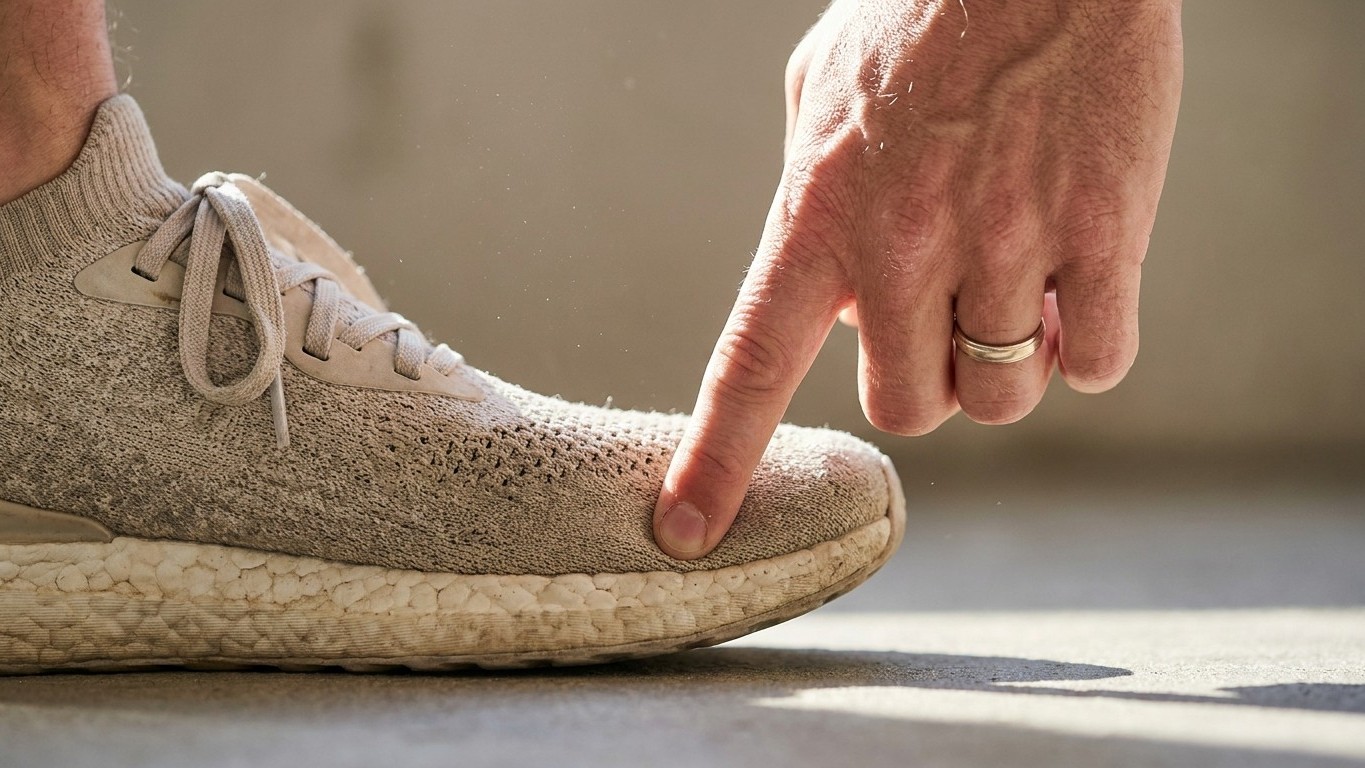
Running shoe foam does not recover instantly. That single fact, once you understand the mechanics behind it, changes how you think about your entire training setup. Most runners rotate clothing, socks, and even water bottles without a second thought, yet they lash the same pair of shoes to their feet day after day, wondering why their knees start aching around week six of a training block.
Key takeaways
- Running shoe foam doesn’t bounce back instantly—it needs a full day or more to recover its cushioning properties
- A major study found that runners rotating shoes had 39% fewer injuries than those using a single pair
- The simple thumb test reveals everything: a rested shoe feels dramatically different underfoot than one used back-to-back
What actually happens to your shoes while you sleep
The midsole of a modern running shoe is built from compressed foam, typically EVA (ethylene-vinyl acetate) or one of its more advanced derivatives. When you run, that foam is compressed thousands of times per session. The cells within the material deform, lose their spring, and retain heat. What most runners don’t realise is that full recovery from a single run takes somewhere between 24 and 48 hours, depending on the foam compound, your body weight, and how hard the session was. A study published in the British Journal of Sports Medicine confirmed that midsole hardness increases measurably after a single run, and that this stiffness doesn’t fully resolve until the shoe has had adequate rest.
Think of it like a sponge that’s been wrung out. You can use it again immediately, but it won’t absorb nearly as well as one that’s been left to expand overnight. The foam in a rested shoe genuinely performs differently under foot strike, offering more cushioning and energy return than one that went straight from yesterday’s tempo run to this morning’s long run.
There’s a practical implication here that goes beyond comfort. As the midsole stiffens during consecutive use, the forces travelling through your foot, ankle, and knee change. Your body begins compensating, subtly shifting load onto structures that weren’t designed to absorb it repeatedly. Over the course of a training cycle, this adds up.
The numbers behind shoe rotation
Research from the University of Luxembourg followed recreational runners over a five-month period and found that runners who rotated between multiple pairs of shoes had a 39% lower risk of running-related injury compared to those who wore a single pair exclusively. That figure surprised even the researchers involved. The working hypothesis is twofold: rotating shoes varies the precise mechanical stress on the body, and it ensures that no single pair is ever used in a fully compressed, underperforming state.
Shoe lifespan also factors in. Most running shoe manufacturers recommend replacing a pair between 300 and 500 miles of use, though this varies considerably with body weight and running surface. If you’re logging 30 miles a week on a single pair, you’re looking at roughly three to four months before degradation becomes significant. Rotate two pairs through those same miles, and each pair lasts considerably longer, meaning the upfront cost of buying a second pair is partially offset by the extended life of both. It’s not quite a freebie, but it’s closer to cost-neutral than it first appears.
The type of shoe matters too. Many experienced runners keep one pair for faster sessions or races and a second, more cushioned model for easy days and recovery runs. This isn’t just a quirk of the enthusiast crowd; it reflects the genuine mechanical differences between shoe categories and how those differences serve different training intensities.
How to make rotation work without overcomplicating it
The simplest approach: buy your second pair when your first is around three months old. That way, you’re not starting both on zero miles at the same time, and you’ll have a clearer read on when each needs replacing. Alternate days rather than alternating weeks. If you ran Monday in pair A, run Tuesday in pair B. The foam in pair A is then resting for 48 hours, which is exactly the window it needs.
Storing your shoes properly between sessions helps too. Leaving them in a warm car boot accelerates foam degradation. A cool, dry environment with good air circulation allows the material to off-gas heat and expand back towards its original structure more effectively.
If you’re suspicious of buying the same shoe twice, this is actually a reasonable moment to try two different models side by side. Different heel drops, stack heights, or levels of cushioning can complement each other across a training week, and varying those inputs is thought to reduce overuse injuries by preventing any single movement pattern from dominating. Your tendons and muscles respond well to variety, just as the rest of your training does.
A word on budget and priorities
The counterargument to rotation is cost, and it’s a fair one. Running shoes aren’t cheap, and not everyone can absorb two purchases at once. A pragmatic middle ground is waiting for sale periods, which tend to cluster around seasonal transitions when retailers clear older models. These are often shoes from the previous year’s range, perfectly functional, sometimes 30 to 40% cheaper. Buying one full-price pair and one discounted pair keeps the rotation principle alive without doubling your spend.
What changed my thinking about all of this wasn’t the injury statistics, though those are compelling enough. It was the simple act of pressing a thumb into the midsole of a shoe I’d worn the previous evening and then pressing it into a pair that had been resting for two days. The difference in resistance is immediate and obvious. The rested shoe gives. The used shoe pushes back. Your joints feel that difference on every single stride, even if your brain doesn’t register it consciously.
One more thing worth knowing: foam technology is evolving quickly, and some newer compounds, particularly the carbon-plated race shoe foams, claim faster recovery times than traditional EVA. Even so, independent testing consistently shows that rest improves performance across all foam types currently on the market. The chemistry changes; the physics doesn’t.
Always consult your GP or a qualified sports medicine professional if you’re experiencing persistent pain or injury related to running.