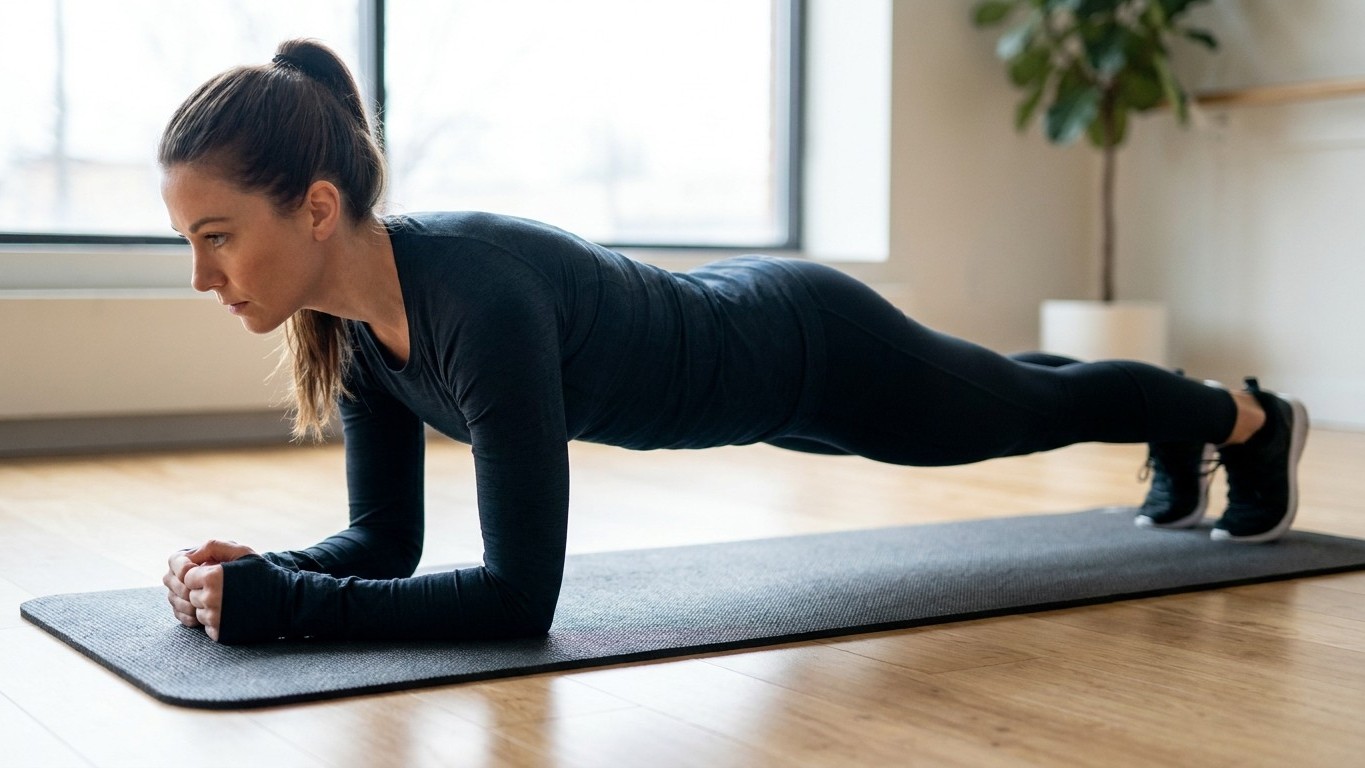
The plank is one of those exercises that looks deceptively simple, no weights, no equipment, just you and the floor. But a 90-second plank performed badly is worth considerably less than a 20-second plank done well, and the difference almost always shows up in the hips. When my coach reviewed my footage and told me to stop, the problem wasn’t my endurance. It was that my hips had drifted upward into a gentle tent shape, quietly defeating the entire purpose of the exercise.
Key takeaways
- A 90-second plank with poor form is worthless compared to a perfect 20-second hold
- Your drifting hips are a silent signal that your muscles have checked out
- The fix isn’t longer holds—it’s shorter, stricter ones that rewire your neuromuscular control
What your hips are actually telling you
The plank is a spinal stability exercise at its core. The goal is to maintain a neutral spine, which means your body should form a straight line from the back of your skull to your heels. When your hips rise, the lumbar spine flexes, and your abdominals stop working under meaningful tension. You’re essentially resting on your skeleton rather than actively engaging your muscles. The challenge disappears, and with it, the benefit.
The opposite problem is equally common: hips that sag toward the floor. This creates hyperextension in the lower back, compressing the lumbar vertebrae and putting real strain on the erector spinae. Research into lower back pain consistently identifies poor lumbopelvic control as a contributing factor in non-specific back injuries, and the sagging plank is a textbook demonstration of exactly that loss of control. Both errors, hips too high or too low, are your body’s way of finding an escape route when the target muscles fatigue.
The muscles most responsible for keeping your hips in line are the deep abdominals, particularly the transverse abdominis, along with the glutes. Most people, when they plank, think about their abs in a vague, general way. A more useful cue is to think about squeezing your glutes as if you’re trying to crack a walnut between them, and simultaneously pulling your navel gently toward your spine. That combination tends to lock the pelvis into a neutral position far more reliably than simply “holding on.”
The case for shorter, stricter holds
There’s a persistent cultural idea that longer planks signal greater fitness. The world record for a plank hold runs into hours, and gyms routinely run challenges built around hitting the two- or three-minute mark. The problem is that for most people, the form breaks down well before they think it does, and without video evidence, they have no idea.
A 2021 study published in the Journal of Strength and Conditioning Research looked at how plank form degrades over time in untrained individuals and found that meaningful deviation from neutral alignment begins far earlier than participants self-reported. People, in short, are optimistic about their own form. This is exactly why filming yourself, as uncomfortable as it can be, is one of the most practical training tools available to anyone, at any level.
The recommendation from most physiotherapists working in sports rehabilitation isn’t to push through form breakdown in the hope that the muscles will catch up. It’s to stop at the point of deviation and rest. Three clean 20-second holds will build more functional strength than a single 90-second hold where the last minute is spent in a poorly loaded position. Volume accumulates; bad patterns do too.
How to fix your plank before you extend it
Before worrying about duration, it’s worth establishing whether you can hold a perfect position for ten seconds. That sounds almost insultingly easy, but it changes when you apply the right cues simultaneously. Forearms flat on the floor (if you’re doing a forearm plank), elbows directly below the shoulders, a long neck, glutes engaged, quads contracted, feet hip-width apart. Every single element matters, because the body is creative about offloading work from fatigued muscles onto neighbouring structures.
A drill that physios often recommend for re-teaching this is the dead bug exercise, which trains the same transverse abdominis engagement in a supine position, with far less opportunity for the hips to cheat. Building that neuromuscular awareness on your back before transferring it to the plank position tends to produce faster improvement than simply planking more often.
One specific coaching cue that tends to cut through the noise: press the floor away from you rather than just resting on it. Whether you’re in a forearm plank or a high plank on hands, that active pushing sensation switches on the serratus anterior (the muscle that wraps around your ribcage), which contributes to scapular stability and stops the chest from caving. It also, almost immediately, changes the quality of the hold.
When planking is genuinely not the right exercise
For people with existing lower back problems, the plank isn’t automatically the safest starting point. The high compressive load on the lumbar spine in a plank can aggravate certain disc issues, and anyone with a history of back pain should get clearance from their GP or a chartered physiotherapist before loading the position. This isn’t overcaution, it’s the difference between rehabilitation and re-injury.
The side plank, which tends to get far less attention, is more valuable for many people. It loads the lateral stabilisers of the trunk, particularly the quadratus lumborum and the obliques, which are chronically underworked in most training programmes. The lateral chain is heavily involved in walking and running mechanics, and weakness there often contributes to hip drop and knee pain in runners, problems that a standard front plank won’t fix.
My coach’s advice, after reviewing the footage, was simple: drop to 30 seconds, own it completely, and build from there. Three weeks later, I could hold 45 seconds with no drift whatsoever. That felt, genuinely, like a bigger achievement than the wobbly 90-second version ever did, because this time, something was actually working.
Always consult your GP or a chartered physiotherapist before starting a new exercise programme, especially if you have a history of back pain or joint problems.