
The scan would have shown something researchers actually documented: while the hopping leg quietly built new bone, the other hip carried on losing it, exactly as ageing bone tends to do when left to its own devices. That’s not a hypothetical. It’s the real result from a British trial that asked older adults to hop on one leg every single morning for a year, then compared each hopping hip against its untouched twin.
The research in question is Loughborough University’s so-called Hip Hop study, and it remains one of the more striking pieces of evidence that a genuinely tiny daily habit can reshape ageing bone. The Hip Hop study, which measured the effect of daily hopping exercises in 34 men over 65, has shown bone density in the hopping leg improved after just one year. The researchers invited 34 men over the age of 65 to hop for 2 minutes a day for one year, and the men hopped only on one leg, so the other leg could be used for Comparison. That design is what makes the findings so persuasive. Each participant became his own control group, which strips out all the usual noise from diet, genetics or general activity levels that muddies most exercise research.
Key takeaways
- Researchers discovered one leg can visibly strengthen while its twin quietly weakens—all from a two-minute daily habit
- The improvement appeared precisely where fractures happen most, suggesting real protection against falls
- Women over 55 showed the same bone-building response, challenging assumptions about aging bone’s capacity to adapt
What the scan actually revealed
Bone mass increased by up to 7% in parts of the exercised hip’s outer shell or cortex, and the results also showed increases in the density of the layer of spongy bone under the cortex. The improvements weren’t scattered randomly across the hip either. These effects were also seen in the thinnest areas of the hip bone, the parts that are most likely to suffer a fracture during a fall. That detail matters more than it might sound. A hip doesn’t fail everywhere at once; it tends to give way at specific weak points near the femoral neck, and this is precisely where the hopping leg showed its biggest gains.
The scans were analysed using a bone mapping technique that goes well beyond a standard DEXA reading. CT scans, taken at University Hospitals Leicester, were analysed by a novel bone mapping technique developed at the University of Cambridge and showed clear visual differences between the exercise and control legs. Dr Winston Rennie, the consultant radiologist who oversaw the imaging, said the bone maps showed “clear changes in bone, with localised adaptions at regions that may be important to reducing hip fracture.” Put another way: you could actually see, colour-coded on a map of the femur, where one leg had been doing homework the other hadn’t.
None of this happened by accident of biology. Bone responds to mechanical stress the way muscle responds to resistance training, a principle known as Wolff’s Law, which holds that living bone adapts and remodels according to the loads placed upon it. It has been known since the 1800s that putting an unusual load on bone sends a signal for bone to grow stronger, as if upon noting high impact, the body says to the bone that it needs to be stronger because heavy loads are coming. Hop on one leg for months and that leg, quite literally, gets the message. The other one doesn’t, because nobody told it to.
Why this isn’t just a men’s story
Skeptics might reasonably ask whether this only applies to men over 65, and for a while that caution was fair. Earlier jumping studies in postmenopausal women had produced disappointing results, leading some researchers to assume ageing bone had simply lost its capacity to respond to impact. That assumption didn’t survive scrutiny. A later trial specifically tested one-legged hopping in women aged 55 to 70, using the same within-person design. The women hopped on one leg only, so each woman’s other leg acted as her own control, and after six months, femoral neck bone density had risen slightly in the hopping leg and fallen in the non-hopping leg. The gain was modest, but the direction of travel was the real story. Even a small gain represents a meaningful change of direction against bone that would otherwise have been quietly declining.
It’s worth being honest about the limits here too. The other hip sites did not improve in the older group in the broader meta-analysis, meaning the femoral neck responds well but the trochanter and total hip measurements don’t necessarily follow suit in older adults the way they do in younger ones. That’s a real argument for starting early if you can, though it certainly doesn’t make hopping pointless once you’re past fifty. The trial also had a real-world hiccup worth mentioning: of the fifty men originally recruited for the Hip Hop study, only thirty-four stuck it out to the end, with discomfort and time pressures cited as the main reasons people dropped off.
Building the habit without breaking anything
If you fancy trying this yourself, the protocol used in these trials is genuinely modest and worth respecting rather than rushing. Participants didn’t start at fifty hops; they built up gradually over several weeks, and the movement was deliberately multidirectional rather than a simple straight-up-and-down bounce, since varying the angle of impact loads different parts of the hip. A sensible way in looks something like this:
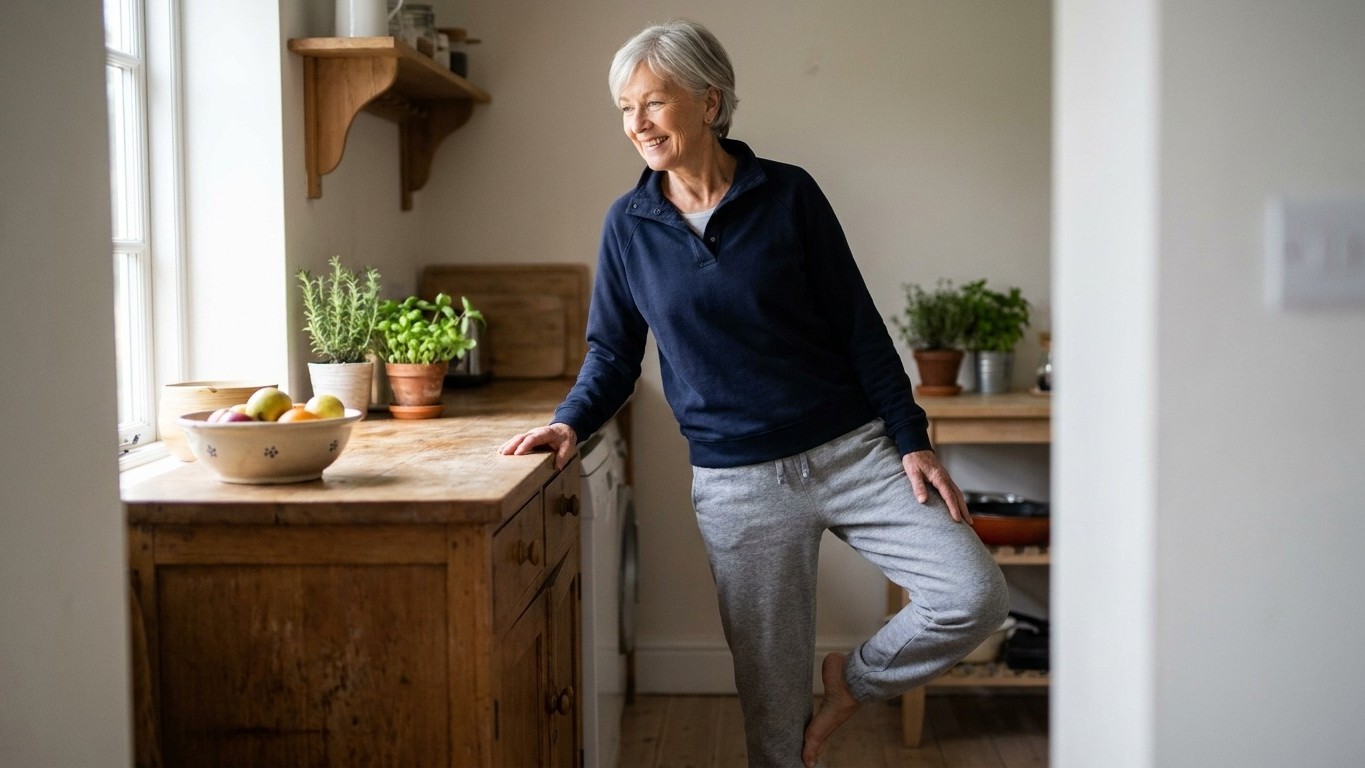
- Start with a handful of gentle hops on a supportive surface, holding onto a worktop or wall for balance if needed
- Add a few hops each week rather than jumping straight to fifty
- Once comfortable, vary the direction, forward, sideways, slightly diagonal, rather than hopping only on the spot
- Keep sessions brief; two to four minutes daily is enough to match what the research actually tested
None of this is a substitute for proper medical advice, particularly if you already have osteoporosis, a joint condition, or a history of falls. High-impact loading isn’t automatically safe for everyone, and anyone with fragile bones or balance concerns should get clearance from their GP before attempting a hopping routine. But for a healthy adult wanting a two-minute habit with a genuine evidence base behind it, this is about as low-cost as bone health advice gets. What strikes me most, rereading the trial data, is how unglamorous the whole thing is. No equipment, no gym membership, no supplement. Just one leg, quietly doing the work the other one never got asked to do.
Sources : sciencedirect.com | pubmed.ncbi.nlm.nih.gov