
Two and a half years pedalling or doing lengths at the pool, and yet the bone at the top of your thigh, the femoral neck, the very spot where a fracture can change the rest of your life, hasn’t budged. That’s not a hypothesis. It’s what researchers keep finding when they measure bone density directly, and it’s the uncomfortable truth behind a piece of exercise science that deserves far more attention than it gets.
The clearest illustration comes from the LIFTMOR trial, published in the Journal of Bone and Mineral Research in 2018. Australian researchers recruited postmenopausal women with low bone mass and randomised them to either eight months of twice-weekly, supervised high-intensity Resistance and impact training, or a home-based, low-intensity exercise programme. The results were stark. The high-intensity group saw femoral neck bone mineral density change by 0.3% versus a 1.9% decline in the low-intensity control group, a statistically significant difference. the low-impact exercisers didn’t just fail to improve their hip bone, they kept losing it at nearly the same rate as if they’d done nothing at all.
Key takeaways
- A landmark 2018 trial tracked postmenopausal women doing either gentle cardio or intense resistance work—the results were starkly different
- Your skeleton ignores effort and breathlessness; it only responds to specific mechanical strain that water and bicycle saddles simply don’t deliver
- Heavy barbell work and jumping produced dramatic hip and spine improvements where swimming and cycling produced almost nothing
Why gentle cardio leaves the hip bone untouched
Cycling and swimming feel virtuous, and they genuinely are good for your heart and lungs. But bone doesn’t respond to effort or breathlessness. It responds to mechanical strain delivered through the skeleton, ideally at speed. A systematic review dedicated specifically to this question concluded that trials examining swimming as a way to prevent or treat osteoporosis showed no evidence of positive effects on bone mass, with one study finding no changes in femoral neck or lumbar spine density after six months of swimming three times weekly in postmenopausal women. Cycling fares no better. The same body of research points to cyclists needing complementary weight-bearing activity, precisely because their sport alone doesn’t maintain bone mass.
This isn’t a fringe finding either. An individual patient data meta-analysis pooling ten controlled trials and 595 women concluded that comparison of initial and final bone mineral density values between exercise and control subjects revealed no statistically significant effect of exercise on femoral neck bone mineral density, meaning the exercise protocols used across these studies simply did not improve femoral neck density in postmenopausal women. And a more recent review of the field summarised it bluntly: low-impact exercises such as walking, and non-weightbearing exercises such as cycling and swimming, do not exert a positive effect on bone mineral density.
What your skeleton actually needs to hear
Bone remodels according to what physiologists sometimes call the mechanostat, a feedback system that only bothers laying down new mineral when it detects strain rates it isn’t used to. Water buoys you up; a bicycle saddle carries your weight. Neither delivers the jolt of ground reaction force that tells hip bone to reinforce itself. Walking sits somewhere in the middle: better than nothing, but still too gentle for most postmenopausal skeletons, which is why a meta-analysis of walking programmes found the effect on bone density underwhelming compared with genuinely high-impact loading.
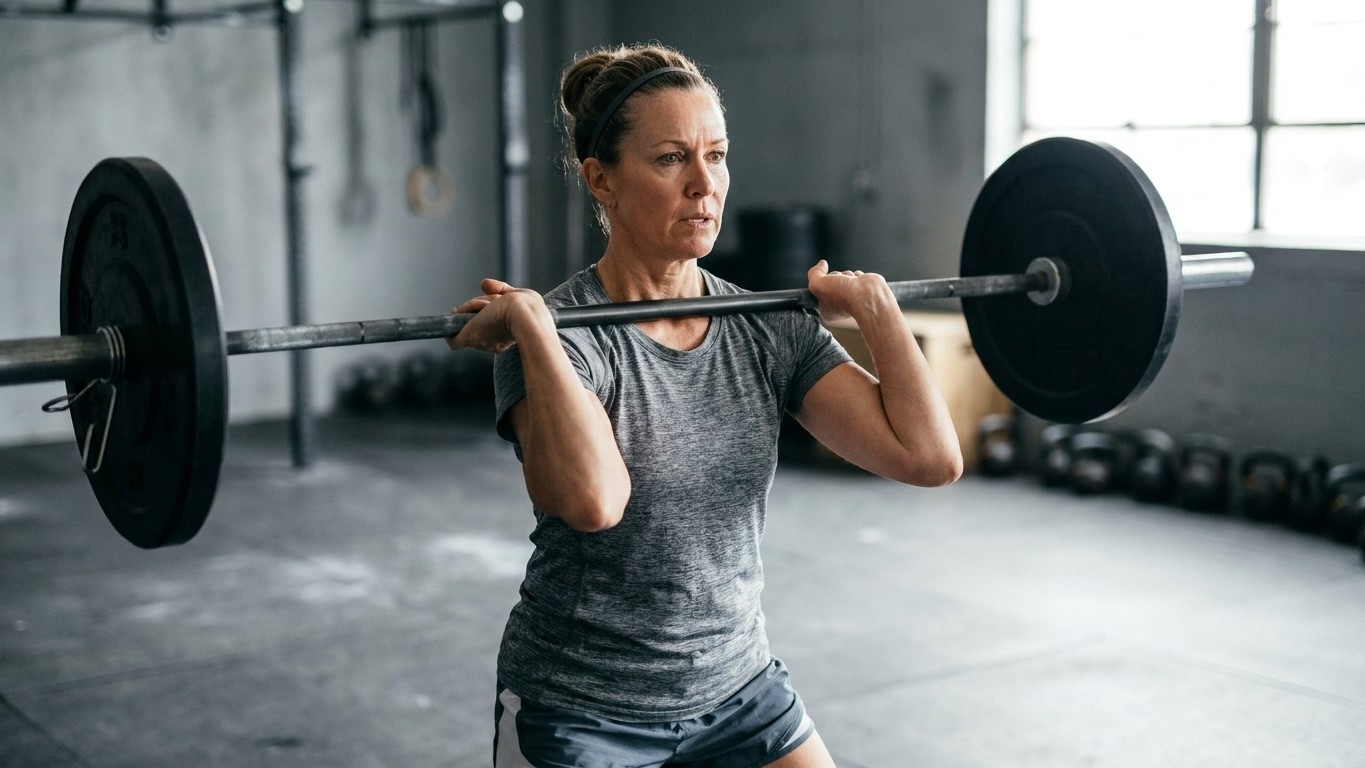
Contrast that with what did work in LIFTMOR. The programme wasn’t jogging or step aerobics. It was heavy barbell training, deadlifts, overhead presses, back extensions, combined with jumping chin-ups, all performed at high intensity, twice a week. The lumbar spine responded even more dramatically than the hip, gaining 2.9% versus a 1.2% loss in the control group, and cortical thickness at the femoral neck improved too. This is loading of a completely different order to a Sunday cycle ride, and it took real supervised strength work, not just “staying active”, to shift the numbers.
Turning this into something practical
None of this means swimming and cycling are a waste of time. They protect your cardiovascular system, support joints that can’t tolerate impact, and help with weight management, all worthwhile in their own right. The point is narrower and more useful: if your goal includes protecting the femoral neck specifically, these activities shouldn’t be your only strategy after menopause.
What seems to matter, based on the pattern across these trials, is a combination of three elements:
- Resistance training that progressively overloads major muscle groups, ideally at meaningful intensity rather than light weights and high repetitions
- Some element of impact, even modest jumping or hopping, since ground reaction force appears to be what triggers bone’s adaptive response
- Consistency over many months, since exercise frequency of at least two sessions per week has been shown to positively influence bone response, particularly when programmes run longer than twelve months
Starting a programme like this after years of low-impact exercise isn’t something to improvise alone, particularly if you already have osteopenia or osteoporosis; a GP or physiotherapist can help assess whether high-intensity impact work is appropriate for your joints and existing bone density, and refer you to supervised strength training where needed. One detail from the LIFTMOR trial is worth remembering too: despite the heavy loads and jumping involved, the researchers reported the programme was well tolerated with no serious adverse events, suggesting that for many postmenopausal women, the barrier to this kind of training may be more about confidence and access to proper supervision than actual physical risk.
Sources : onlinelibrary.wiley.com | ncbi.nlm.nih.gov