
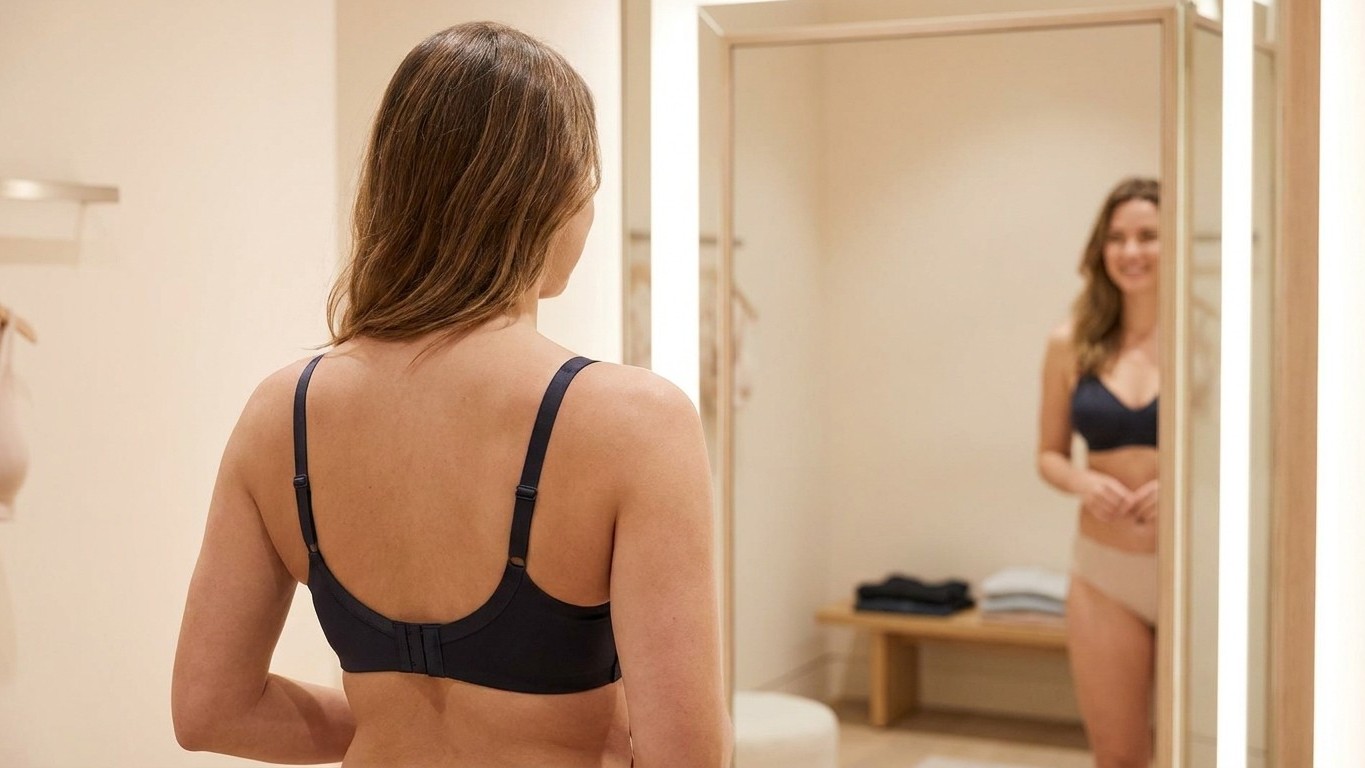
Two years of aching between the shoulder blades, and the answer wasn’t a stretching routine or a new office chair. It was a tape measure wrapped around my ribcage in a department store fitting room, which revealed I’d been wearing the wrong bra size the entire time, and that mismatch had been quietly dragging on my upper back with every step.
The fitter pulled the band up two sizes and dropped the cup down one, and the difference in how my shoulders sat was immediate. No posture app, no foam roller, no amount of “sit up straight” reminders had touched the actual mechanical problem: unsupported breast tissue pulling my centre of gravity forward, forcing the muscles across my upper back to work overtime just to keep me upright.
Key takeaways
- A two-year mystery of shoulder blade pain was solved in a fitting room, but not the way you’d expect
- The underband does 80% of a bra’s support work, not the straps—and loose bands force your back muscles to compensate
- Even after finding the right fit, the real recovery required targeted physiotherapy, not just better posture habits
The 80/20 rule nobody tells you about
Most people assume the shoulder straps do the heavy lifting on a bra. They don’t. The underband provides the majority of support for the breasts, around 80%, with the shoulder straps providing just 20%. If the band at the back is too loose, it causes the shoulders to carry the weight of the breasts instead of the back. That single fact explains why my supposed “posture problem” never improved no matter how many times I rolled my shoulders back at my desk. The band on my old bras had stretched and ridden up, so my shoulders and upper back muscles were doing a job they were never designed to do.
This isn’t a niche issue either. Close to 80% of women are wearing the incorrect bra size currently, which tends to be ill-fitting and can lead to shoulder, chest, neck, and spine pain, along with headaches. An older study on young women found something similar: a small 2008 study on breast size, bra fit, and thoracic pain in young women found 80 percent of participants were wearing the incorrect bra size. What’s striking is that women with larger breasts were more likely to wear an incorrect bra size, which is exactly the demographic most likely to already be carrying extra postural load.
There’s a biomechanical explanation for why this matters so much for the thoracic spine specifically. Increased breast volume increases thoracic kyphosis, the curvature of your upper back, which in turn forces the head and shoulders forwards, changing the biomechanics of the whole upper body. Add a band that’s stopped doing its job, and a poorly fitting bra with tight shoulder straps and excessive elevation of breast tissue acts to increase the downward drag of breast weight and alter mechanics further. It’s a slow, cumulative process, not a sudden injury, which is exactly why it’s so easy to mistake for generic “bad posture” and shrug off for two years.
Why “it’s just your posture” isn’t the whole story
I want to be honest about the research here, because it’s more nuanced than a single satisfying villain. Not every study agrees that bra fit itself is the direct cause of pain. One correlational study on young women concluded that bra fit appears unrelated to pain in normal healthy individuals despite the theory that a poorly fitting bra would compromise bra function and contribute to unfavourable spinal mechanics. And a Cleveland Clinic physician was blunt about it, stating she doesn’t believe bras in themselves, even improperly fitted ones, can actually cause back pain any more than they can prevent it.
What the evidence does support more consistently is a link between breast size itself and pain. A 2020 study found a positive correlation between large breasts and reports of upper back pain, noting that for each increase in breast size score, people were 13% more likely to report upper back pain. Separately, researchers concluded that a larger cup size played a significant role in causing shoulder and neck pain. Fit, is one thread in a tangle that also includes breast weight, body weight, age and general muscular strength, not a single tidy cause.
Age plays its own quiet role too. Breasts typically get bigger as people age, and studies involving females who were over 40 years old or postmenopausal suggest that breast size may influence pain. One postmenopausal study went further, linking hormonal changes directly to the mechanics at play: bra fit has the potential to change when the anthropometrical measures used to determine bra size change, such as post-menopausally, and one in five women have reported that after menopause they had to buy a larger bra because of changes in breast size. Nobody tells you that your bra size is a moving target across a lifetime, but apparently it is.
What actually helped, beyond blaming posture
Fixing the fit was step one, not the whole cure. A correctly sized bra removed the constant low-grade strain, but the muscles between my shoulder blades had spent two years compensating and needed retraining. This is where the physio appointment I’d been avoiding actually earned its keep: targeted work on the rhomboids and mid-trapezius, rather than generic stretching, made the difference that posture reminders never could.
Clinicians tend to agree on the combination. One consultant’s advice was straightforward: emphasise core strength, cardio exercise and stretching, and especially for upper back pain, work on improving core strength and the strength of the muscles between the shoulder blades. On the fitting side, the practical guidance is worth repeating because it’s so often ignored: bras should be replaced every three to six months, with a professional fitting each time they’re replaced, since most bras don’t stay the same size with repeated wear and washing, and are expected to stretch up to as much as four inches over time.
If you’ve been nursing a similar ache and quietly assuming it’s just your desk setup or your habit of slouching, it’s worth booking both appointments rather than choosing between them: five minutes with a tape measure at a proper fitting, and a proper assessment with a physiotherapist or your GP if the pain persists once the fit is sorted. One average statistic puts the scale of the drift in perspective: over the past 20 years, average bra size has increased from a 12B to 12DD, which means an awful lot of us are walking around in support that quietly stopped matching our bodies years ago, and calling it posture in the meantime.
Sources : ncbi.nlm.nih.gov | medicalnewstoday.com