
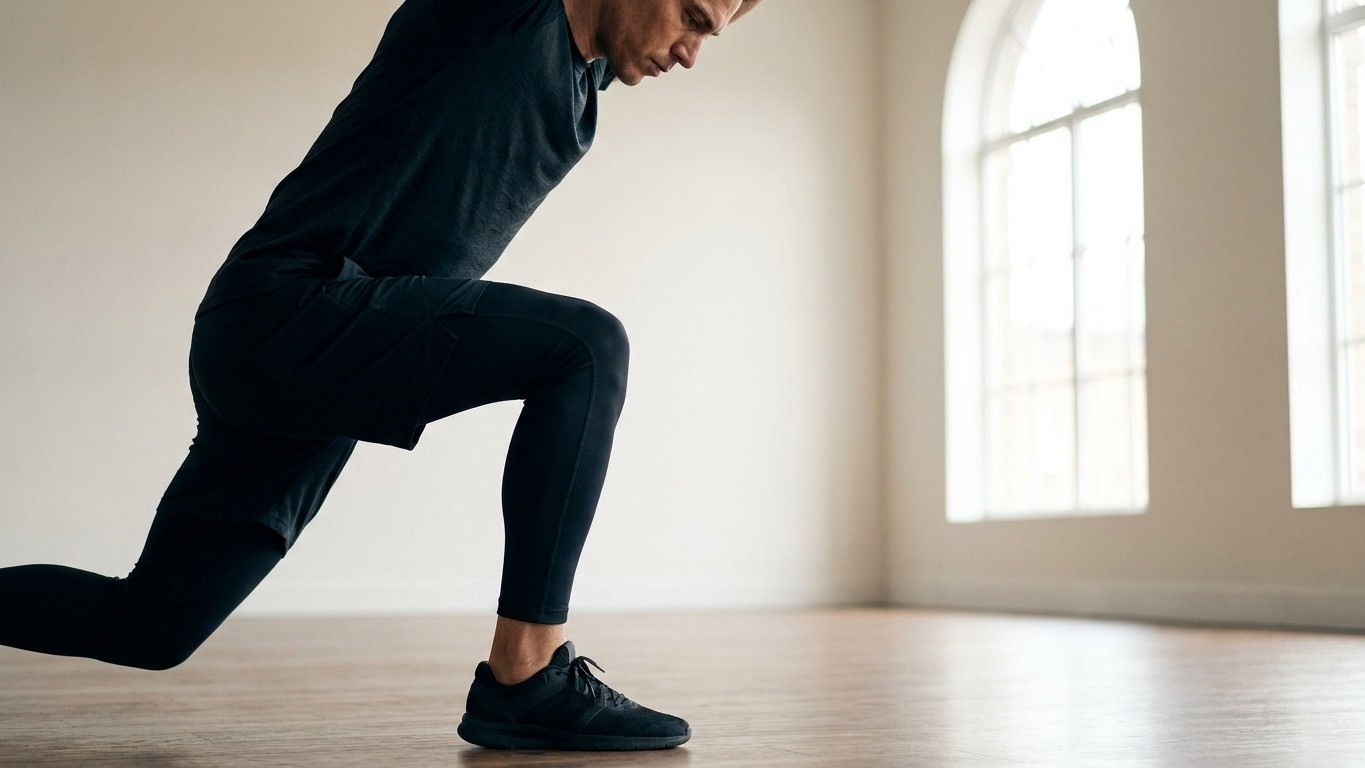
After years of lunges, squats, and leg days that left me genuinely sore, a physiotherapist said six words that reframed everything: “Your quad has never truly fired.” She wasn’t being dramatic. She was pointing to something measurable, something I could feel when she pressed her fingers against my vastus medialis oblique (VMO), the teardrop-shaped muscle just above the inner knee, while I dropped into a lunge. Nothing. The muscle was essentially switched off, letting my knee drift inward and my hip compensate for every repetition I’d ever done.
Key takeaways
- A single cue during lunges might be silently shutting down the most important quad muscle for knee health
- The ‘knee-past-toes’ rule that dominated fitness for decades may have been preventing proper quad activation all along
- One unsexy resistance band exercise holds the key to waking up a muscle that decades of training couldn’t touch
The quad isn’t just one muscle, and that matters enormously
Most people treat the quadriceps as a single unit. Train legs, feel the burn, done. But the quadriceps is actually a group of four muscles, and the one most likely to go quiet is the VMO. It’s responsible for the final degrees of knee extension and plays a significant role in keeping the kneecap tracking properly in its groove. When it under-activates, the patella pulls slightly outward, the knee drifts medially during loading exercises, and the surrounding structures, including the iliotibial band and patellar tendon, absorb stress they were never designed to handle.
This is sometimes called quadriceps inhibition, and it tends to develop silently. Pain, swelling, or even a minor injury can cause the nervous system to reflexively reduce activation of the quad as a protective mechanism. The problem is that once the inhibition sets in, it often persists long after the original trigger has resolved. You continue training, the VMO stays dormant, and other structures compensate. Research published in the Journal of Orthopaedic & Sports Physical Therapy has documented how quad inhibition correlates with increased patellofemoral pain and altered knee mechanics, particularly in loaded movements like the lunge.
What I was actually doing wrong in every lunge
The lunge looks straightforward. Step forward, lower the back knee, push back up. But there’s a specific cue that separates a lunge that loads the quad properly from one that becomes a glute-dominant, hip-hinging exercise: where your weight goes during the push phase. My habit was to drive back up from my heel and lean very slightly forward at the torso, which transferred the work almost entirely to my glutes and hip extensors. Not wrong for glute training. Completely wrong if the intention is to strengthen the quad through its full range.
The knee-over-toe position is the other piece. For years, the fitness industry repeated the warning that the knee should never travel past the toes in a lunge. This turned out to be an oversimplification. Allowing the knee to travel forward, provided the heel stays grounded and the knee tracks directly over the second and third toes, actually increases the demand on the VMO and the patellar tendon in a way that builds capacity over time. Restricting forward knee travel shifts load to the hip and reduces quad involvement. My physio demonstrated this on a force plate during a session, and the difference in VMO electromyography readings between a restricted and an unrestricted lunge was, frankly, embarrassing to witness.
There’s also the question of foot position. A slightly flared front foot, around 10 to 15 degrees externally rotated, creates a more stable base and tends to encourage better VMO recruitment compared to a completely parallel foot placement. Small adjustment, measurable difference.
Retraining a muscle that has gone quiet
The first thing my physio prescribed had nothing to do with lunges. It was a terminal knee extension exercise with a resistance band anchored at knee height, standing a short distance away, and gently straightening the leg from about 30 degrees of flexion to full extension. Boring. Slow. About as glamorous as filling in a tax return. But the VMO fires most strongly in that final range of extension, and the exercise isolates it without loading the joint through a full movement pattern.
From there, the progression moved to wall sits with a rolled towel between the knees to encourage VMO engagement, then to Spanish squats (using a strap looped around a fixed point to allow the knees to travel forward while the torso stays upright), and finally back to the lunge, but with explicit attention to the sensation of the VMO contracting. The process took about six weeks before I could palpate the muscle firing consistently during a bodyweight lunge.
Biofeedback helped. Some physiotherapy clinics use surface electromyography to show patients in real time which muscles are activating, which turns an abstract instruction like “feel your quad” into something concrete and actionable. If you don’t have access to that, pressing two fingers gently into the VMO while performing slow terminal extensions at home gives a basic sense of whether the muscle is contracting at all.
Why knee pain from lunges often isn’t what you think
Patellofemoral pain syndrome, sometimes called runner’s knee despite being extremely common in gym-goers, frequently gets attributed to tight hip flexors or weak glutes. Those factors do matter. But quad inhibition, specifically VMO dysfunction, is often overlooked as a direct contributor to the anterior knee ache that shows up after a leg session. Treating the glutes while ignoring the VMO is a bit like replacing a car’s tyres while leaving the wheel alignment unchecked.
One detail worth keeping in mind: the VMO is disproportionately affected by even small amounts of joint effusion, the fluid that accumulates after knee irritation or minor injury. Studies have found that as little as 20 to 30ml of fluid in the knee joint can measurably inhibit quad activation. This means that a knee that feels only mildly puffy after a session may already be operating with a significantly compromised quad, compounding the issue with every subsequent workout. If your knee swells even slightly after lunges, that’s worth discussing with a physiotherapist before continuing to load it.
This article is for informational purposes only. Please consult your GP or a registered physiotherapist for advice specific to your situation.