
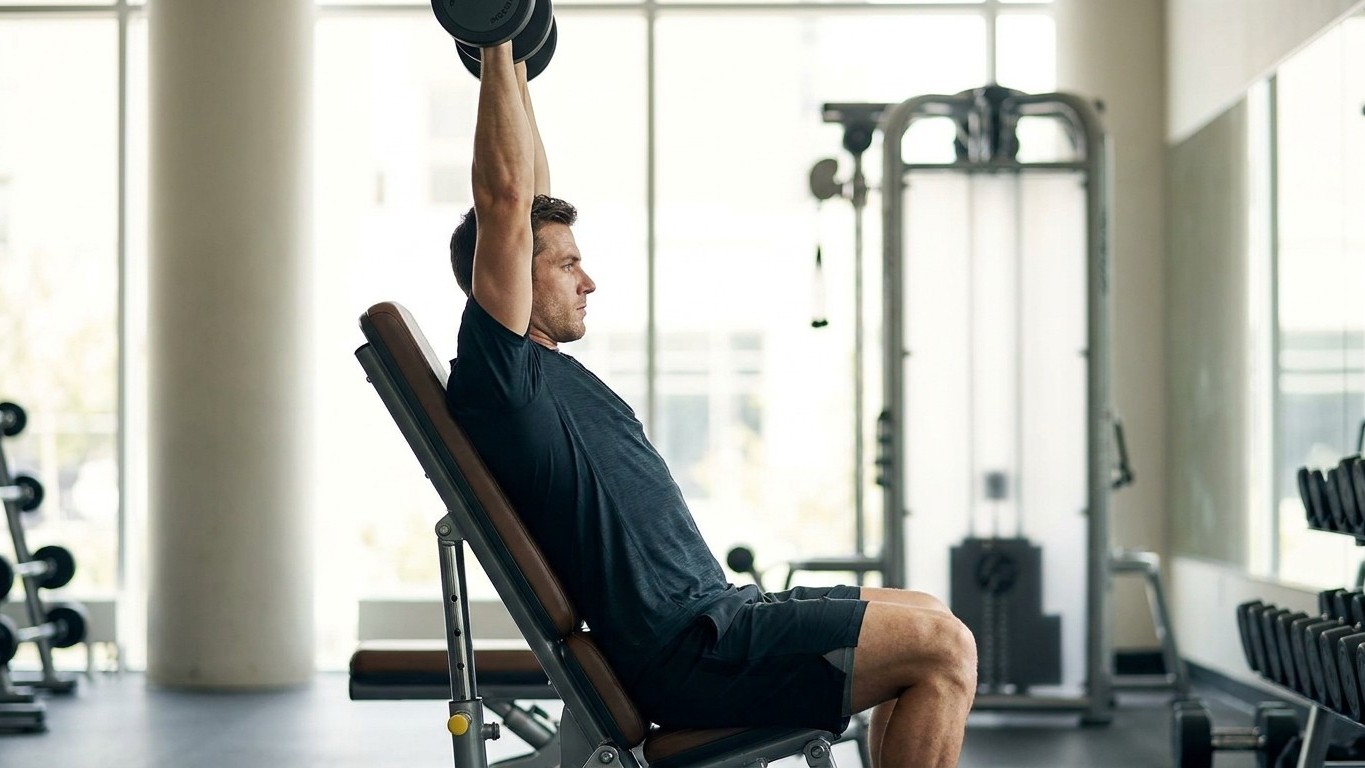
Excessive lumbar extension during overhead pressing is one of the most common, and most quietly damaging, habits in recreational weight training. It feels strong. The bar goes up, the ego stays intact, and nobody in the gym flags it as a problem. But that dramatic arch in your lower back is almost certainly stealing range of motion from your shoulder joint, reducing the actual stimulus to your deltoids, and setting you up for a rotator cuff issue that arrives without much warning.
Key takeaways
- Your lower back arch is cutting your shoulder range of motion short—and you might not even realize it’s happening
- When you fix the arch, you’ll need to drop the weight by 15-25%, exposing how much work your spine was doing instead of your shoulders
- One lifter’s shoulder growth doubled in 8 weeks after correcting this single habit—here’s the exact protocol
What the arch actually does to your shoulder mechanics
When you hyperextend the lumbar spine during an overhead press, you effectively tilt your entire torso backwards. The bar may be travelling vertically relative to the floor, but relative to your body, it’s being pressed at an angle. Your shoulder joint never reaches true overhead position. The range of motion stops short, the deltoid never achieves full elongation at the bottom of the movement, and the upper chest and anterior deltoid take on a disproportionate share of the load. You’re essentially turning a shoulder exercise into a very awkward incline press.
The shoulder joint relies on what physiotherapists call a “stable base of support” from the thoracic spine and scapulae. When the lumbar spine compensates with excessive extension, the scapulae tend to wing outward and tilt anteriorly, which disrupts the normal upward rotation pattern they need for safe overhead movement. The subacromial space, the gap through which the rotator cuff tendons pass, narrows under these conditions. Repeat that pattern for months and you create the conditions for impingement, even if you never feel acute pain until something finally gives.
There’s a useful analogy here: pressing overhead with a severe lumbar arch is a bit like trying to open a door fully while standing at an angle to it. You can push it open partially, but the hinge mechanics are wrong and you’re wearing things out unevenly. The fix isn’t to push harder.
Why correcting it changes the training stimulus completely
Eliminating the arch, typically by bracing the core firmly, slightly posteriorly tilting the pelvis, and keeping the ribcage down rather than flared, forces the shoulder to do the actual work. The movement gets harder immediately. Most people discover, somewhat humblingly, that they need to drop the weight by 15 to 25 percent when they first address this. That drop is diagnostic information, not failure. It tells you how much of your previous pressing was being handled by spinal compensation rather than shoulder musculature.
The deltoid, particularly the middle and posterior heads, responds to stretch-mediated tension. Getting the arm into true overhead position, with the glenohumeral joint in full flexion and the scapula properly upwardly rotated, creates the mechanical conditions for genuine hypertrophic stimulus. Research on muscle growth increasingly points to the importance of training through a full range of motion, with load applied at longer muscle lengths, as a driver of hypertrophy. Cutting the range short by arching isn’t just a postural quirk; it’s leaving growth on the table.
One practical marker worth knowing: if you can see daylight between your lower back and a flat wall when you press, the arch is excessive. A simple test before you load the bar.
The eight-week correction protocol that actually works
Correcting an ingrained pressing habit takes more than good intentions. The arch often persists because of genuine mobility restrictions in the thoracic spine and hip flexors, not just motor pattern laziness. Spending five to ten minutes before each pressing session on thoracic extension mobility work, using a foam roller placed perpendicular to the spine across the mid-back, makes a measurable difference to what’s available when you actually press. Tight hip flexors pull the pelvis into anterior tilt and make the lumbar arch almost reflexive under load, so addressing these with sustained stretching is part of the same problem.
For the pressing itself, the seated dumbbell press is a genuinely useful corrective tool, partly because the back support of a bench makes excessive arching immediately obvious and harder to sustain. Performing the movement in front of a mirror, or recording a side-on video, removes the self-deception that’s easy to maintain when you’re focused on the effort of lifting. Many people are genuinely shocked to see how severe their arch has been.
The landmine press deserves a mention here. The angled pressing pattern it creates is more forgiving of thoracic mobility limitations than a strict vertical press, while still training the deltoid through a meaningful range. It’s a sensible bridge exercise during the weeks when you’re rebuilding the movement pattern from scratch.
Progressing back to heavier loads should be gradual, and the test should always be positional: can you maintain a neutral spine under this weight? If the answer is no, the weight is too heavy for your current movement quality. That’s not a permanent verdict; it’s a current limitation.
The rotator cuff dimension people overlook
Correcting pressing mechanics does more than improve shoulder aesthetics. The rotator cuff muscles, particularly supraspinatus and infraspinatus, function as dynamic stabilisers of the glenohumeral joint. When pressing mechanics are poor, these muscles work harder as stabilisers to compensate for the compromised position, leaving less capacity for their actual job. Over time this creates a fatigue and load pattern that’s quite different from what the tissue was designed to handle.
A point that often surprises people: the rotator cuff tendons have relatively poor blood supply compared to larger muscles, which means they heal slowly when irritated. Prevention through mechanics is considerably more time-efficient than rehabilitation after the fact. Four to six months of recovery from rotator cuff tendinopathy is not unusual, and that estimate assumes you stop aggravating it promptly once it’s diagnosed. Consult your GP or a physiotherapist if you’re experiencing shoulder pain, particularly with overhead movements, before assuming it will resolve on its own.
One final detail worth holding onto: grip width matters more than most people realise in managing arch tendency. A slightly narrower grip than the standard barbell press grip reduces the demand on shoulder external rotation, makes neutral spine easier to maintain, and shifts more of the work onto the lateral deltoid rather than the anterior. Small adjustment, genuinely different result.