
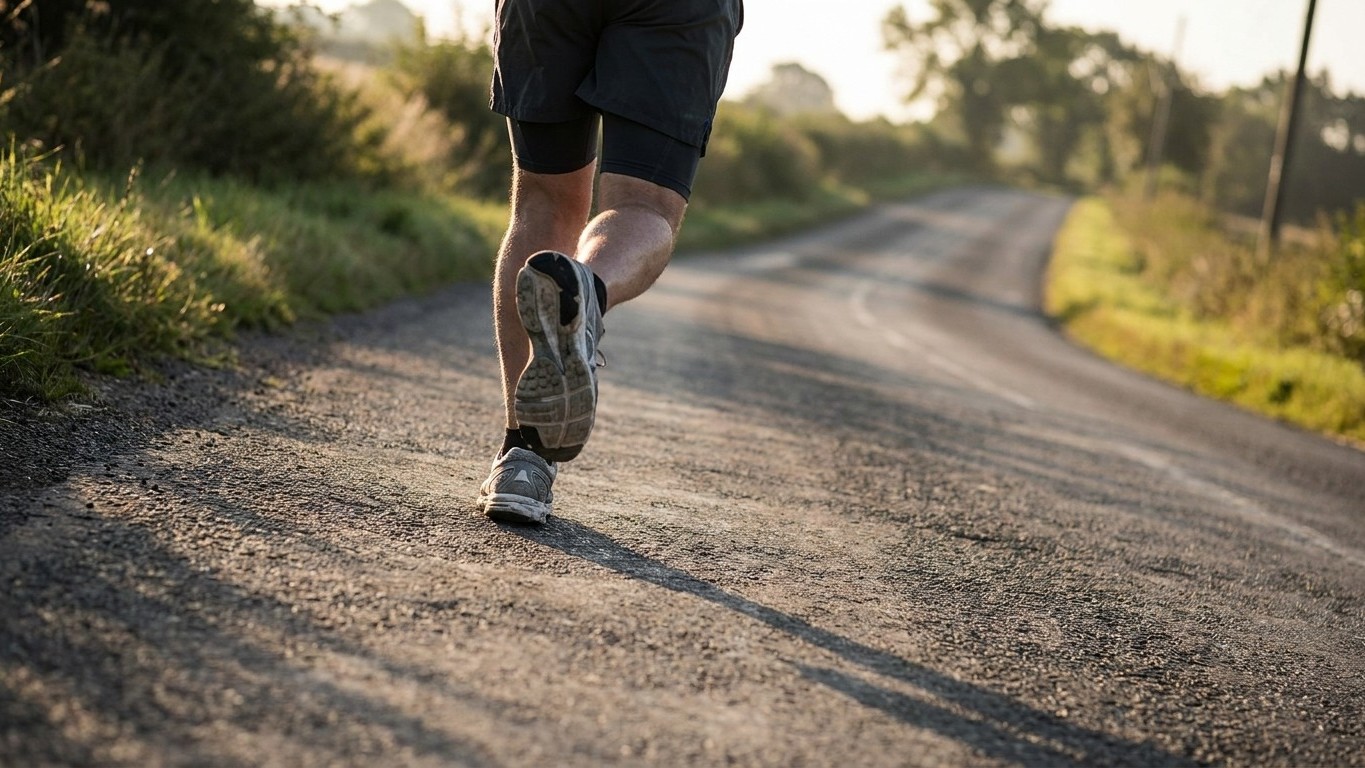
That nagging hip pain that develops around week three of a new running routine is one of the most reliably misunderstood injuries in recreational running. Most people blame their shoes, their pace, or simply “overdoing it.” The actual culprit is often hiding in plain sight, literally beneath their feet: a subtle, consistent gradient in the road surface that their body absorbs thousands of times per outing without ever registering it consciously.
Key takeaways
- Road camber creates thousands of repetitions of asymmetrical loading per run—but why doesn’t it hurt immediately?
- Connective tissue lags behind cardiovascular fitness: your lungs feel fine in week one, but your tendons don’t catch up until week three
- One simple test reveals if camber is your culprit—and it might surprise you how quickly the pain vanishes
Why a 2-degree slope is more stressful than it sounds
Roads are cambered by design. That gentle arc you see on most tarmac surfaces exists to drain rainwater towards the kerb, and it typically runs between 1.5 and 3 degrees. You’d never notice it walking to the shops, but running changes the biomechanical equation entirely. At a typical recreational pace, a runner strikes the ground somewhere between 150 and 180 times per minute per foot. Over a 30-minute run, that’s roughly 4,500 repetitions of the same asymmetrical loading pattern on each leg. A 2-degree camber means your downhill foot lands on a surface that effectively raises your heel slightly relative to your forefoot on one side and lowers it on the other. The hip compensates. Every single time.
The pelvis tilts laterally to accommodate the uneven ground, and the gluteus medius, the muscle on the outer hip responsible for stabilising the pelvis during single-leg stance, works harder on the uphill side to prevent an excessive drop. Repeat this 4,500 times per session, three or four times per week, and you have a recipe for cumulative overload that doesn’t announce itself until the tissue is genuinely irritated. Research on iliotibial band syndrome and greater trochanteric pain syndrome, two of the most common lateral hip complaints in runners, consistently identifies asymmetrical loading as a contributing factor. The pain doesn’t appear on day one because the body adapts, up to a point.
The week-three phenomenon
There’s a reason this pattern tends to surface around the third week of a new running block rather than the first session. Connective tissue, specifically tendons and the iliotibial band, adapts more slowly than cardiovascular fitness or muscular strength. Your lungs feel capable, your legs feel willing, and so you continue pushing the same route at the same pace. The tendon, however, is still catching up. Sports physiotherapists often describe this as the “fitness-tissue lag,” where perceived capacity outpaces Structural readiness.
The gluteus medius tendon, which attaches to the greater trochanter (the bony prominence you can feel on the outer upper thigh), is particularly susceptible to compressive load when the hip adducts across midline, which is exactly what happens on a cambered surface. A 2023 analysis of lateral hip tendinopathy presentations found that unilateral symptoms, pain on one side only, were strongly associated with habitual asymmetrical training environments, including cambered roads. The fact that most UK runners run on the left side of the road means the left hip consistently occupies the lower, more adducted position, which partially explains why left-sided hip complaints are disproportionately reported among road runners who stick to a single consistent route.
How to identify whether camber is your problem
The diagnostic clue is specificity. If your hip pain appears consistently on the same side, worsens towards the end of your run, and eases on rest days, but returns the moment you resume the same route, the surface gradient deserves serious attention before you consider other explanations. A genuinely useful test is to reverse your route, running the same distance but in the opposite direction, so the cambered road now tilts the other way. If your discomfort shifts to the opposite hip or diminishes substantially, you have strong circumstantial evidence that camber is the primary driver.
Running on a flat surface, such as a running track, a towpath, or even a smooth car park, for one week and monitoring whether symptoms resolve is another practical way to isolate the variable. Many runners are surprised to discover their hip pain disappears almost entirely when the surface changes, even though nothing else about their training has been altered. This kind of systematic self-investigation isn’t a substitute for assessment by a physiotherapist, but it can provide genuinely useful information to bring to that appointment.
Please do consult your GP or a chartered physiotherapist if you have persistent hip pain, particularly if it disturbs your sleep or is accompanied by groin discomfort, as these can indicate conditions that require clinical evaluation.
Practical adjustments that actually help
The most straightforward fix is route variation. Alternating your running direction on out-and-back routes distributes the cambered load symmetrically across both hips over the course of a week. Running on trails or paths without consistent camber, even once or twice per week, gives the overloaded structures genuine recovery time. Some runners find that temporarily increasing the proportion of off-road running during a rehabilitation phase resolves the issue without any other intervention.
Strength training for the gluteus medius is well-supported by research as both a treatment and a preventive measure. Lateral band walks, single-leg deadlifts, and side-lying hip abduction exercises target the precise muscle that struggles on a cambered surface. The goal isn’t just strength in isolation but stability under load, so incorporating single-leg exercises that mimic the demands of running stance tends to produce better functional results than exercises performed lying flat.
One detail that often surprises people: the speed at which you run on cambered surfaces matters. Faster running increases ground reaction forces and reduces the time available for the hip stabilisers to respond, amplifying the asymmetrical stress. Slowing down on sections of obvious camber, particularly during a return from pain, isn’t defeat. It’s load management with a purpose.
The broader point, and one that biomechanics researchers have been making for years, is that the most injurious training errors in recreational running are rarely dramatic. They’re quiet, repetitive, and completely invisible to the runner until week three arrives and the hip finally says something.