
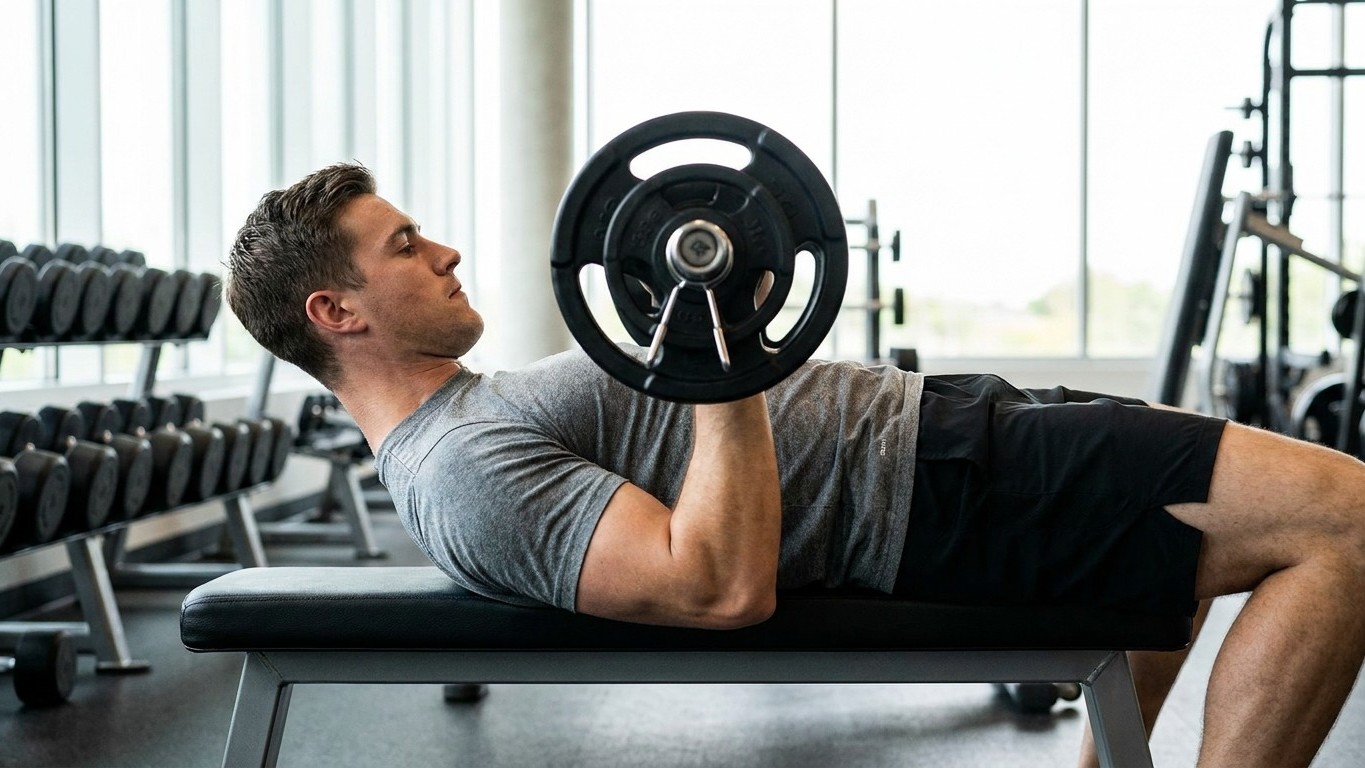
Your grip width on the bench press does far more than determine how comfortable your wrists feel. According to biomechanical research, the distance between your hands directly influences which muscles take the brunt of the load, and a grip that is too wide or too narrow can shift the primary work away from the pectorals entirely. Coaches who work with beginner and intermediate lifters consistently flag this as the single most common technique error they see, and the consequences go beyond aesthetics: reduced chest development, increased shoulder strain, and a plateau that has nothing to do with effort or programming.
Key takeaways
- One grip mistake cuts chest activation nearly in half and shifts all the work to your shoulders
- Coaches reveal the exact hand position (1.5x shoulder width) that restores mechanical advantage to your pectorals
- Why paused reps expose your grip mistake instantly—and how to fix it before shoulder pain arrives
Why grip width changes everything about the movement
The bench press is, in theory, a horizontal pushing exercise targeting the pectorals, anterior deltoids, and triceps. But the pectorals only function as the dominant mover when the shoulder joint is positioned to allow maximum horizontal adduction, which is the action of bringing the upper arm across the body. A grip that is excessively wide places the elbows in a highly abducted position, reducing the range through which horizontal adduction can occur. The chest never fully lengthens at the bottom of the movement, and it never fully shortens at the top. You are essentially pressing with your anterior deltoids and letting your pectorals along for the ride.
A grip that is too narrow creates a different problem. The triceps dominate, the elbows track close to the torso, and the pressing angle starts to resemble a close-grip bench press, which is a perfectly valid triceps exercise but not what most people believe they are doing. The chest contributes, but less than it should. Research published in the Journal of Strength and Conditioning Research has examined how grip width affects muscle activation during the bench press, with findings consistently showing that a moderate grip, roughly 1.5 times shoulder width measured between the index fingers, produces the greatest electromyographic activity in the pectoralis major. That is not a trivial difference in practice.
The specific mistake coaches keep correcting
The most common error, by a considerable margin, is gripping too wide. There is a cultural logic to it: a wider grip feels more powerful, the bar path looks more direct, and many lifters have seen images of powerlifters using very wide grips to shorten the range of motion. What those lifters are optimising for, however, is the maximum weight moved from point A to point B, not chest hypertrophy. The rules differ depending on the goal.
When a lifter grips at or beyond the smooth-to-knurling transition on a standard Olympic barbell, their elbows tend to flare out past 90 degrees relative to the torso. At that angle, the shoulder joint is under considerable stress and the pectorals are mechanically disadvantaged. The load gets distributed to the anterior deltoid and the rotator cuff becomes a stabiliser under significant shear force. Over time, this is a reliable route to shoulder impingement. Coaches describe watching this happen repeatedly: a client reports pressing more weight than ever while complaining that they cannot feel their chest working. Both observations are entirely consistent with what the biomechanics predict.
The correction is simple but requires deliberate practice. Moving the grip inward so the index fingers sit roughly 1.5 to 2 times shoulder-width apart, then actively tucking the elbows to approximately 45 to 75 degrees from the torso rather than letting them flare, restores the mechanical advantage of the pectorals. Many lifters experience a genuine shock at how much harder their chest works at a lower weight. That sensation is the muscle doing its job.
What to do with your wrists, elbows, and bar path
Grip width is only part of the picture. The way the bar sits in the hand matters too. A common secondary fault is holding the bar high in the palm, near the fingers, which creates excessive wrist extension and a torque that travels directly into the wrist joint. Coaches uniformly recommend a straight, neutral wrist position, with the bar sitting low in the palm directly over the forearm bones. This protects the wrist. Also, improves force transmission through the pressing movement.
The elbow path during the descent is where the grip width decision becomes visible in real time. With a moderate grip and tucked elbows, the bar should travel to the lower chest, roughly the nipple line, rather than the mid-chest or clavicle. This is not arbitrary. The angle of force application at that contact point is better aligned with the fibre orientation of the sternal head of the pectoralis major, which is the large, visually prominent portion most people are trying to develop. A bar landing higher on the chest is often a sign the elbows have drifted forward, which again reduces pectoral contribution.
Paused reps can be a useful diagnostic tool here. Pausing at the bottom for one to two seconds removes the elastic rebound of the stretch-shortening cycle and forces you to actually feel which muscles are under load. If you pause and feel primarily your shoulders working, your grip is almost certainly too wide. If you feel a deep stretch through the pectorals and find the press genuinely hard to initiate from the bottom, the mechanics are closer to where they should be.
One detail worth knowing: the optimal grip width is not identical for everyone. Lifters with longer arms or broader shoulders may find that the 1.5x guideline places their elbows slightly differently than it does for someone with a narrower frame. The target is not a specific Measurement on the bar but a specific elbow angle, roughly 45 to 75 degrees of abduction at the bottom of the lift. Using that angle as the reference point, rather than a fixed finger position, tends to produce better individual calibration and, over time, noticeably more chest development.
Please consult your GP or a qualified physiotherapist if you experience shoulder, wrist, or elbow pain during pressing movements.