
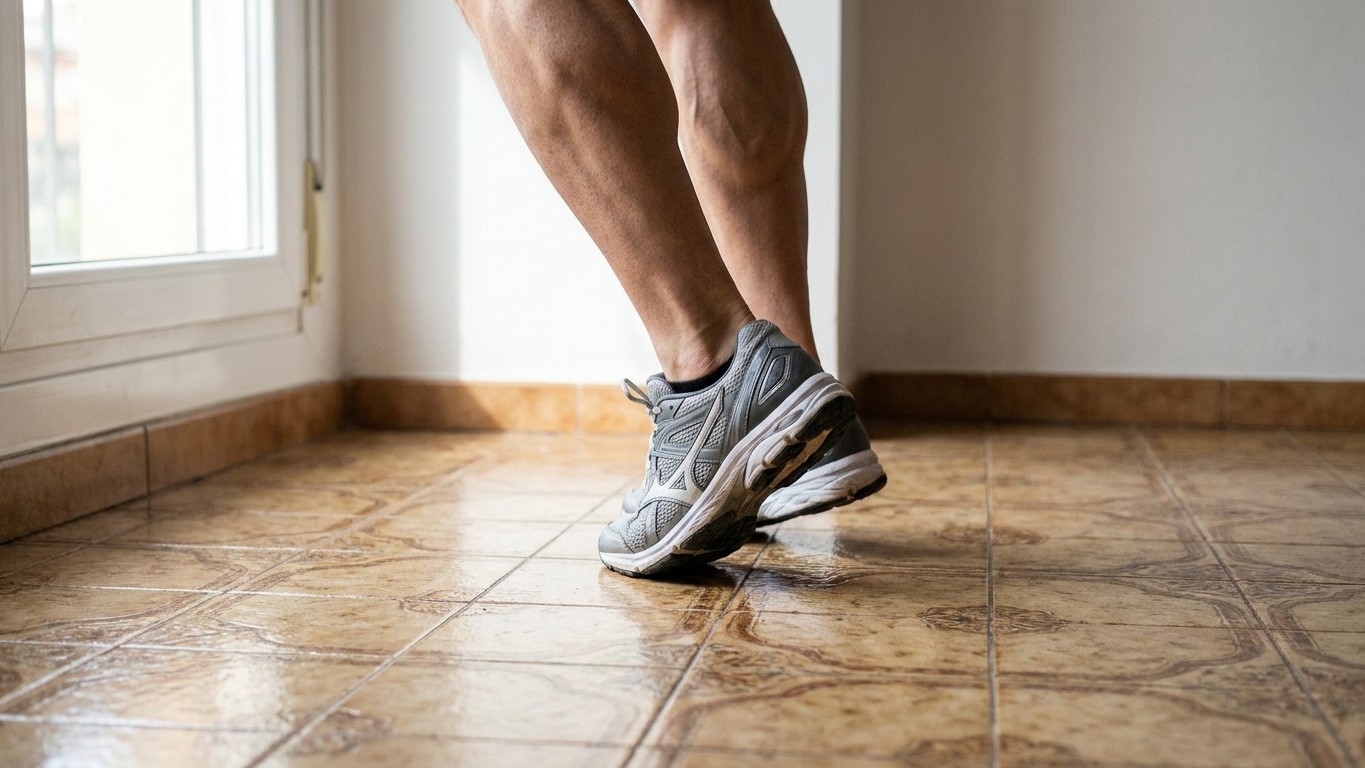
That dull ache running up the front of your shin after a skipping session isn’t fatigue settling into tired muscles. It’s the tibial periosteum, the thin fibrous sleeve wrapped around your shin bone, being repeatedly jarred by ground reaction forces that a hard tile floor simply refuses to absorb. Medial tibial stress syndrome is an overuse injury characterised by diffuse tibial anteromedial or posteromedial surface subcutaneous periostitis, usually alongside underlying cortical bone microtrauma. In plain terms: the lining of your shin bone becomes inflamed because it’s taking a battering it wasn’t built to absorb, jump after jump, on a surface with zero give.
Key takeaways
- Hard tile floors send 100% of impact force straight into your shin bone, while softer surfaces absorb the shock
- The pain often fades when you stop, which is exactly why people ignore it until it becomes serious
- Women are significantly more susceptible to shin splints than men, according to clinical data
What’s really happening under the skin
Skipping rope involves hundreds, sometimes thousands, of small vertical impacts per session. On grass, sprung flooring or a rubber mat, some of that force gets absorbed before it reaches bone. Tile, laminate or concrete send almost all of it straight back up through the ankle and into the tibia. MTSS is characterised by exercise-induced pain along the medial tibial border, involving repetitive microtrauma to the tibialis posterior, soleus and flexor digitorum longus muscles, alongside irritation of the tibial periosteum, resulting in localised inflammation. That’s the mechanism behind the ache you’re dismissing as “tired legs”: it isn’t muscular exhaustion, it’s the outer bone lining reacting to repeated micro-trauma.
What makes this trickier to spot early is that the pain often fades once you stop and warms up again as you resume, which is exactly why so many people push through it for weeks before realising something’s wrong. The discomfort is normally worse the next day, subsiding gradually, and is commonly felt in the middle of the medial tibia, though it can impact the entire length of the leg. If left unaddressed, that dull soreness can tip into something more serious. Continuous pain can lead to stress fractures if preventive action isn’t taken, as these are small tiny breaks in bone that develop over time due to excessive repetitive forces.
Why the surface matters more than most people think
It’s tempting to blame technique alone, but the flooring beneath your feet is doing more damage than most home skippers realise. Hard surfaces like concrete or asphalt are often the leading cause of shin splints, because concrete is very dense and offers no shock absorption when you land, putting more stress on your joints compared with softer surfaces like rubber or wooden flooring. Kitchen tile behaves the same way as concrete in this respect: dense, unforgiving, with no capacity to flex under load.
This isn’t a fringe theory dreamt up by fitness bloggers, either. Official clinical guidance lists surface as one of several recognised contributing factors. There are certain things that have been suggested that may make shin splints more likely, including a sudden increase in training frequency or intensity, a lack of calcium, hard running surfaces, and previous leg injury. Paediatric sports medicine specialists echo this: training errors, shoe wear, and changes in training intensity, duration, and surface can all contribute to the development of medial tibial stress syndrome.
Who’s actually affected isn’t a small, niche group either. Shin splints affect between 13.6% and 20% of runners and contribute to up to 60% of lower limb injuries. Among people doing repetitive impact training, the numbers can be startling. MTSS is highly prevalent among military recruits, with an incidence ranging from 35% to 56%. Women appear more susceptible too, with research noting the condition is quite common and occurs more often in females, a pattern confirmed by other cohort data showing shin splints were seen in more females (55.3%) than males (44.7%).
Telling shin splints apart from something worse
Here’s where I’d urge a bit of caution rather than self-diagnosis from a wellness article, however evidence-based. The line between “annoying but manageable” shin splints and a genuine stress fracture isn’t always obvious to the person experiencing it, which is precisely why it catches people out. Clinicians typically rely on more than symptoms alone. Medial tibial stress syndrome is diagnosed based on a review of the patient’s history and physical examination of the lower leg, X-rays appear normal in people with shin splints, and if the doctor is unsure of the diagnosis, an MRI or bone scan may be used to rule out a more serious condition such as a stress fracture. Diffuse tenderness along a wide stretch of bone tends to point towards MTSS, whereas a very localised, pinpoint spot of pain is more of a red flag for a fracture. If skipping on tile has left you with persistent, worsening pain rather than the dull soreness that settles with rest, that’s a conversation for your GP or a physiotherapist, not something to push through with painkillers and hope.
What actually helps, beyond swapping the floor
The obvious fix is the flooring itself. Jumping rope exercises should not be performed on very hard surfaces such as concrete; instead, opt for a rubber mat or wooden floor, as they help reduce the pressure on your musculoskeletal system. A cheap interlocking foam mat or even a folded yoga mat under your feet makes a genuine difference, and it costs a fraction of what a physiotherapy course will.
Footwear matters just as much as flooring, and it’s the bit people skip because they’re “only doing five minutes.” Invest in supportive jump rope shoes that offer good cushioning and stability, and avoid flat shoes or running shoes that lack proper support for this type of activity. Technique plays its part too: landing softly on the balls of your feet with slightly bent knees helps absorb impact, while landing heel-first puts excessive stress on the shins.
Beginners also tend to overestimate how high they need to jump. Many jumping rope newbies think that jumping higher makes the exercise more fruitful, but the higher your jump, the bigger the risk of tearing ligaments or developing shin splints; a good place to start is jumping just high enough for the rope to pass under.
If you’ve already got that telltale ache, the standard advice from sports medicine is unglamorous but effective. Rest is the main treatment for shin splints, meaning reducing and often completely avoiding the activity that led to them, while switching to non-impact exercises such as cycling or swimming can be a good way to maintain fitness in the meantime. Once symptoms have properly settled, rather than the moment they merely fade, reintroduce skipping gradually on a forgiving surface, in proper shoes, keeping jumps low and short. And if the pain doesn’t shift after a week or two of rest, or if it’s sharply localised rather than diffuse, get it checked by a GP or physiotherapist rather than guessing. Bone doesn’t forgive being ignored twice.
Sources : rxsmartgear.com | honorathletics.ca