
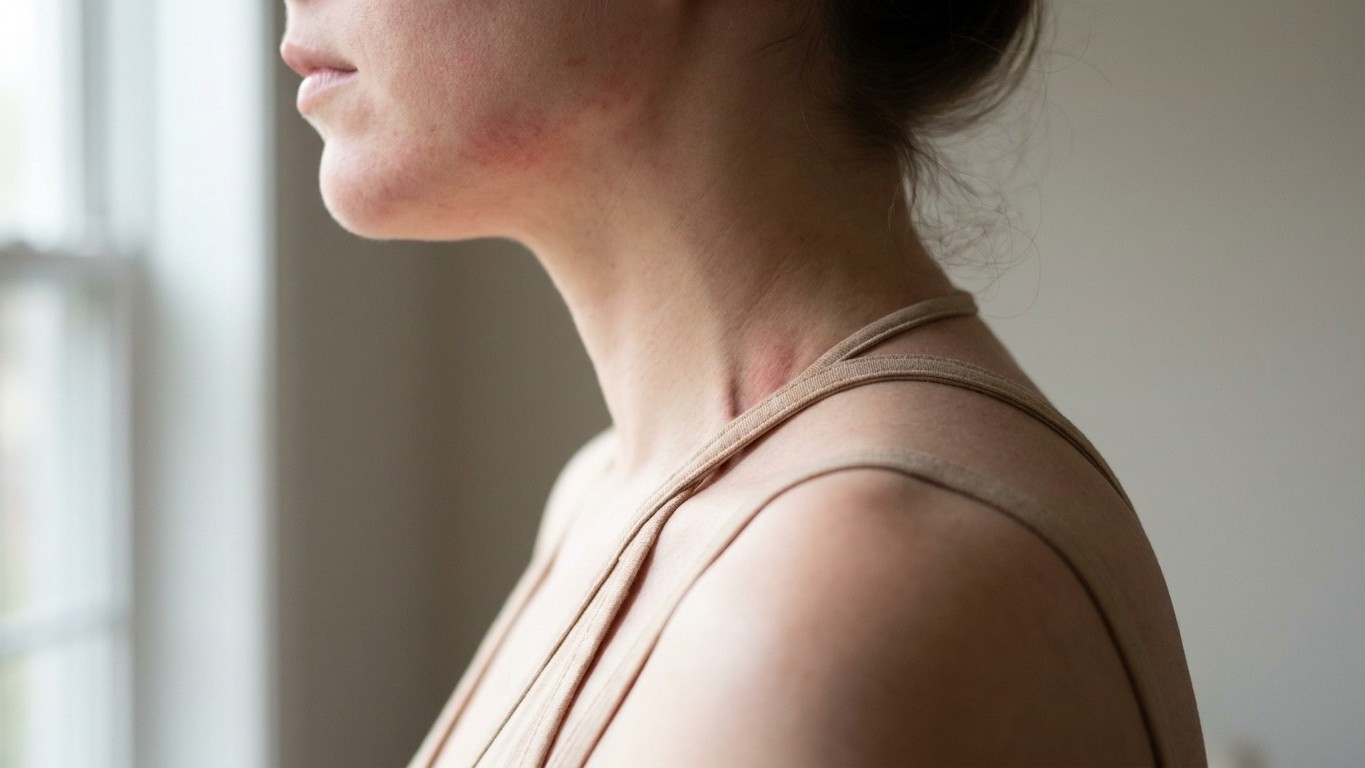
Every dermatology forum is full of women swearing their jawline breakouts are “hormonal”, timed to their cycle, impossible to shift. Sometimes that’s true. But a huge number of these stubborn chin and jaw spots have nothing to do with oestrogen or testosterone at all. They’re caused by something far more mundane: a strap, a collar, a helmet chin guard or a face covering pressing against the same patch of skin, day after day, for exactly the same hour.
Dermatologists have a name for this: acne mechanica. It’s a type of acne caused by frequent friction or pressure against the skin. Unlike acne vulgaris, which is commonly caused by underlying hormonal changes, acne mechanica is directly caused by “mechanical” means. In plain English, it’s not your hormones misbehaving. It’s your skin being irritated, heated and rubbed until it revolts.
Key takeaways
- The spots on your jaw might follow a perfectly straight line you’ve never noticed
- One hour of daily friction from a strap, bra, or mask can escalate a minor bump into a cyst by Friday
- Removing the trigger works faster than any skincare routine designed to fix hormonal acne
Why one hour of rubbing can undo a whole skincare routine
The mechanism is almost embarrassingly simple. When heat and sweat are trapped on your skin, bacteria can thrive and pores can get clogged. As the equipment or clothing rubs against your heated skin, it can cause irritation and new breakouts. A strap doesn’t need to be tight to cause damage. It just needs to sit against the same spot long enough, generating friction and trapping warmth underneath it, for a follicle to become inflamed.
What starts as barely noticeable often escalates quickly if the pressure continues. When the skin is constantly rubbed, it initially becomes rough and then starts to develop acne-like bumps with continuing irritation like sweating or more friction. If the skin continues to be irritated for a longer period of time, a more serious acne lesion develops that grows in size and redness. That’s why a breakout that seemed minor on Monday can look like a proper cyst by Friday, especially if the same strap keeps returning to the same square centimetre of jaw.
The tell-tale sign hormonal acne doesn’t have: a straight line
This is the detail I find genuinely useful when people ask me to help them work out what’s going on. Hormonal acne tends to cluster in oil-rich zones and follows an internal rhythm, flaring around ovulation or before a period. Friction-driven acne behaves completely differently. Hormonal acne follows your internal cycle and appears in zones rich with oil glands regardless of external contact. Acne mechanica ignores hormonal timing entirely, it flares when you wear the triggering equipment and often improves during rest periods.
There’s also a spatial signature worth checking for. Because it’s triggered by external friction, acne mechanica tends to have a linear distribution. if your forehead breakouts line up with your bike helmet, it might be acne mechanica. Run your finger along your jaw and ask yourself honestly: does that row of spots follow the exact path of a bra strap crossing your shoulder up to your neck, a bag strap, or the elastic of a mask? If the answer is yes, hormones probably aren’t the main culprit.
The everyday straps nobody thinks to blame
People picture rugby chin straps and cycling helmets when they hear “acne mechanica”, but the more common offenders in daily life are far quieter. Chin straps from football helmets create breakouts along the jawline. Backpack straps generate spots where weight presses fabric against skin during movement. Tight clothing causes problems when synthetic materials that don’t breathe well trap sweat against skin during exercise. Musicians aren’t spared either: musical instruments held against the face, like violins pressed under the chin and jaw, create one-sided breakout patterns that musicians recognise immediately.
Bra straps deserve particular attention, because the skin-to-fabric contact is prolonged and often unnoticed. Friction, or rubbing, caused by tight clothing and repetitive pressure, such as backpack straps rubbing against shoulders, can lead to a type of acne known as ‘acne mechanica’. A consultant dermatologist quoted in one industry piece put it plainly: “Tight clothing mixed with friction and excess moisture, such as sweat, can lead to the development of acne.” Add a phone jammed between shoulder and ear during long calls, tight-collared shirts, cycling helmet straps, or the elastic of a face mask, and you have a long list of one-hour habits that could be quietly seeding jawline spots without a single hormone involved.
What actually helps, without waiting for your cycle to change
The reassuring part of all this is that friction acne responds fast once the trigger is removed, which is a useful diagnostic tool in itself. Try loosening the offending strap, swapping to a wider or padded version, or simply removing it sooner after exercise, and watch what happens over the following week. Wear loose-fitting clothes whenever possible. Reach for moisture-wicking fabrics with the ability to quickly absorb sweat. Place clean, soft padding between your equipment and skin. Something as small as adding a soft strap cover to a rucksack can make a genuine difference.
Hygiene around the gear itself matters more than people assume. You should wash your hats and helmets frequently to stop sweat and grime from sitting against your forehead. Rinse off as soon as you finish your workout to keep sweat from drying on you. For anyone who wears a mask for long shifts, glasses that press into the cheeks, or a headset for hours of calls, the same logic applies: clean the contact surface regularly, and give your skin windows without pressure whenever you can.
If you’ve adjusted every strap, changed fabrics and cleaned your kit, and the jawline spots are still deep, painful and cyclical, that’s genuinely worth a conversation with your GP or a dermatologist, since true hormonal acne can need targeted treatment. But before assuming your endocrine system is to blame, it’s worth spending one week simply noticing which strap, collar or headset sits against your jaw for longest. Quite often, the answer to a “mystery” breakout has been resting against your skin for an hour at a time, all along.
Sources : clearritual.com | ncbi.nlm.nih.gov