
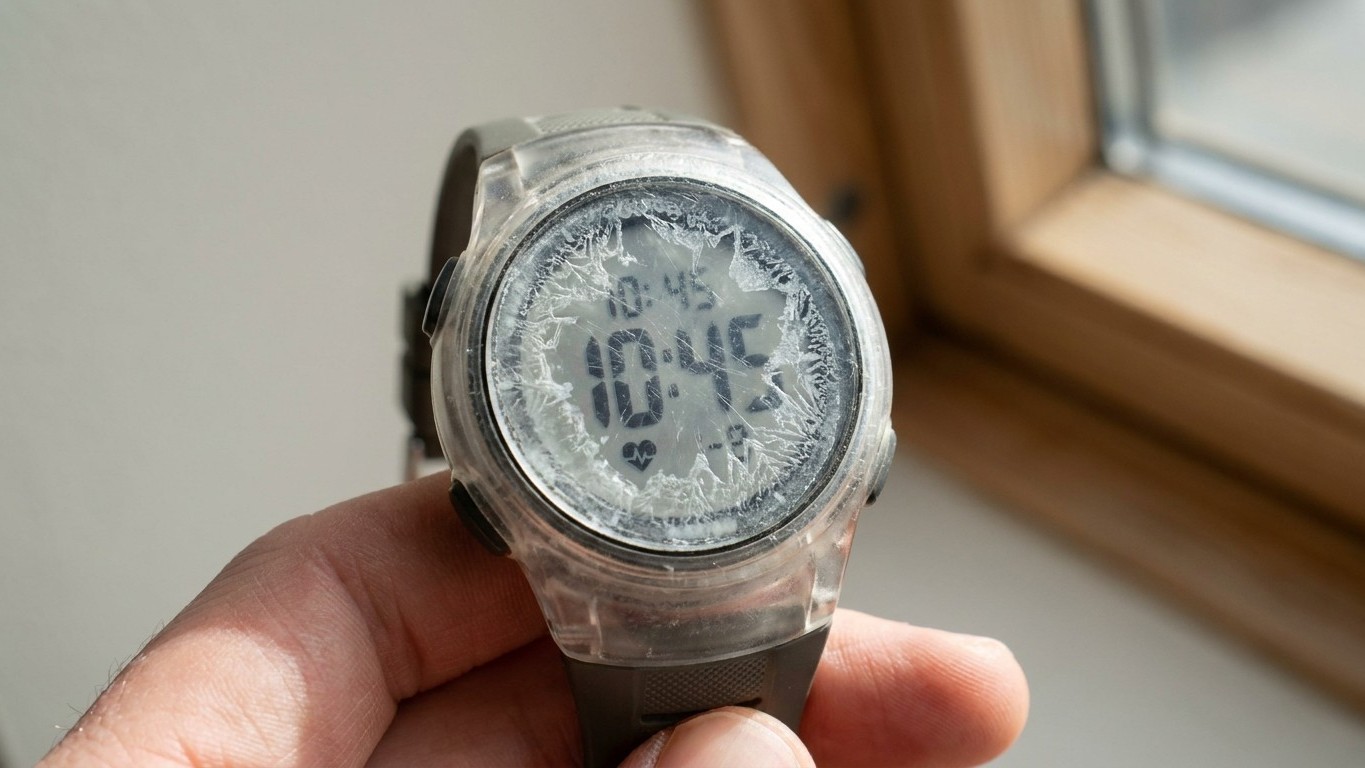
By the time she noticed the milky, spider-webbed patch spreading across her sports watch, the damage was already done. Three weeks of nightly spritzing before evening runs had quietly dissolved the plastic lens without her ever seeing it happen in the dark. What looked, in daylight, like a crack or a scratch was actually something closer to a chemical burn: the repellent had melted the surface of the watch face.
This is not a freak accident. It is a well-documented, entirely predictable reaction between one of the world’s most common insect repellents and the plastics we wear every day. DEET is a plasticizer and can damage certain rubber, plastic, vinyl, or elastic materials such as contact lenses, eyeglass frames and lenses, watch crystals, combs, painted and varnished surfaces, and certain synthetic or treated fabrics. If you run at dusk with bare, sprayed arms swinging past a plastic watch face, you have almost certainly created the exact conditions for this kind of damage.
Key takeaways
- A common insect repellent silently destroyed outdoor gear without the wearer noticing until daylight revealed the damage
- The chemistry behind why this happens is deliberate and predictable—but almost nobody knows about it before it’s too late
- There’s a simple fix that takes seconds, plus a safer alternative ingredient that health authorities recommend just as highly
Why DEET eats plastic but leaves cotton alone
The chemistry here is straightforward, if a little unnerving once you understand it. DEET gives off an odour that many people find unpleasant, leaves the skin greasy and can dissolve plastics and synthetic fabrics. It behaves as a solvent rather than an abrasive, meaning it does not scratch a surface so much as break down its molecular structure from the outside in. If you get it on your fingers and hands, it acts as a solvent and may dissolve or permanently fog plastic glasses lenses including sunglasses, watch crystals, or GPS and satellite communicator screens.
What makes this particularly sneaky for runners is the timing. You spray your arms in fading light, the watch sits against your wrist as you move, and the reaction happens gradually over repeated exposures rather than in one dramatic moment. One patent filing on repellent formulations puts it bluntly: it is a powerful plasticizer and will dissolve or mar many plastics and painted surfaces. Forum threads from hikers, campers and watch enthusiasts are full of near-identical stories: a diving watch left unreadable after a spray accident, a GPS touchscreen destroyed, a mandolin’s varnish eaten away simply because DEET-covered hands touched the wood. One outdoors writer switched repellents entirely after growing frustrated with the damage that DEET made to his outdoor navigation gear including watches, compasses, and GPS units, saying it just got expensive to keep replacing after a while.
Natural fibres, by contrast, are essentially immune. DEET in all concentrations can harm outdoor gear and clothing made with synthetics, like nylon and waterproof or breathable membranes, as well as plastics, but it doesn’t harm outerwear or gear made with natural materials, including cotton, wool, aluminium, or steel. That is why a cotton running top survives years of repellent exposure while a synthetic rain jacket, a pair of leggings with spandex, or a plastic watch crystal can degrade within weeks.
The trade-off nobody warns you about
None of this means DEET is dangerous to your skin, and it would be misleading to suggest otherwise. Quite the opposite: it remains one of the most rigorously tested repellents on the market. The Environmental Protection Agency’s most recent review of DEET found no human health or environmental safety concerns, and a review of evidence by the Environmental Working Group found no indication of toxic effects in adults or children. A technical advisor for the American Mosquito Control Association goes as far as calling it “by far the gold standard” for situations where you’ll likely encounter lots of disease-carrying insects, adding that safety concerns “are based on misconceptions from decades ago.”
The real trade-off is material, not medical. DEET can damage plastics, so care is needed when applying it around watches and other gear. Concentration matters for effectiveness against bites, though there’s a ceiling: research summarised for parents notes that 10% DEET provides protection for about 2 hours, and 30% DEET protects for about 5 hours, while anything over 50% DEET does not provide longer protection. So reaching for a stronger bottle purely for durability’s sake buys you nothing extra against mosquitoes, and more risk to your gear given the higher solvent load per spray.
What actually works instead
The simplest fix is sequencing. Spray your arms, wait for the repellent to dry fully (a minute or two, not thirty seconds), and only then strap the watch back on or start your run. Better still, spray onto your palms first and rub it in, keeping the nozzle itself well away from the wrist entirely. If you run with your sleeves down or your watch on the opposite wrist to where you spray, you remove most of the risk without changing your routine at all.
For anyone who runs regularly at dawn or dusk during mosquito season, switching active ingredients solves the problem more permanently. Picaridin is safe to use around plastics, synthetic apparel, and gear with synthetic coatings such as sunglasses, watches, GPS units, or phone screens, and crucially it is not some inferior substitute. It is recommended by the WHO, CDC and the NHS in the UK, among other health authorities, for protection against mosquito bites in the same way as DEET. It also tends to be kinder to skin, since picaridin has the advantages of being not irritating to skin and eyes, devoid of pungent odour, and evaporates from the skin more slowly than DEET, meaning it may repel insects for longer periods.
If your kit includes clothing or gear you specifically want insect-proofed rather than just your skin, there is a separate route entirely. Permethrin can be used to treat clothing and outdoor gear without harming it the way DEET does, sold either as a spray-on treatment or as a liquid to soak items in, and it actually kills mosquitoes and ticks that land on treated fabric rather than simply repelling them. It’s a completely different mechanism from skin repellents, so the two are typically used together, permethrin on the kit, DEET or picaridin on exposed skin, rather than as alternatives to each other.
As for the ruined watch itself, there’s rarely a fix beyond a replacement crystal or a light buff with fine polish if the damage is only superficial fogging rather than pitting. The more useful takeaway sits on your wrist right now: check whether your watch face is genuinely mineral glass or sapphire, both of which shrug off DEET without issue, because a five-second glance at the spec sheet before your next spray could save you the same daylight surprise.
Sources : watchuseek.com | sawyer.com