
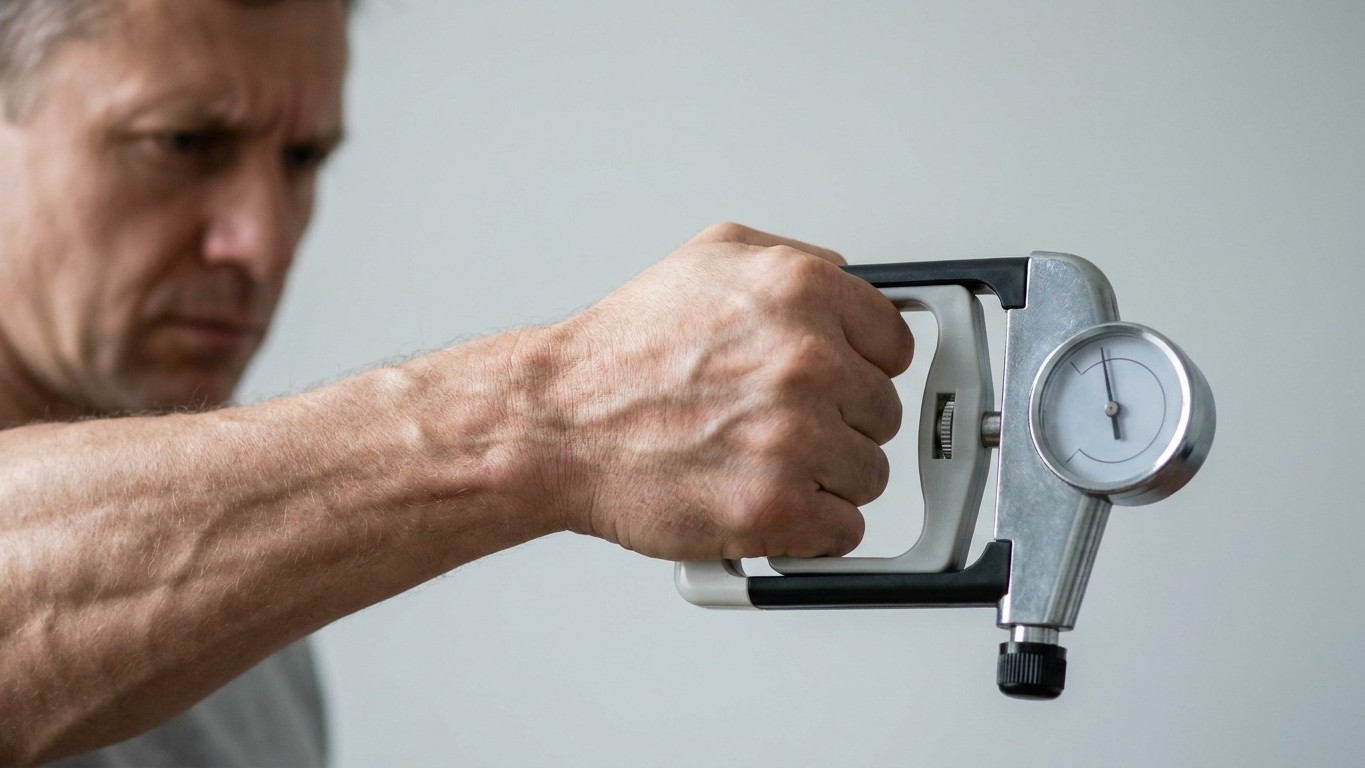
Squeeze a dynamometer for a few seconds and you reveal far more than how many years you’ve spent lifting weights or carrying shopping bags. According to a landmark UK Biobank analysis of 475,397 adults, the strength of your grip tracked closely with how well people performed on tests of memory, reasoning and reaction time, tasks that had nothing to do with muscle power at all. Published by researchers including Joseph Firth and colleagues, this remains one of the largest investigations ever conducted into the link between physical strength and brain function.
The team behind the study, Grip Strength Is Associated With Cognitive Performance in Schizophrenia and the General Population, drew on baseline data from the UK Biobank collected between 2007 and 2010, analysing 475,397 individuals from the general population, and 1,162 individuals with schizophrenia. Participants attended one of 22 assessment centres across the UK, where invitations were mailed out to over 9.2 million homes throughout the UK, recruiting 502,664 adults, aged 37 to 73. Once there, they underwent physical measurements, questionnaires and face-to-face interviews, a scale of data collection rarely matched in health research.
Key takeaways
- 475,000 people squeezed a dynamometer, and researchers found something unexpected lurking in those numbers
- Weaker grip strength tracked with poorer performance on memory, reasoning, and reaction time tests—none of which involve muscles
- The brain regions controlling grip overlap with those managing cognition, suggesting both decline together as we age
Five mental tests, one physical measurement
What makes this study stand out is the breadth of what it tested. Rather than relying on a single crude screening tool, the researchers used linear mixed models and generalized linear mixed models to assess the relationship between grip strength and five cognitive domains: visual memory, reaction time, reasoning, prospective memory, and number memory, controlling for age, gender, bodyweight, education, and geographical region. That last point matters enormously. By adjusting for education and bodyweight, the researchers weren’t simply capturing “fitter people tend to be smarter too” as a lazy correlation. They were isolating something more specific.
The results were consistent across the board. Maximal grip strength was positively and significantly related to visual memory, reaction time, reasoning, number memory, and prospective memory, all with statistical significance below P < .001. In plain terms, people with a weaker squeeze systematically scored worse on tasks measuring how quickly they reacted, how well they solved abstract puzzles, and how reliably they remembered lists of numbers or planned tasks for later. The pattern held even among a smaller subgroup of participants living with schizophrenia, where grip strength was strongly related to visual memory and reaction time, a population known to experience pronounced cognitive difficulties.
Why muscle and mind move together
The obvious question is why. Grip strength doesn’t directly power your working memory, so what’s actually going on beneath the surface? The most compelling explanation comes down to shared biology rather than shared behaviour. The brain regions that coordinate fine motor control, including grip, overlap substantially with those involved in processing speed and executive function. Research from the US National Institute on Aging notes that grip strength also can weaken due to age-related changes in parts of the brain that coordinate movement, and these same areas of the brain also correspond to cognition. Rather than one causing the other, both may simply be downstream symptoms of the same underlying neurological wear and tear.
A separate UK Biobank study looking at brain scans in over 40,000 participants adds weight to this idea. It found widespread associations between stronger grip strength and increased grey matter volume, especially in subcortical regions and temporal cortices, precisely the areas that support memory and processing. That same research followed people over time and discovered something worth pausing on: baseline grip strength was related to cognitive performance at roughly nine years follow-up, while the reverse effect was much weaker. Weak grip strength today appears to be a better predictor of tomorrow’s cognitive performance than the other way round, which is precisely why researchers are so interested in it as an early warning marker rather than a mere afterthought of ageing.
There’s a sex difference too, and it’s not a small one. The brain-imaging study found that grip strength of females showed stronger associations with most behavioural outcomes than males. Other research involving thousands of participants has echoed this, observing stronger associations of grip strength in women with fluid intelligence as well as hippocampal volume and white matter hyperintensities. Nobody has fully explained why, though hormonal differences in muscle Maintenance and brain ageing are the leading suspects.
What this actually means for you
None of this means a weak handshake is a diagnosis, and I want to be entirely clear on that point: this is population-level statistics, not a personal verdict. Plenty of people with modest grip strength have sharp minds, and plenty of powerlifters forget where they left their keys. What the data does suggest is that maintaining muscular strength through midlife, particularly the kind involved in gripping, carrying and pulling, may be one of the more accessible ways to support long-term brain health alongside the usual advice about diet, sleep and social connection.
Simple resistance activities count here: gardening, carrying groceries without splitting them into smaller trips, gripping exercises with a stress ball or hand gripper, or basic strength training two or three times a week. None of this requires a gym membership or specialist equipment. If you’re concerned about a noticeable, sudden drop in your own grip strength, particularly alongside memory lapses or slower thinking, that combination is worth flagging to your GP rather than dismissing as ordinary ageing. As always, this article offers information, not a diagnosis, and any specific health worries deserve a proper conversation with a doctor who knows your history.
One detail from the original study rarely gets mentioned: the researchers didn’t just measure grip once. They took the maximum reading across multiple attempts on both hands, precisely because a single squeeze can be thrown off by fatigue, nerves or an awkward dynamometer grip. It’s a small methodological point, but it’s part of why this dataset has held up so well under scrutiny for nearly a decade since publication.
Sources : ncbi.nlm.nih.gov | researchgate.net