
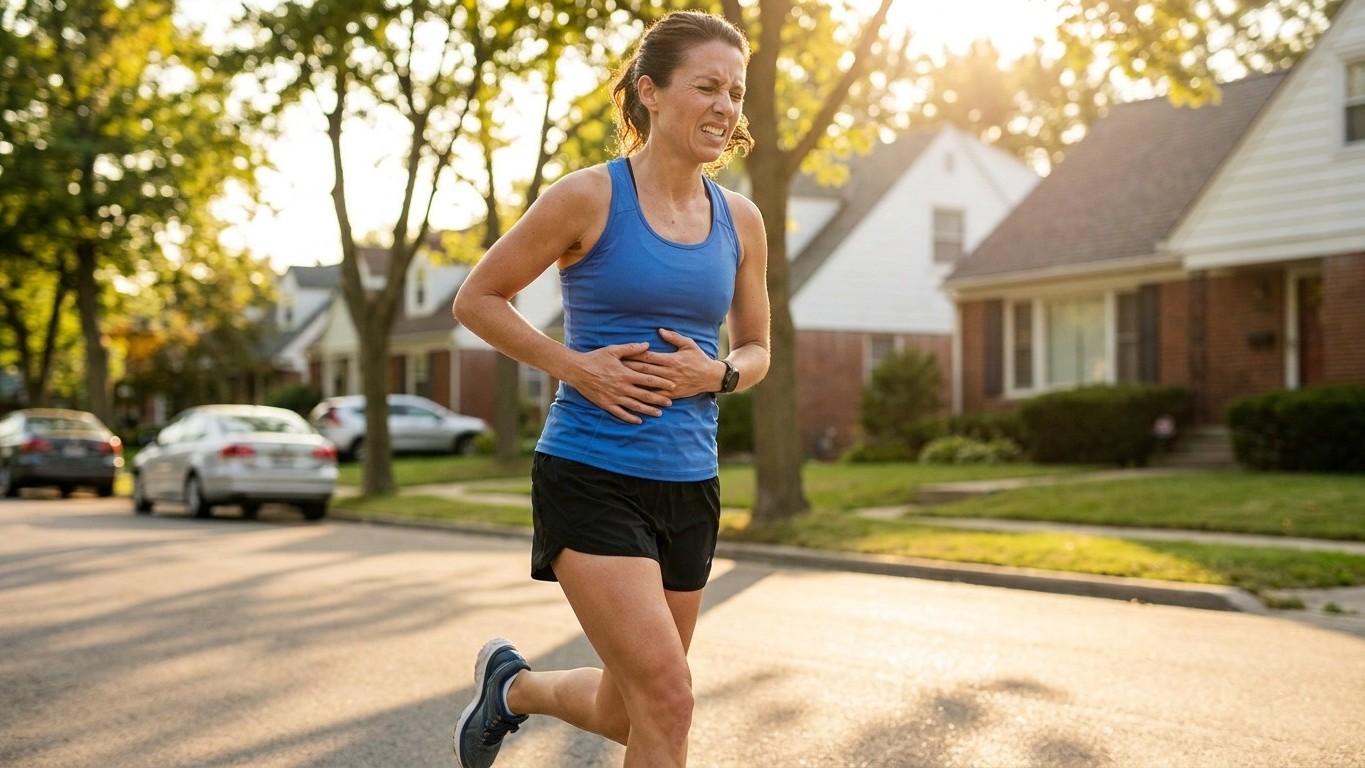
That mid-afternoon run that turns into a gut-wrenching slog has nothing to do with the sun. The real culprit is sitting in your stomach: a sandwich, a wrap, maybe a bowl of pasta, all still being processed by a digestive system that your legs are about to hijack for oxygen. Blood flow delivers the oxygen and nutrients needed to break down your meal, with about 90% of your stomach contents emptying within four hours under normal conditions. Run before that window closes and you’re asking two demanding systems to share resources that simply aren’t available in sufficient supply.
Key takeaways
- Your intestines lose 80% of their blood flow the moment you start running, while your muscles demand 20 times more oxygen than at rest
- A high-fat cheese sandwich stays in your stomach 2-3 hours longer than simple carbs—timing matters as much as what you eat
- Heat amplifies the problem but isn’t the main culprit; intensity and meal timing are far more decisive factors
Your gut loses the blood flow battle
Here’s What Actually happens the moment you start moving. During running, your body redistributes blood flow to your large working muscles, particularly your legs, to provide oxygen and fuel, and this shift directs blood flow away from digestive organs, which can slow digestion and cause discomfort. The scale of this reshuffling is genuinely striking. Blood flow to your gut decreases by a dramatic 80%, while your working muscles receive 20 times more blood than they do at rest. Picture a restaurant kitchen mid dinner rush, suddenly stripped of most of its staff because the front of house needs them more urgently. That’s roughly what happens to your intestines.
This isn’t a minor inconvenience for a small fraction of runners either. Studies show that up to 61% of runners experience some form of gastrointestinal distress, and among marathon runners specifically the figure has been estimated as high as 30–90% depending on the study. Younger runners and those pushing harder efforts tend to notice it more, which fits with the physiology: the harder you run, the more aggressively blood gets pulled from the gut to the muscles.
What was on the plate matters as much as the clock
Not all lunches are created equal when it comes to gastric emptying. Simple carbs like white bread or sports drinks clear your stomach in 30-45 minutes, while complex carbs need 1-2 hours. Fats and proteins are a different story entirely. Proteins and fats significantly slow gastric emptying, and a high-fat meal can delay emptying by 2-3 hours compared to carb-only options. That creamy pasta bake or the cheese-laden sandwich you had at your desk could still be sitting there, largely undigested, when you lace up two hours later. The advice from sports nutritionists is fairly consistent on this point: avoid fatty foods like nuts, cheese, or fried items within 3 hours of training.
Fibre deserves a mention too, since it’s often overlooked. High-fiber foods can cause digestive distress during exercise, and whole grains, beans, and raw vegetables may trigger cramping or bathroom emergencies. So the virtuous lentil salad you had with good intentions might actually be working against you more than a plain chicken and rice lunch would. There’s a broader research-backed guideline worth remembering here: exercising after eating may be okay for some people depending on the type of exercise, but it’s probably best to give your body 1-4 hours to digest the food before you take on anything super strenuous. That four-hour figure isn’t arbitrary. It’s roughly the window many gastroenterology studies use as a benchmark for substantial gastric emptying to occur.
Heat isn’t innocent, but it’s not the main culprit
Blaming the weather is tempting, and there’s a kernel of truth in it. Warmer conditions do send extra blood to the skin for cooling, which competes for the same limited supply your gut is already fighting over. But peer-reviewed research points the finger more firmly at intensity and timing than temperature alone. A systematic review published in the journal Alimentary Pharmacology & Therapeutics found that exercise stress of ≥2 hours at 60% VO2max appears to be the threshold whereby significant gastrointestinal perturbations manifest, irrespective of fitness status, though it did note that the addition of heat stress and running mode appears to exacerbate these markers of gastrointestinal disturbance. So heat is an amplifier, not the trigger. On a cool October afternoon you can still end up doubled over if you’ve run hard on a full stomach.
Intensity itself changes the equation in a measurable way. Older physiological research examining gastric emptying during treadmill exercise found that gastric emptying was similar for all intensities during walking and at 57% and 65% VO2max during running, but running at 74% VO2max decreased the volume of original drink emptied as compared to all lower exercise intensities. In plain terms: an easy jog after lunch is far more forgiving than pushing pace on the same stomach. That stitch under your ribs, incidentally, may not even be about blood flow at all. One theory that’s gained traction proposes that side stitches occur because the gut tugs on ligaments that connect the GI muscles to the diaphragm, with food and drinks that contribute to loading the gut stretching this area, causing tension. Research has also cast doubt on the idea that oxygen-starved breathing muscles are to blame, since respiratory muscle function was unchanged after treadmill exercise even in participants who experienced side stitch during the trial.
Making peace with the post-lunch run
None of this means lunchtime running is off limits, it just means the meal needs rethinking rather than the run itself. A few adjustments make a genuine difference:
- Swap heavy, fatty lunches for something carbohydrate-led and lower in fibre on run days
- Keep portions moderate rather than the biggest meal of your day right before training
- Drop your effort down a notch if you’re running within two hours of eating
- If a big lunch is unavoidable, push the run to the far edge of that four-hour window rather than the near edge
I’d add one more thing from years of writing about this: your gut is trainable. Runners who repeatedly practise eating a similar pre-run meal at a similar interval often report fewer symptoms over time, likely because gastric emptying and gut motility adapt somewhat to familiar patterns. If cramping, nausea or bathroom urgency persists regardless of what or when you eat, particularly alongside blood in stools or severe pain, that’s worth mentioning to your GP rather than putting down to another warm afternoon. Rare cases of exercise-induced gut ischaemia have been documented in high-performance athletes, and it’s always sensible to rule out anything beyond the ordinary before assuming it’s simply lunch getting in the way.
Sources : link.springer.com | researchgate.net