
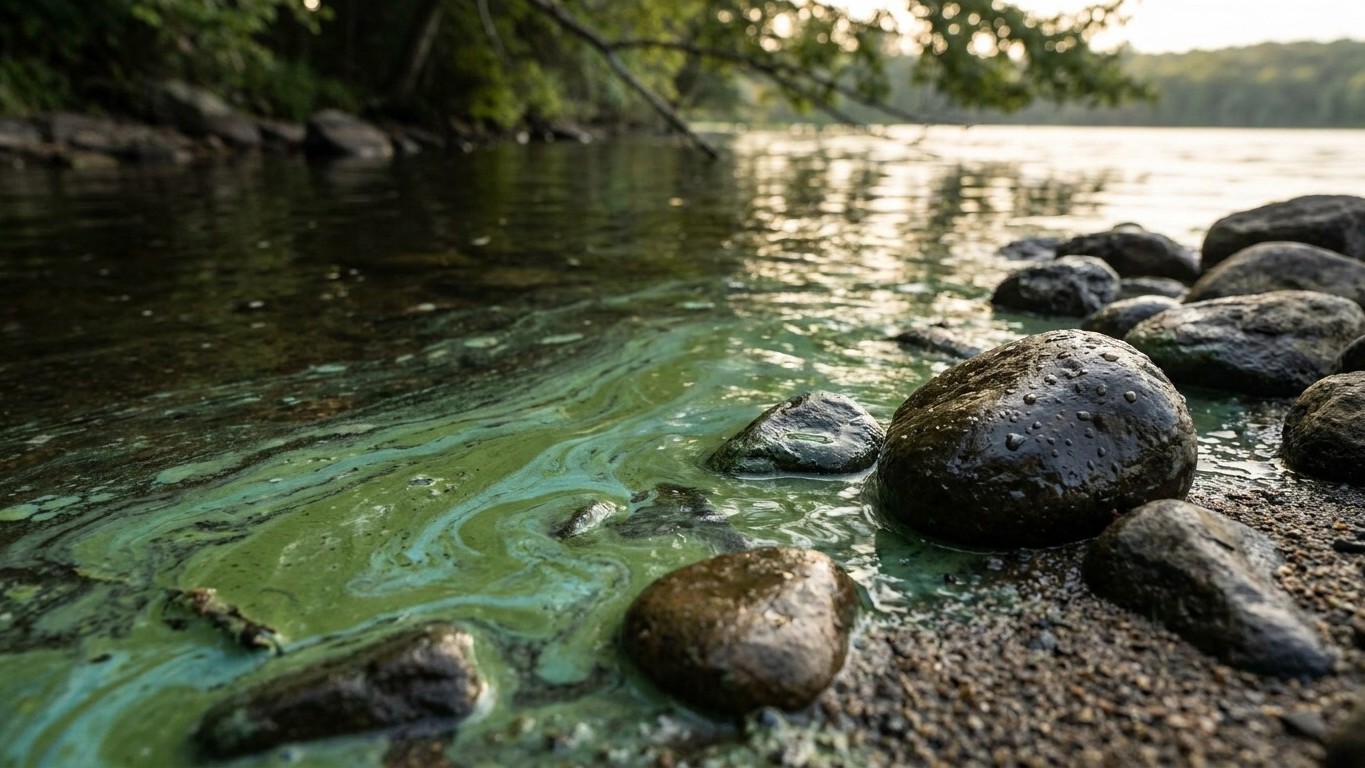
That murky green sheen skimming across a lake or slow-moving river isn’t ordinary pond scum. It’s often a cyanobacterial bloom, and the few seconds you spend hosing off before heading home matter far less than what happens to your skin over the following two days. A proper wash, done right after you leave the water, is what actually determines whether you spend the rest of the weekend fine or nursing a rash and stomach cramps.
Key takeaways
- That paint-like green film isn’t cosmetic—it releases toxins you can’t see by looking
- A 15-second splash under the tap is dangerously insufficient; dermatologists say 10-15 minutes with soap is needed
- Symptoms don’t arrive immediately—they lurk for 12 to 48 hours, and knowing what to watch for could save your weekend
What that paint-like film actually is
Cyanobacteria, still commonly called blue-green algae, thrive in warm, still water and multiply fast enough in summer to form visible surface blooms. The UK Centre for Ecology & Hydrology describes the look precisely: it can look like green or turquoise wispy paint, green scum or clumps of green particles, and often these surface scums accumulate along the shore, exactly where paddlers, dog walkers and wild swimmers tend to wade in. Despite the name, colour is no reliable guide. While usually green, or blue-green in colour, they may be khaki, blue, black, dark brown or red.
What makes this more than a cosmetic nuisance is chemistry, not aesthetics. Blooms of blue-green algae can form thick scums on the surface of the water and are often cause for concern because as they start to break down they can release a range of toxins, which if ingested in large quantities can present risks to human health, and long-term exposure of human skin to the toxins can cause irritation. The Lake District National Park puts it bluntly: not all blue-green algae blooms and scums are toxic, but you can’t tell just by looking at them, so it’s best to assume they are. I’d rather be over-cautious than find out the hard way, and honestly, so should you.
Why a quick splash under the tap isn’t enough
Here’s the part most swimmers get wrong. Cyanobacterial cells and their toxins cling to skin, hair and swimwear fabric long after you’ve climbed out, and a fifteen-second rinse barely disturbs them. American clinical guidance for poison centres recommends something far more thorough: remove contaminated clothing and jewelry, and wash skin with soap and water for 10–15 minutes. That’s a proper shower with soap, not a courtesy splash from a water bottle at the car park.
Timing matters just as much as technique. Reactions don’t always show up immediately. Dermatological research on algae-related rashes notes that most people see breakouts about 12 to 48 hours after being exposed, which is precisely the window the title is pointing to. Health bodies list the same cluster of complaints. NHS Fife warns that people such as paddle boarders, wind surfers and swimmers who come into contact with blue-green algae scum or who accidentally swallow affected water can suffer from skin rashes, eye irritation, vomiting, diarrhoea, or pains in muscles and joints. The Lake District’s own guidance for visitors lists an almost identical picture: illnesses including skin rashes, eye irritation, vomiting, diarrhoea, fever and muscle and joint pain have occurred in people who’ve swallowed or swam through algal scum.
None of this means every dip in a British lake ends badly. Reassuringly, the sailing world’s own environmental guidance notes the effect on humans in the UK has been limited to illness rather than death. But “illness rather than death” still covers a genuinely miserable 48 hours, and rashes worsen precisely where swimwear traps damp skin against the toxin, so don’t be surprised if the itching is worst under a bikini line or wetsuit seam.
The 48-hour watch: what to actually do
If you’ve swum through anything resembling a green film, treat the next two days as a monitoring period rather than a non-event. Wash thoroughly with soap as soon as you can, launder your swimwear and towel separately rather than reusing them straight away, and keep an eye on your skin and stomach rather than assuming a clear conscience because you felt fine on the drive home. Most cases stay mild and settle on their own, but the official advice is consistent on when to escalate:
- Skin that reddens, blisters or itches intensely in the areas that were underwater
- Vomiting, diarrhoea or fever appearing a day or two after swimming
- Eye irritation that doesn’t settle with a rinse
- Any symptoms in young children, who are more vulnerable to the same exposure
If any of these appear, contact your GP or NHS 111, and mention specifically that you swam in water with visible algal scum. Doctors unfamiliar with the exposure history sometimes chase the wrong diagnosis first. The Environment Agency also wants to hear about it: please call the Environment Agency on 0800 80 70 60 to report your sighting, or log it through the Bloomin’ Algae app, which helps provide a rapid and more comprehensive picture of harmful algal blooms in your area and feeds warnings back to local authorities before the next person wades in.
Prevention beats treatment
The genuinely useful habit isn’t a better shower afterwards, it’s a five-second scan beforehand. If the shoreline looks like someone’s spilt emulsion paint into the water, or there’s a greenish scum drifting near where you’d normally get in, choose a different spot that day. Blooms shift with wind and temperature, so a lake that’s clear on Tuesday can carry a visible film by Friday afternoon after a run of warm, still weather, which is exactly when cyanobacteria multiply fastest. Fish and other wildlife dying off nearby is another red flag worth taking seriously rather than dismissing as coincidence.
One detail surprises most people: toxins don’t necessarily vanish once the visible scum disappears. Even after a bloom looks like it’s cleared, residual toxin can linger in the water and along the shoreline for longer than the algae remains visible, which is why cautious advice favours waiting rather than returning the moment the surface looks clean again. As always, this is general health information rather than a diagnosis, so if you’re worried about a reaction after swimming, your GP or NHS 111 remains the right first call.
Sources : ceh.ac.uk | nhsfife.org