
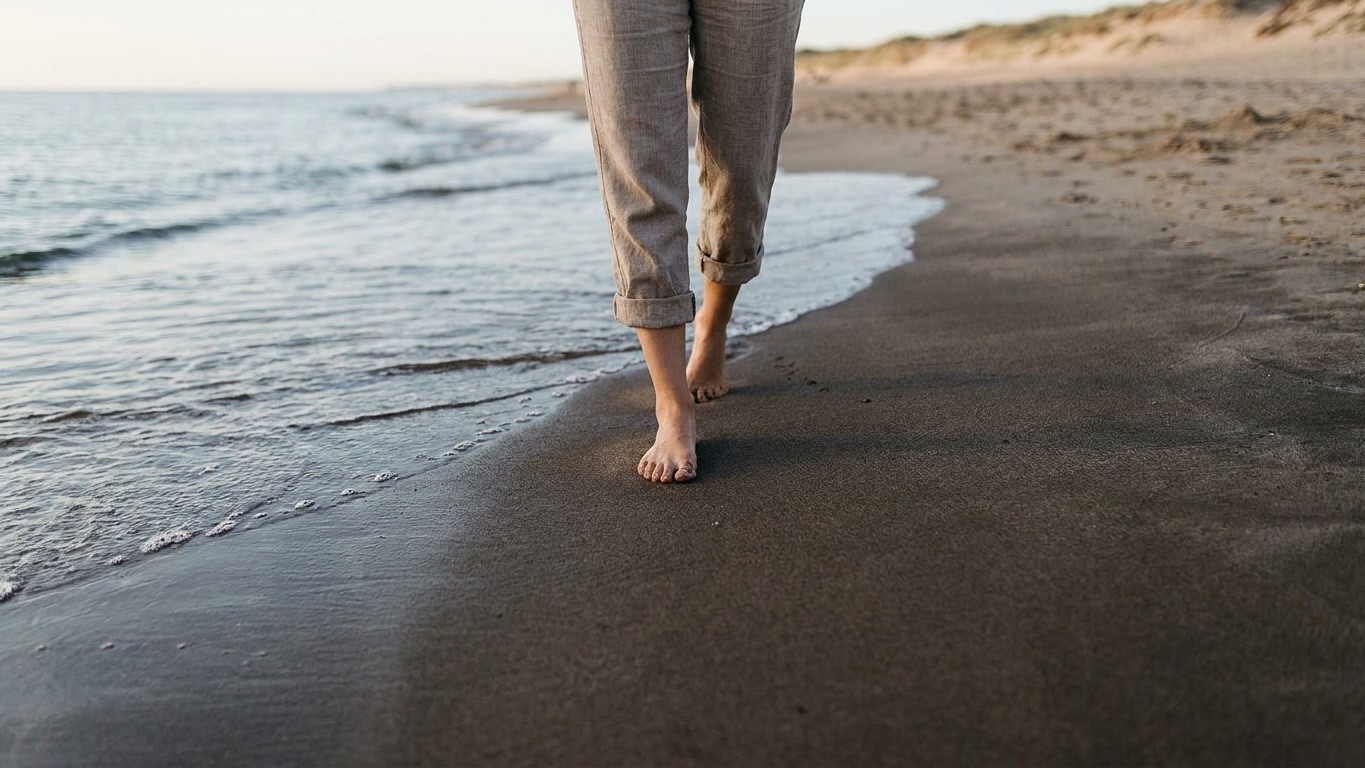
Burning calves after a week of “gentle” beach walks are not a coincidence, and they are certainly not a sign that you should push through. That sensation is your calf muscles and Achilles tendon working considerably harder than they would on a pavement, because dry sand is one of the most physically demanding surfaces you can walk on, not the soft option it appears to be.
The instinct makes sense. Concrete feels hard and unforgiving, so soft dry sand seems like the kinder choice for your joints. But research shows that running on soft surfaces like athletic tracks and sand increases the risk of developing Achilles tendinopathy, while running on hard surfaces such as asphalt seems to have a small protective effect. That finding surprises most people, myself included the first time I read it. We’ve been culturally trained to think “soft equals safe”, yet the body doesn’t quite work that way.
Key takeaways
- Dry sand forces your Achilles tendon to work over twice as hard as walking on firm ground at the same pace
- The ‘sinking’ sensation with every step disrupts your body’s natural spring-and-release mechanism, creating cumulative stress
- Burning calves after a week aren’t a sign of weakness—they’re your body struggling to adapt to an unexpected demand
Why “gentle” sand is actually the harder option
Every step on dry sand involves your foot sinking slightly before it finds purchase, and that sinking motion changes Everything/”>Everything about how your leg absorbs and generates force. Studies comparing walking on sand substrates of varying foot-sinking depth show that greater sinking depth is associated with statistically significant changes in joint angles and spatiotemporal variables. In plain terms, your ankle has to travel through a different, often greater range of motion with every stride just to compensate for the ground giving way beneath you.
This instability also raises the energy cost of the walk itself. Sand is a yielding surface that provides constant instability, and walking on sand has been shown to increase vertical centre-of-mass displacement, potentially increasing energy expenditure. Older exercise physiology data back this up with hard numbers: when walking on sand, the energy cost increased linearly with speed from 3.1 joules per kilogram per metre at 3 km/h to 5.5 J/kg/m at 7 km/h, whereas on a firm surface it reached a minimum of just 2.3 J/kg/m. At a brisk beach pace, you could be working more than double as hard as you would strolling along a promenade at the same speed, without necessarily noticing it because the scenery is so pleasant.
What’s happening inside your Achilles tendon
The Achilles doesn’t just sit there attaching your calf to your heel. It acts like a spring when you run and walk, absorbing and storing force from landing, which can reach up to six times your body weight, before releasing that energy back into the ground to propel you forward. It doesn’t manage this alone, of course, and the calf muscles and Achilles tendon combined produce about 50% of the force that propels you forward. On firm ground, that spring-and-release mechanism is efficient because the surface pushes back predictably. Sand steals that predictability. Every time your heel or forefoot sinks, the tendon and calf have to generate extra tension just to find a stable platform, then work again to push off from unstable, shifting grains rather than solid ground.
Multiply that by several thousand steps on a morning walk and you get exactly the kind of cumulative, low-grade overload that leads to the calf burning and tightness so many beach walkers report after a week or two of daily walks, precisely what prompted this realisation in the first place. It’s not injury in the dramatic sense. It’s the tendon and its muscles adapting, sometimes too quickly, to a demand nobody warned you about.
Walking on sand without wrecking your calves
None of this means sand walking is bad for you. Used sensibly, it’s genuinely excellent low-impact conditioning for the lower leg, foot, and ankle stabilisers that trainers and shoes can allow to become lazy. The issue is dose and surface choice, not the activity itself. A few adjustments make a real difference:
- Start with the firmer, wet sand near the waterline rather than dry, loose sand further up the beach; it behaves far more like a stable surface and reduces the sinking effect considerably.
- Build up gradually, adding perhaps five to ten minutes every few days rather than launching straight into a 45-minute daily habit on dry sand.
- Alternate surfaces within the same week, mixing sand walks with pavement or grass so the Achilles isn’t asked to adapt to a novel load every single day.
- Pay attention to tightness rather than waiting for pain; a niggling calf ache after a sand walk is your cue to scale back, not to push through for a personal best.
If burning or stiffness persists beyond a couple of days of rest, or if you notice swelling, sharp pain, or a “creaking” sensation around the back of the heel, it’s worth having it looked at by a GP or physiotherapist rather than assuming it will simply settle on its own. Achilles tendon issues have a habit of becoming chronic if the underlying load isn’t adjusted early.
One detail worth remembering next time you’re tempted onto the soft, dry stretch of a beach: the firmness underfoot changes dramatically within just a few metres of the tideline, and that narrow band of damp, compacted sand offers nearly all the joint-friendly cushioning you’re after with a fraction of the instability. The gentlest option was there the whole time, just closer to the water than most of us think to walk.
Sources : ncbi.nlm.nih.gov | ncbi.nlm.nih.gov