
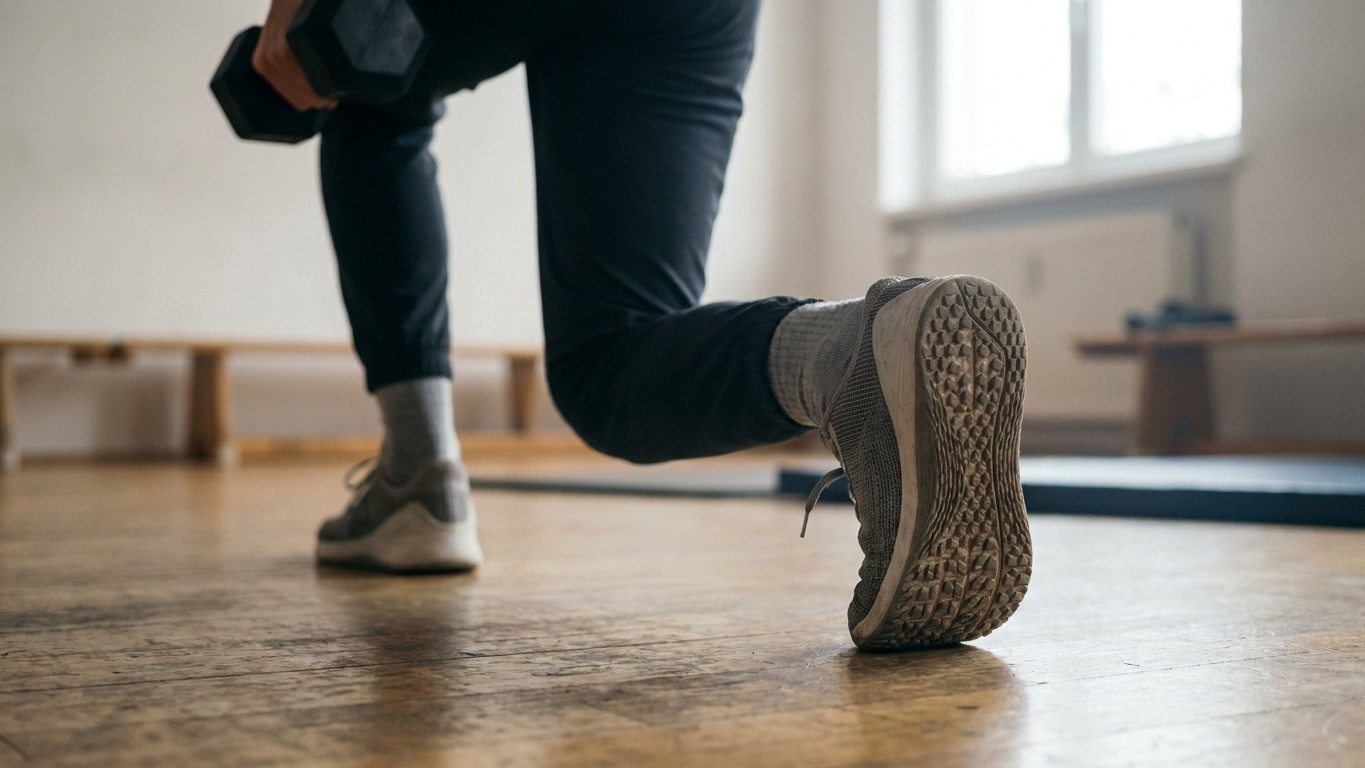
Fashion sneakers with slick, polished soles are brilliant for a coffee run. They are a liability the moment you load a dumbbell and drop into a lunge. I found this out the hard way: mid-rep, my trailing foot skated backwards on a gym floor that wasn’t even particularly shiny, and for a split second my knee did all the stabilising work my foot should have been doing. That’s the moment you feel exactly what a compromised base does to the joint above it.
The gym floor hadn’t changed. My trainers had simply been chosen for how they looked with joggers, not for what they’d need to do under load. Smooth rubber, minimal tread, a sole designed for pavement grip rather than gym traction. It took one slide to understand why every serious lifting shoe guide bangs on about outsole grip before anything else.
Key takeaways
- A mid-rep foot slide in fashion sneakers exposed exactly what happens when grip fails during loaded movements
- Researchers have tracked footwear traction as a major cause of knee injuries for 40 years—and the physics is more complex than ‘more grip is better’
- The shoe that looks sharp on your morning walk becomes a liability the moment you load a lunge
Why the back foot needs to grip, not glide
In a dumbbell lunge, your rear foot is doing more than just balancing you. It’s anchoring one end of a kinetic chain that runs straight up through the ankle, knee and hip. If that anchor point moves even slightly, every joint above it has to scramble to compensate. Reviewers who test training footwear specifically for leg work point out that exercises such as lunges, leg presses, or calf raises activate the ball of the foot, which means the forefoot needs both grip and enough flexibility to let the foot do its job properly.
Orthopaedic guidance on gym footwear is fairly blunt about the consequences of getting this wrong. Specialists note that weightlifting requires excellent traction to keep your feet planted firmly on the ground, and the outsole should have a non-slip, grippy material that allows you to maintain balance and stability during exercises like squats and lunges. Skip that, and you’re not just risking a wobble. Clinicians warn that slips or loss of balance can result in serious injuries to the ankles, knees, and lower back.
What a slipping foot actually does to the knee
Here’s the biomechanical detail that made my post-lunge slide feel less like bad luck and more like basic physics. Footwear traction has been on researchers’ radar for decades precisely because of what happens at the knee when a foot doesn’t behave predictably underneath it. As one review of sports injury literature puts it, for the past 40 years, footwear traction has been implicated as a major cause of noncontact lower extremity injuries in sports. The tricky part, researchers admit, is that traction of footwear does not follow the laws of mechanical dry friction, so it’s not a simple case of “more grip equals safer.”
That nuance matters, because too little traction and too much can both cause trouble. Orthopaedic writing on knee injuries explains that footwear with inadequate cushioning increases impact forces transmitted through the ankle, knee, and hip, and reduced traction on wet surfaces increases the risk of sudden slips and uncontrolled knee movements, potentially leading to ligament or meniscus injuries. On the flip side, the same analysis notes that shoes with very high grip may prevent the foot from rotating naturally during sudden turns or pivots, and when the foot sticks while the body twists, the strain has to go somewhere, usually the knee.
What I felt in that lunge sits firmly in the “not enough grip” camp. When my rear foot slid, my body’s automatic reaction was to jam the knee inward to regain control, the classic valgus collapse pattern that Physiotherapists flag as a warning sign. It’s the same alignment fault linked to poor ankle mobility and footwear choices more broadly, and one commentary on the topic notes that the resulting loss in ankle mobility leads your body to take the path of least resistance, thereby causing foot pronation and valgus collapse during squats, running, and other functional movements. My ankle mobility wasn’t the problem that day. My sole was.
Choosing footwear that actually protects your knees
None of this means you need spiked lifting boots for a living-room dumbbell circuit. But a few sole characteristics genuinely earn their keep once you start loading single-leg movements like lunges and split squats.
A flat, flexible forefoot with a textured rubber outsole lets your toes splay and grip simultaneously, rather than skating on a slick surface. Testers who put training shoes through lunges and split squats consistently flag flexibility at the forefoot as the feature that lets the foot “do its job” during that stepping motion, describing a high degree of sole flexibility, which is awesome for those who love shoes that move well when doing exercises like split squats, lunges, plyometrics, and agility workouts. A secure, snug upper matters just as much as the sole; if your heel or midfoot shifts inside the shoe on the way down, the outsole’s grip becomes irrelevant.
For anyone lifting genuinely heavy loads rather than moderate dumbbells, the calculus shifts further towards a proper training shoe rather than a running or lifestyle sneaker. Footwear reviewers who test extensively for gym use draw a clear line: if you’re lifting more than 110 kg for squats or 40 kg for standing dumbbell curls, ignore soft running shoes, because at that weight a stable training shoe offers better safety. Most home lunge sessions with light-to-moderate dumbbells won’t hit that threshold, but the underlying logic holds regardless of load: a shoe built for lateral stability and forefoot grip will behave far more predictably than one built to look sharp on a morning walk.
My smooth-soled trainers are back in the wardrobe now, reserved for exactly what they were designed for: walking on flat, dry pavement. For lunges, split squats and anything else where one foot has to plant and hold while the other leg does the work, I’ve switched to a pair with a properly gripped, flexible forefoot. My knee, unsurprisingly, has stopped complaining. If your training shoes still have that showroom shine on the sole after months of gym use, that’s not durability. It’s a sign they’ve barely been gripping anything at all. As ever, if you’re dealing with ongoing knee pain rather than just a one-off scare, it’s worth getting it looked at by your GP or a physiotherapist rather than assuming footwear is the whole story.
Sources : lermagazine.com | quora.com