
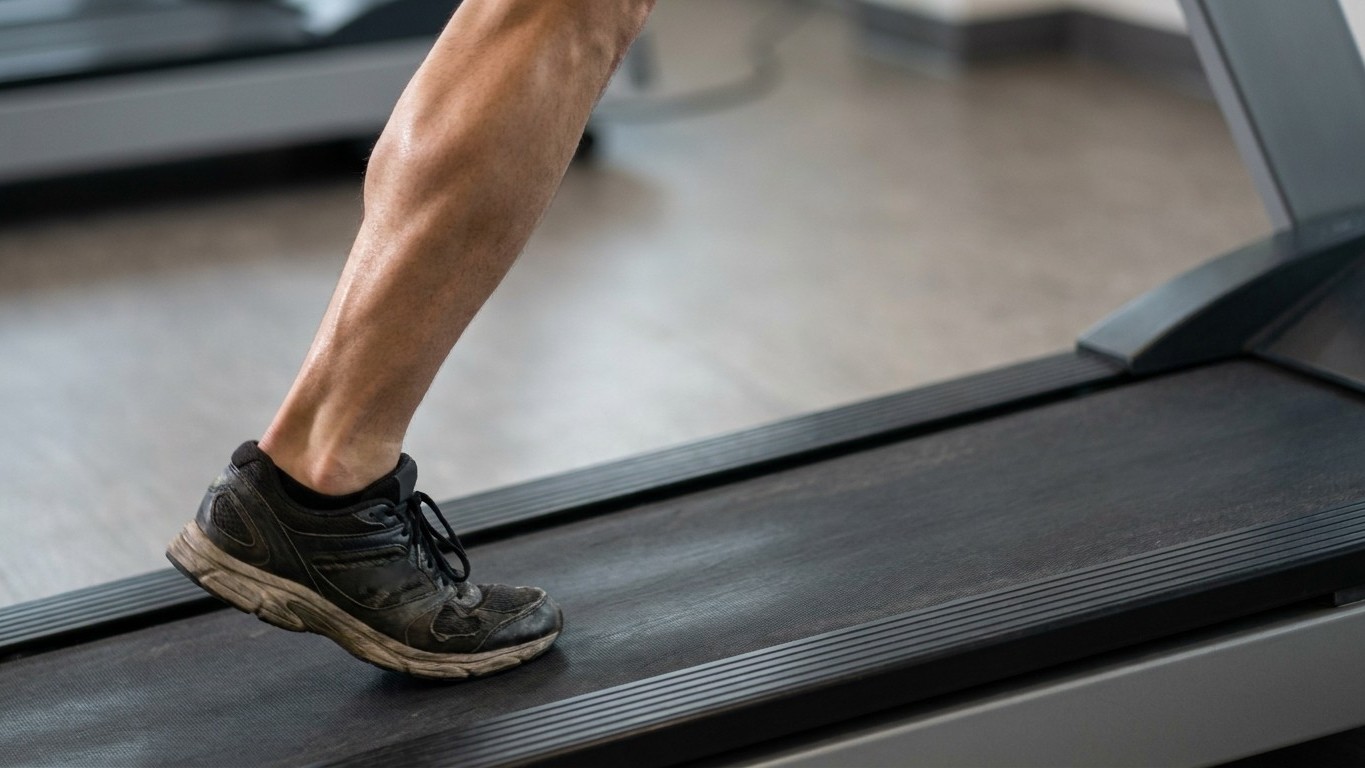
Three months. That’s how long I ran and walked on that permanent 1% gradient before my left Achilles announced itself with a sharp, unmistakable pull one Tuesday morning. Not a niggle. Not stiffness. A genuine, stop-mid-stride pull that made me grab the handrail. What I hadn’t clocked, until a physiotherapist explained it slowly and patiently, was that my calf had never once been allowed to fully lengthen and rebound the way it does on flat ground or genuinely varied terrain. Months of low-grade, unchanging tension had quietly rewritten how that tendon tolerated load.
Key takeaways
- A single study from 1996 spawned decades of treadmill dogma—but recent research suggests that 1% correction barely matters for slower speeds
- Real hills are temporary; your calf recovers between climbs. A locked treadmill incline never gives that tissue a break
- Tendon tissue adapts on a timeline of weeks, while muscle adapts fast—creating a dangerous invisible gap that precedes injury
Where the 1% obsession actually comes from
The habit of nudging the incline to 1% isn’t some fitness myth invented by a gym influencer. It traces back to a genuine piece of exercise physiology from 1996. Nine trained male runners ran for six minutes at six different velocities, with the routine repeated on a treadmill set at different grades and once outdoors along a level road. The study demonstrated equality of the energetic cost of treadmill and outdoor running with the use of a 1% treadmill grade over a duration of approximately 5 minutes and at velocities between 2.92 and 5.0 m/s. In plain terms: when running indoors on a treadmill, the lack of air resistance results in a lower energy cost compared with running outdoors at the same velocity, and a slight incline of the treadmill gradient can be used to increase the energy cost in compensation.
That’s a sound rationale for a single session, or a training block designed to mimic outdoor conditions. What it was never meant to be was a permanent setting, month after month, run after run, walk after walk. More recent work has actually softened the rule’s importance for most of us. A 2019 systematic review by Miller and colleagues found that oxygen consumption was only slightly lower during treadmill running, by about 0.55 ml/kg/min, compared with outdoor running. Other researchers have gone further, noting that the 1% incline correction only becomes relevant at higher speeds, typically above 10 mph, while for slower speeds the energy cost difference is negligible. I’ll admit I raised an eyebrow when I first read that. Years of treadmill orthodoxy, and it turns out the gradient I’d been religiously dialling in barely mattered for someone jogging at a conversational pace.
Why a fixed gradient is different from a genuine hill
Here’s the biomechanical bit nobody warns you about. A real hill is temporary. You climb it, your calf and Achilles work harder for a stretch, then the road flattens and the tissue gets a break. A treadmill locked at 1% for the length of every single session removes that variation entirely. If you incline the treadmill belt, simple physics dictate that your calves and Achilles are stretched through a greater-than-normal range of motion, making you more susceptible to strains. Do that for twenty minutes a day, five days a week, for three months, and you’ve clocked an enormous number of repetitions in a slightly extended range with essentially zero recovery variation built in.
The gastrocnemius and soleus, the two muscles that taper into the Achilles tendon, are doing constant, low-grade extra work every single stride on an inclined belt. The soleus lies deeper and lower and blends seamlessly into the Achilles tendon, which anchors the muscles to the heel bone, and together these tissues are responsible for the toe-off or push-off phase of the stride. Podiatrists have flagged this specific pattern for years. According to podiatrist Dr Stanley Beekman, using an incline on the treadmill can increase your likelihood of developing or exacerbating Achilles tendinitis. It’s not that incline training is inherently harmful, plenty of runners use hill sessions productively, but a fixed, unchanging gradient held for months functions less like training variety and more like a repetitive strain machine. Other clinical sources echo this directly: using too much incline on a treadmill or walking or running on hilly terrain can lead to an Achilles injury.
What surprised me most in hindsight was how unremarkable the injury felt in the making. There was no single dramatic session. No twinge I could point to and say “that was the moment.” Just an accumulation, invisible week to week, until the tendon’s tolerance ran out. That’s fairly typical of tendinopathies generally; they’re notorious for building silently before the first symptom appears.
Getting back on the belt without repeating the mistake
My physio’s advice was refreshingly unglamorous: vary the gradient, don’t fear it. Alternate flat sessions with genuine incline intervals rather than a static setting, and let the calf work through its full range rather than a narrow, constantly-loaded one. General guidance for home treadmill users points in a similar direction, suggesting a 5–7% incline is enough to boost intensity without overstraining your joints, and higher inclines of 10% or above should be saved for short bursts or interval training rather than default settings. Progressive loading, not avoidance, tends to be the more useful frame here too: recovery is based on progressive loading, rather than complete rest.
I’ve also gone back to basics on warm-up, something I’d been skipping because “it’s just walking, why bother.” Calf raises, a few minutes of ankle circles, a genuinely gradual ramp into pace rather than starting at target speed from step one. And I’ve stopped treating the incline button as a permanent calorie-burning cheat code; if anything, the research suggests the calorie difference from that 1% nudge was probably smaller than I’d assumed for years. None of this replaces proper assessment, so if you notice persistent pulling, swelling, or morning stiffness around your heel cord, it’s worth getting your GP or a physiotherapist to look at it rather than pushing through, since Achilles issues respond far better to early, structured loading than to guesswork.
One detail stuck with me from that appointment: tendon tissue adapts slowly, on a timescale of weeks, while muscle adapts comparatively quickly. That mismatch, muscle happily coping while tendon quietly falls behind, is exactly the gap a constant, unvaried incline can widen without you ever noticing until the morning it doesn’t.
Sources : ciss-journal.org | researchgate.net