
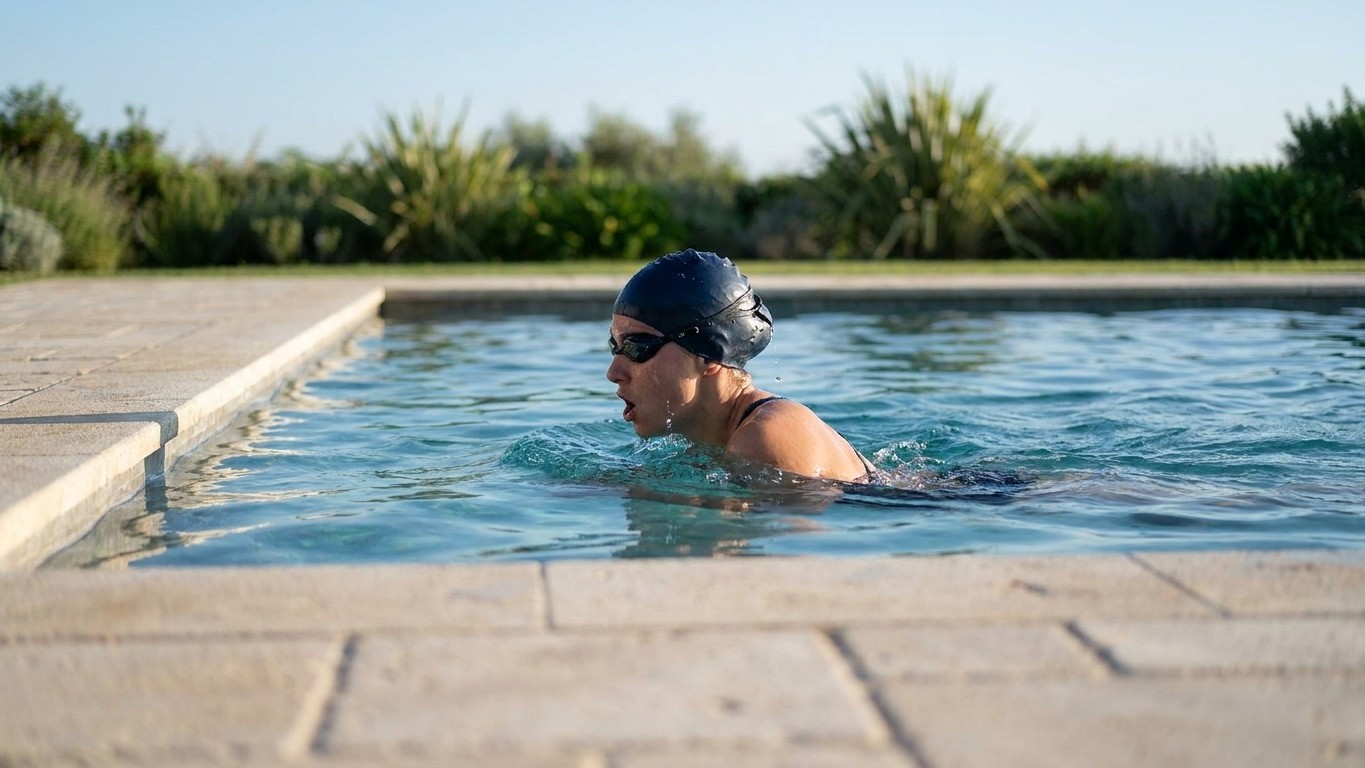
Lifting your chin high to keep your face dry might feel like the safest way to swim breaststroke, but Physiotherapists see it as one of the most common causes of the very back pain swimmers are trying to avoid. Swimming breaststroke with your head held high out of the water and your chin pointed skywards can put excess pressure on your lumbar spine. The instinct to stay dry and alert, chin up, eyes forward, turns out to load the spine in exactly the wrong direction.
The mechanics are straightforward once you understand them. Each time you lift your head to breathe, Your Lower Back has to arch to compensate, because the spine works as a chain. Poor technique and stroke mechanics can have a detrimental effect on your lower back muscles, caused by lumbar hyperextension, where the lumbar spine is subjected to repetitive bending or arching beyond its normal range of motion. Do that thirty or forty times a length, several times a week, for years, and you’re asking a joint designed for occasional movement to absorb thousands of repetitive extensions.
Key takeaways
- A seemingly safe head position actually loads your spine in the worst possible way
- 30-50% of swimmers experience lower back pain, mostly from breaststroke—here’s why
- Your physiotherapist might suggest an unexpected tool to reset your technique
Why the “safe” head position is anything but
Breaststroke and butterfly are consistently flagged by sports physiotherapists as the strokes most associated with lower back problems, precisely because of this undulating, arching action. Pain in the lower back can be caused by the undulating motion of butterfly or breaststroke, and by tight hip flexor or adductor muscles that force the lumbar region to compensate. The numbers back this up. Low back pain affects 30-50% of swimmers, most commonly with breaststroke and butterfly. That’s not a niche issue affecting the occasional unlucky masters swimmer. It’s roughly half the breaststroke community at some point.
The knock-on effect isn’t limited to soft tissue strain either. A small crack or stress fracture in the pars interarticularis, called spondylolysis, can occur in sports involving repetitive stress on the spine such as swimming, especially in butterfly and breaststroke, both of which involve excessive loading of the spine through hyperextension. Facet joints at the back of each vertebra, tiny structures never meant to bear repeated compressive force, take the brunt of it.
The neck suffers too, and this is where I’d argue most swimmers get caught out completely. Keeping the head permanently above water isn’t a neutral position, it’s sustained cervical extension. Keeping your head above water in breaststroke is likely to put stress on the muscles and ligaments of your spine, and arthritis in the neck bones can also lead to neck pain when swimming. One chiropractic clinic put it bluntly: that head-lifting motion at the end of each stroke forces your neck into repeated extension that can compress vertebrae and strain muscles.
The rare but frightening extreme
Most swimmers who lift their head persistently will end up with nagging stiffness or an ache that flares after long sessions, nothing more sinister. But there’s a documented, if uncommon, worst-case scenario worth knowing about. A case report published in the journal BJR Case Reports and archived on PubMed Central described a swimmer who, twenty minutes into a breaststroke session, developed sudden onset neck and upper back pain radiating down his right arm, which progressed alarmingly. The authors linked this to a rare condition sometimes called a variant of surfer’s myelopathy, noting that prolonged repeated hyperextension of the spine, as in breaststroke swimming, is proposed to have a similar effect on the spinal cord arterial system as sustained but static hyperextension.
This is genuinely rare, and I don’t want to alarm anyone who swims a few gentle lengths on a Sunday morning. But it illustrates a principle that applies at every level: sustained hyperextension isn’t neutral for the spine, it’s a load, and loads accumulate.
What a proper stroke, and a proper assessment, actually looks like
The fix isn’t complicated, though it does require unlearning a habit that may feel protective. Breaststroke has potentially the same problem as butterfly; a good fluid rhythm between the kick and pull should allow for breathing without having to actively contract your back muscles to lift you out of the water, because extending your back repeatedly will result in injury. propulsion from a strong kick and pull should lift your shoulders and head naturally at the top of each stroke cycle. You shouldn’t need to crane your neck upward separately, the timing should do the work for you.
Physiotherapists who treat swimmers regularly tend to start with a proper assessment rather than a quick fix. A physiotherapy assessment starts with your symptoms, stroke type, training load and recent changes, and your physiotherapist may ask about weekly kilometres, kick volume, sprint sets, dry-land training and previous back pain. From there, rehab often targets core stability, pelvic control, hip strength, thoracic mobility and back extensor endurance, because a stiff thoracic spine or weak hips will force the lower back to move more than it should to compensate.
If your neck and shoulders genuinely aren’t flexible enough to breathe using timing alone, a snorkel is a legitimate short-term tool rather than an admission of failure. Using a mask and snorkel to keep your head in the water can help avoid the tendency to arch your lower back when coming up for a breath. It’s a simple swap that removes the urge to lift the chin altogether while you rebuild better mechanics.
One detail that surprises most people I’ve spoken to about this: swimming isn’t inherently bad for backs, quite the opposite. Breaststroke strengthens the middle and lower back muscles as well as the muscles in the lumbar spine, which can help to stabilise the spine and reduce pain. The stroke itself isn’t the enemy. It’s the head-up habit layered on top of it that turns a genuinely therapeutic exercise into a slow, repetitive strain. Get the timing right, and the water that was straining your spine for years becomes the thing that’s holding it up.
This article is for general information and does not replace personalised medical advice. If you’re experiencing back or neck pain when swimming, consult your GP or a chartered physiotherapist for an assessment tailored to you.
Sources : sciaticalm.com | bethesda-spital.ch