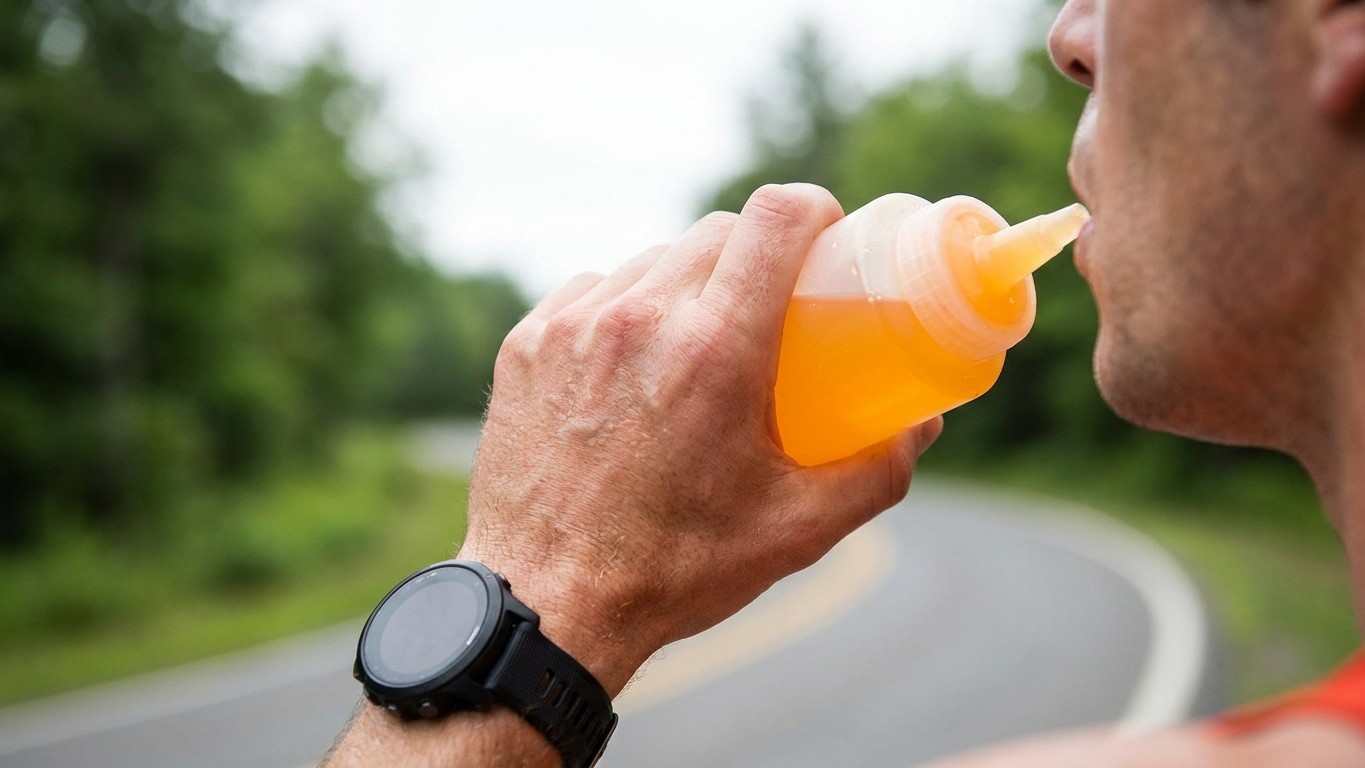
Long-distance runners have a ritual: at roughly the twenty-minute mark, out comes the bottle, a swig of something orange or blue, then back to the rhythm of feet on tarmac. That habit, repeated over years of half-marathons and training loops, was exactly what one dentist’s mirror revealed during a routine check-up: faint, glassy grooves on the biting edges of the front teeth and a slightly yellowed, thinning look to the enamel on the molars. Not decay in the traditional sense, but erosion, the gradual chemical wearing away of the tooth surface by acid.
Key takeaways
- A dentist’s mirror revealed what years of isotonic sips had quietly done to tooth enamel
- Sports drinks aren’t neutral—their acidic pH softens enamel, especially during hard breathing when saliva can’t protect teeth
- The science is messier than headlines suggest, but frequency and contact time matter more than you’d think
What’s actually happening in your mouth mid-run
Isotonic drinks aren’t neutral liquids. Most contain citric acid or similar acids to balance flavour and aid absorption, and that acidity sits in a range that dental researchers consider erosive. Sports drinks typically possess acidic properties, with pH levels ranging from 3.16 to 3.70, which contribute to their erosive potential on dental surfaces. For comparison, plain water sits around pH 7, and enamel starts to soften once the mouth environment drops below roughly pH 5.5.
Running makes the problem worse in a way that has nothing to do with the drink itself. Athletes may be at higher risk due to reduced salivary flow during intense physical activity and frequent intake of energy and isotonic drinks, which are characterised by low pH and organic acids. Saliva is your mouth’s natural buffer and rinse cycle; it neutralises acid and washes it away from tooth surfaces. Breathe hard through your mouth for ninety minutes, and that buffering system is running on a fraction of its usual output, right at the moment the drink is sloshing around your teeth. Sip every twenty minutes, as many runners do to stave off cramp, and you’re essentially re-acidifying the mouth before saliva has had a chance to recover from the last exposure.
What the research actually shows, and it’s more nuanced than headlines suggest
Here’s where I want to be careful, because the evidence doesn’t point in one tidy direction. Several well-designed studies have failed to find a clear link between sports drink use and dental erosion. A study of 304 university athletes in Ohio found sports drinks usage in 91.8% of athletes and a total erosion prevalence of 36.5%, yet nonparametric tests and stepwise regression showed no association between dental erosion and the use of sports drinks, quantity and frequency of consumption, years of usage or nonsport usage; the results revealed no relationship between consumption of sports drinks and dental erosion. A systematic review pooling four studies and 567 athletes reached a similarly cautious conclusion: the available evidence suggests that the consumption of sports drinks alone is not associated with dental erosion.
But other findings complicate that reassurance. A study of amateur runners in Brazil found that gastroesophageal reflux, running frequency per week, and time expended during competition were associated with dental erosion, while the association between use of isotonic drinks and dental erosion was not significant; dental erosion was not associated with use of isotonic drinks, but frequency of exercise per week and gastroesophageal reflux were risk factors. And a more recent review noted one study demonstrated a dose-response relationship, and another showed that swimmers consuming energy sports drinks had over twice the risk of dental erosion compared to non-swimmers. Chlorinated pool water is itself mildly acidic, so swimmers get a double hit that runners on dry land don’t face.
Laboratory work backs up the biological plausibility even where population studies stay ambiguous. Reviews of enamel exposed directly to sports drinks concluded that the enamel surface was softened by sports drinks once consumed but did not qualify as erosion, with no correlation found between sports drinks and dental erosion in most population-level research. Softening isn’t the same as permanent loss, but softened enamel is more vulnerable to the next insult, whether that’s an acidic snack, teeth grinding, or simply a toothbrush wielded too soon after your run.
Reformulation, and what you can actually do about it
The drinks industry has taken some of this on board. Research cited by beverage formulators found that combining a certain pH and a very specific level of calcium in an isotonic drink can stop enamel erosion, giving the same effect on teeth as drinking plain water. Some newer isotonic formulations now sit closer to neutral pH and include added calcium for exactly this reason, though not every product on a supermarket shelf has been reformulated this way, so it’s worth checking labels rather than assuming.
On the practical side, timing matters more than most runners realise. Rinsing your mouth with plain water straight after a sip of an isotonic drink helps dilute the acid and speeds saliva’s job of restoring a neutral pH. Using a bottle with a narrow spout or a straw reduces how much liquid washes directly over your front teeth. And the one piece of advice dentists repeat most often, resist brushing immediately after a run: enamel that has just been softened by acid is more easily abraded by a toothbrush, so waiting thirty to sixty minutes gives saliva time to help remineralise the surface first. Chewing sugar-free gum after a session stimulates saliva flow and can genuinely help counteract the dry-mouth effect of hard breathing.
A habit worth rethinking, not abandoning
None of this means isotonic drinks are the enemy, or that cramp-prone runners should switch to plain water and hope for the best; hydration and electrolyte balance matter for performance and safety, particularly on long runs in warm weather. The nuance is that frequency and contact time seem to matter as much as the drink’s acidity itself, which is why the runners and swimmers who train most often, and for longest, show up more in the erosion data than occasional joggers do. If you recognise yourself in that twenty-minute sipping pattern, a chat with your dentist about your training habits (not just your brushing routine) might be more useful than you’d expect. As always, if you notice sensitivity, visible wear, or discolouration on your teeth, book an appointment with your GP or dentist rather than relying on internet advice, including this article.
Sources : ncbi.nlm.nih.gov | link.springer.com