
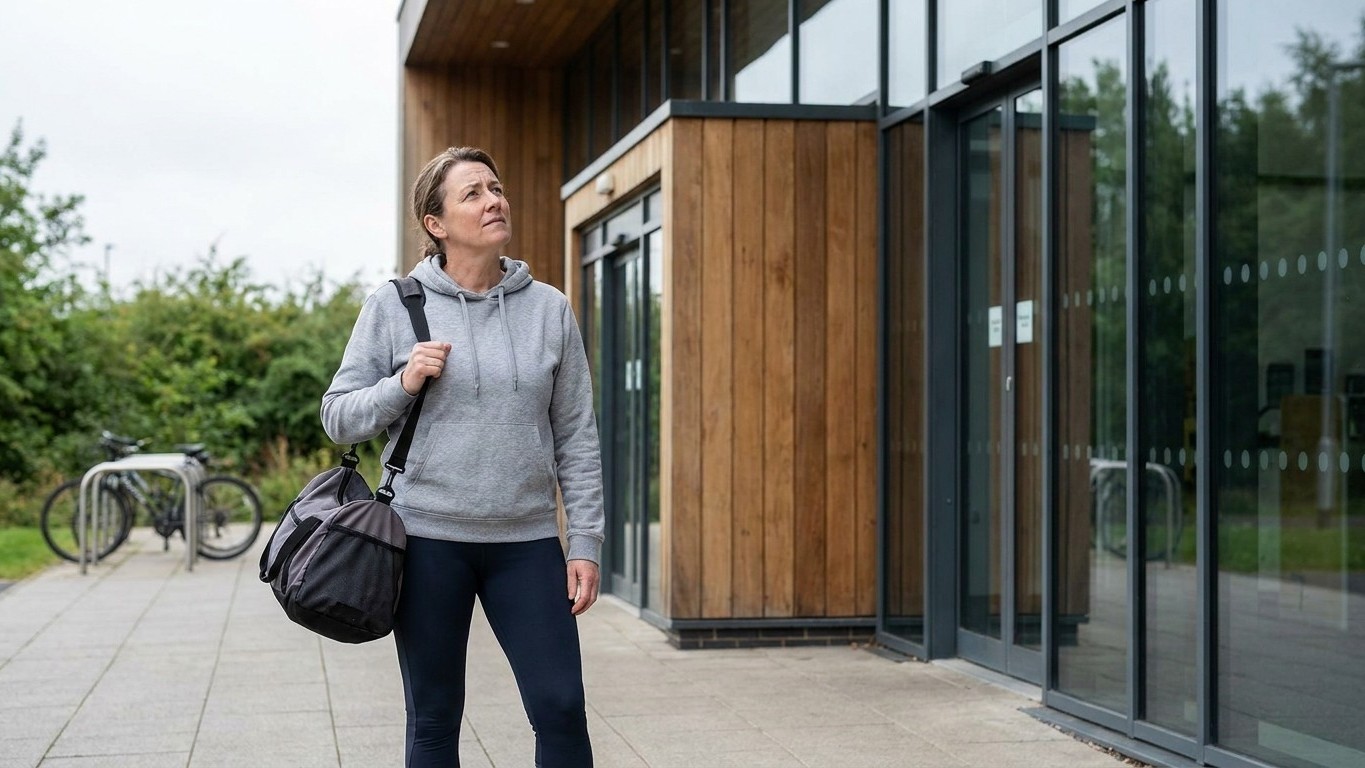
My GP was clear about the target: get moving, and my blood pressure numbers would likely follow. What she didn’t mention is that the twelve-week exercise programme many patients get offered afterwards isn’t a standard NHS product you can request anywhere in England. It’s a local scheme, funded and run differently depending on which council area you happen to live in, and in some postcodes it barely exists at all.
Key takeaways
- Your GP might not tell you that the twelve-week exercise referral scheme availability depends entirely on which council area you live in
- Some regions have well-staffed programmes with health tracking; others have quietly let their contracts lapse
- Isometric exercises like wall squats are proving more effective for blood pressure than the aerobic-only advice most GPs give
What the twelve-week scheme actually involves
These are known as GP Exercise Referral Schemes, and they’ve been part of NHS primary care since the 1990s, though they were first introduced into NHS primary care in the 1990s and have gained popularity in recent years as more people become aware of their benefits for a wide range of conditions, including high blood pressure, diabetes, obesity and depression. Your GP, nurse or physio refers you, but the actual delivery happens through a local gym that holds a contract for the NHS exercise referral scheme, usually the large, council run leisure centres who run such exercise referral schemes.
The structure is fairly consistent where it exists. You’ll typically get a 6 and 12 week review that enables the instructor to support you through your first 12 weeks to a healthier lifestyle, with sessions covering whatever suits your interests, from swimming or water-based activities to gym based exercise or condition-specific programmes. Crucially, a doctor’s referral doesn’t mean a lifelong funded membership, but rather a partly subsidised membership for an initial period of time. Eligibility isn’t automatic either. Most schemes are aimed at inactive adults, 16 years and over, with a low or moderate risk long-term condition, and if your blood pressure is already dangerously high, you’ll be turned away until it’s under better control, since referrals with blood pressure over 180/100 and/or a resting heart rate over 100bpm should be treated to stabilise their condition before being referred to a lifestyle service.
Why the programme depends on your postcode
Here’s the frustrating bit my GP glossed over. There’s no single national exercise referral service, no waiting list you join centrally. Funding decisions sit with local integrated care boards and councils, who manage the NHS budget and work with local providers of NHS services, such as hospitals and GP practices, to agree where their funding is directed. That means one borough might have a slick, well-staffed scheme running out of three leisure centres, while the borough next door offers nothing beyond a leaflet. I’ve spoken to enough people around the country to know the variation is real: some areas run twelve-week blocks with nurses tracking your readings throughout, since health markers such as blood pressure, blood sugars, HbA1c and cholesterol profiles are often measured to see how patients are responding, while others have quietly let their contracts lapse.
If you want to find out what’s actually on offer where you live, the honest answer is to ask your GP practice directly rather than assuming a national standard applies. Speak to your local GP practice to enquire about how to get a referral, because the GP will be aware of the local referral programme and will consider the benefits before making a decision. Don’t be surprised if the answer varies wildly from what a friend in a different county describes. This isn’t a failure of your practice; it’s a structural quirk of how public health funding gets devolved.
What the exercise itself needs to look like
Whether or not a subsidised scheme exists near you, the exercise prescription for blood pressure is well established and worth doing regardless. The Mayo Clinic notes you should try to get at least 150 minutes of moderate aerobic activity or 75 minutes of vigorous aerobic activity a week, or a combination of the two. If that sounds daunting, it doesn’t need to happen in one block, since you can break your workout into three 10-minute sessions and it gives you the same benefit as one 30-minute session. Patience matters too; it takes about 1 to 3 months for regular exercise to have an impact on blood pressure, and the effect isn’t permanent, as the benefits last only as long as you continue to exercise.
What surprised me most in the research wasn’t the cardio advice, which I’d heard before, but the growing evidence for isometric holds. A recent analysis reviewed by the British Heart Foundation found that walking was less effective at lowering blood pressure than cycling or running, and both were less effective than isometric wall squats, which were the most effective exercise of all those compared. Yet current NHS recommendations for managing high blood pressure still only talk about aerobic exercise, recommending at least 150 minutes of moderate-intensity aerobic activity each week. Combine a handful of wall sits with your regular walks or swims and you’re likely covering more bases than the standard advice suggests. There’s also encouraging news for anyone who feels they simply don’t have time: an analysis of activity data from nearly 15,000 people found that running, biking, climbing stairs or brisk walking for just a few minutes can have a positive effect on blood pressure, with up to 20 minutes reducing heart disease risk significantly.
Making progress even without a local scheme
If your area turns out to be one of the ones without a proper twelve-week pathway, you haven’t lost access to the benefits, just the subsidised supervision. Council leisure centres often run their own low-cost beginner classes even outside referral contracts, and walking groups, cycling routes and community swimming sessions cost nothing beyond your time. Resistance work matters alongside cardio too; dynamic resistance training on 2-3 days of the week is recommended alongside 30-60 minutes per day of moderate intensity activity for those diagnosed with high blood pressure. Pair that with attention to diet and sleep, since movement is the most direct lever for lowering blood pressure numbers, but its effects are amplified when combined with healthy habits like the DASH diet, quality sleep and stress management.
One detail worth keeping in mind on your first few sessions back: a single workout can drop your blood pressure temporarily for hours afterwards, a phenomenon researchers call post-exercise hypotension, which is a temporary reduction in blood pressure that can last for several hours after activity. It’s a small, reassuring sign that something is happening at the very first session, long before the twelve weeks are up. As always, check with your GP before starting anything new, particularly if your readings are already high or you’re on medication that affects heart rate.
Sources : ahajournals.org | mayoclinic.org