
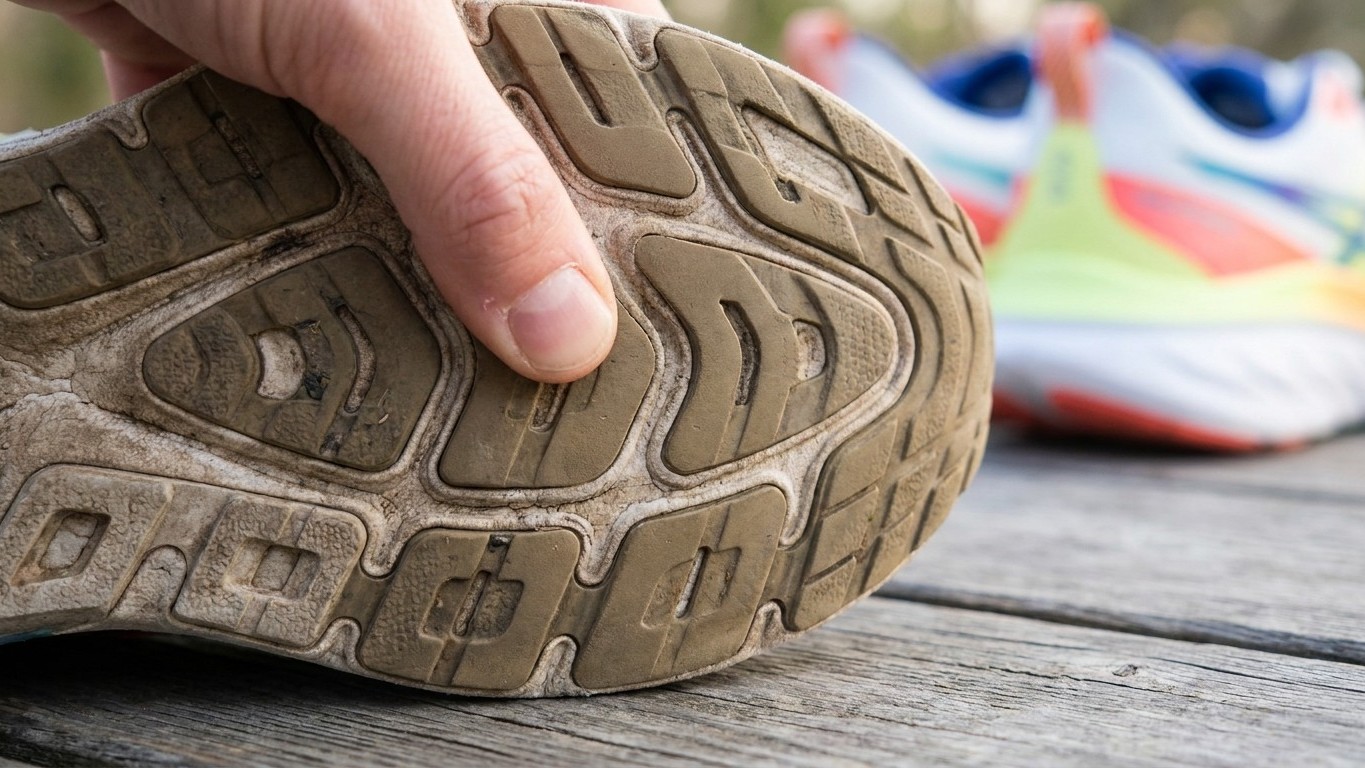
Trainers do not fail like a light bulb, flickering out one day with no warning. They fail slowly, from the inside, while the outside still looks presentable. That is exactly what happened to me: a pair I loved, outsole barely scuffed, tread pattern still crisp enough to photograph for a shoe review. Then, one ordinary Tuesday morning run, my left shin started aching in a way it had never done before, a dull, insistent throb that refused to settle even after I slowed to a walk. The shoes looked fine. The foam inside them was not.
Key takeaways
- Midsole foam can lose up to 40% of its shock absorption by 250-500 miles, while the tread still looks crisp
- Degraded cushioning doesn’t soften—it hardens and stiffens, tricking you into thinking the shoe still works
- Your body’s warning signals arrive weeks after the shoe has already begun failing you structurally
Why the outsole is the worst indicator of a dead shoe
Most runners judge a shoe’s remaining life by glancing at the sole. It is an understandable habit, and also a misleading one. Midsole foam degrades long before the upper or outsole shows visible wear, and a shoe can appear structurally intact at 400 miles while providing minimal joint protection. Appearance is not a reliable indicator of biomechanical function. The rubber tread is built to resist abrasion; the cushioning underneath is built to compress, again and again, until it simply stops bouncing back the way it used to.
What actually happens inside the midsole is almost the opposite of what you’d expect. Counterintuitively, as foam degrades, it often becomes stiffer and less flexible, because the collapsed cell structure offers more resistance to compression, and studies have measured increases in midsole stiffness after wear, sometimes by over 20% or even 40% depending on the foam type and mileage. That stiffening is deceptive. A firmer-feeling shoe can trick you into thinking it still has support, when in fact the cells that once absorbed impact have simply crumpled and can no longer spring back.
The scale of that loss is not trivial either. Nike’s own guidance on footwear and shin splints notes that most shoes lose up to 40% of their shock-absorbing capabilities and overall support at around the 250 to 500 mile range. Independent mechanical testing tells a similarly blunt story: seminal studies from the 1980s showed that shoes could lose over a third of their initial shock absorption capacity within the first 150 miles, and potentially retain less than 60% after 500 miles in mechanical tests. In plain terms, by the time your shins start complaining, the shoe has usually been quietly failing you for weeks.
How worn cushioning actually reaches your shin
The mechanism isn’t mysterious once you understand what the midsole is meant to do. Old running shoes can increase the risk of injuries because they lose their support, cushioning, and responsiveness, which can alter your biomechanics and increase the stress going into your body. Every stride you take sends a shock wave up through the foot, ankle and shin. A fresh midsole absorbs a meaningful share of that force. A collapsed one passes far more of it straight up the bone.
Shin splints, known clinically as medial tibial stress syndrome, sit right at that junction. A biomechanical risk review in the British Journal of Sports Medicine has examined this connection in detail, and orthopaedic guidance echoes the same warning in everyday language: post-run soreness in the feet, shins, or knees with no other training changes is a clinical signal worth taking seriously, since degraded cushioning transfers greater impact force through the joints with every stride. Nike puts it even more bluntly on its own advice page: wearing old, worn-out running shoes is a quick and easy path to shin splints.
There’s a second, subtler mechanism at play too, one I hadn’t fully appreciated until I dug into the research. Stability elements inside the shoe, the medial posting, the heel counter, the structures designed to control how your foot rolls through each stride, degrade alongside the foam. As running shoes wear out, these components break down and the running shoe is no longer able to control pronation effectively, which can allow the runner to overpronate and increase the risk of injury. So it isn’t just about cushioning going soft (or rather, going hard). It’s about the whole architecture that keeps your foot tracking correctly starting to give way.
What to actually check, rather than what to look at
Mileage counters are useful but blunt instruments. The honest answer is that 500 to 800 kilometres is a useful starting range, but shoes might die at 400 kilometres or last to 1,000 depending on construction and usage, so the mileage number is a flag to start paying attention, not an automatic trigger to buy new shoes. What matters more is a quick physical test alongside how your legs actually feel.
- Press test: press the midsole foam with your thumb, and if it feels hard, flat, or unresponsive, the cushioning is gone.
- Comparison test: at 300-plus miles, press into the midsole and compare the response to a newer shoe; dense, unresponsive foam means cushioning has failed.
- Body-as-sensor test: your body is a better sensor than most lab equipment, so if your regular easy-pace run feels like you’re running on a thinner surface, trust that perception, because the foam has lost its energy return and cushioning properties.
Time matters as much as distance, particularly for anyone who runs occasionally rather than daily. It’s recommended to replace your running shoes every six months if you run occasionally, as the materials can break down over time regardless of how few miles have accumulated. Foam is a chemical structure, not a stone; it oxidises and hardens sitting in a cupboard just as it does on the pavement, if more slowly.
I’ve since started writing the purchase date on the tongue of every new pair in permanent marker, a habit several coaches recommend precisely because most of us are hopeless at remembering. It costs nothing, takes ten seconds, and it means the next time my shin starts talking to me on a Tuesday morning, I’ll have an actual answer rather than a guess. The trainers that betrayed me are now bin-bound, tread pattern still looking presentable enough to fool anyone judging a shoe by its sole alone. As ever, if pain in your shins persists beyond a few days of rest or worsens with training, it’s worth getting it checked by your GP or a physiotherapist rather than assuming new trainers alone will solve it.
Sources : ncbi.nlm.nih.gov | umit.net