
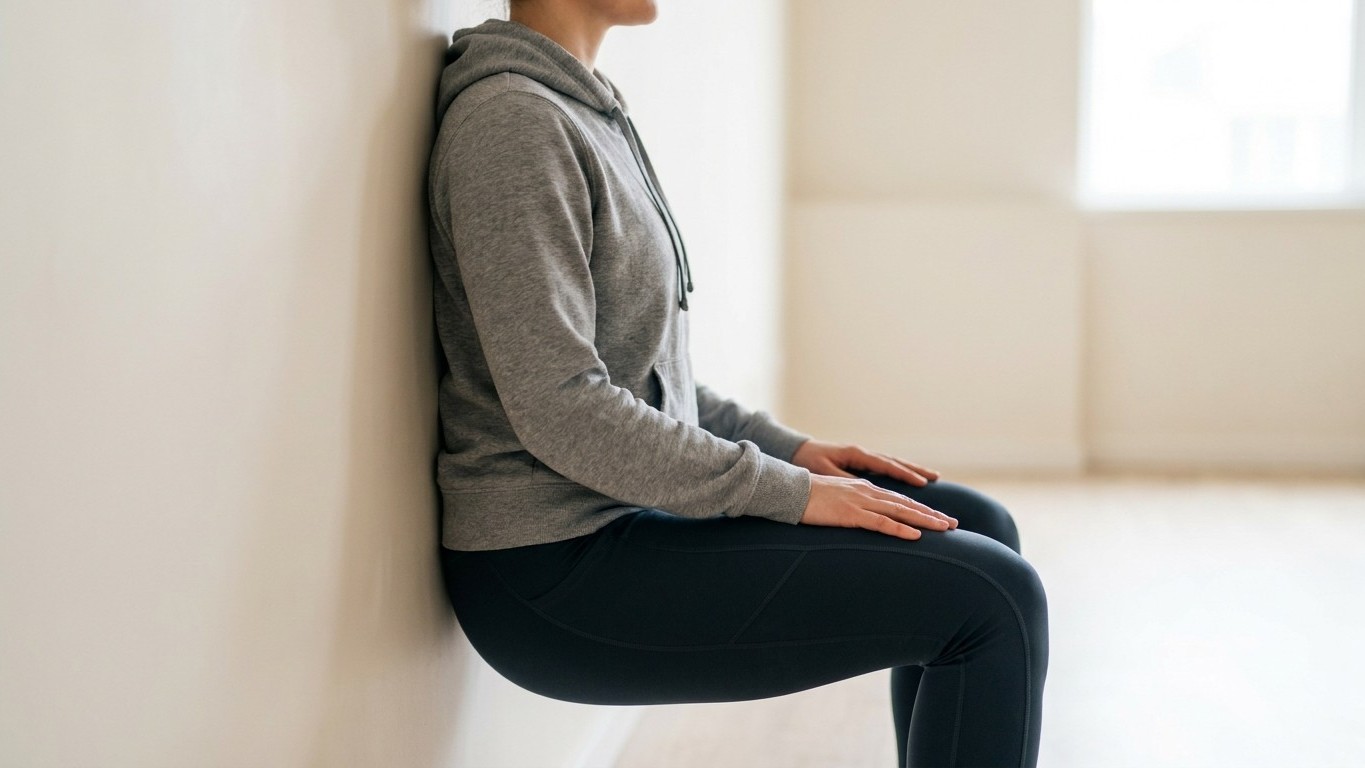
Researchers pooled data from 270 randomised controlled trials involving nearly 16,000 participants to answer a deceptively simple question: which type of exercise lowers blood pressure the most? The winner wasn’t running, cycling or weightlifting. It was the wall sit, a static hold against a wall that involves no equipment and, once you’re in position, no movement whatsoever.
The analysis, published in the British Journal of Sports Medicine, is one of the largest of its kind ever conducted on exercise and blood pressure. The 270 randomised controlled trials were ultimately included in the final analysis, with a pooled sample size of 15,827 participants. Researchers compared five broad categories: aerobic training such as walking, running and cycling; dynamic resistance training like weights and press-ups; high-intensity interval training; combined programmes mixing cardio and strength work; and isometric training, the kind where you hold a muscle contraction without moving your joints.
Key takeaways
- 270 blood pressure studies were ranked head-to-head using statistical modeling—what emerged as the clear winner shocked exercise scientists
- The top-performing exercise takes just 8 minutes per week and requires nothing but a wall—yet outperformed running, cycling, and weights
- The mechanism involves temporary blood flow restriction followed by a surge that trains your arteries to dilate more readily over time
Why static beats dynamic
All five categories produced significant reductions in resting systolic and diastolic blood pressure, with aerobic training achieving -4.49/-2.53 mmHg, dynamic resistance training -4.55/-3.04 mmHg, combined training -6.04/-2.54 mmHg, high-intensity interval training -4.08/-2.50 mmHg, and isometric exercise training -8.24/-4.00 mmHg. In plain terms, holding a wall sit nearly doubled the blood pressure reduction achieved through jogging or cycling.
When the researchers ranked every method using statistical modelling designed to compare interventions that were never tested head-to-head, isometric training came out clearly on top. The rank order of effectiveness based on SUCRA values for systolic blood pressure was isometric exercise training (98.3%), combined training (75.7%), dynamic resistance training (46.1%), aerobic exercise training (40.5%) and high-intensity interval training (39.4%). A gap that wide, in a dataset this large, isn’t noise.
Among the individual isometric exercises tested, one stood out from the rest. Wall squats, or ‘wall sits’, which involve propping yourself up against a wall with your thighs parallel to the ground, were the most effective exercise out of all those compared. Planks and handgrip squeezes also performed well, but the wall sit consistently topped the individual exercise rankings within the isometric category.
What’s actually happening in your blood vessels
The physiology here is genuinely interesting, and it explains why a motionless exercise can outperform ones that leave you breathless. Jamie O’Driscoll, senior author of the report, told the BBC that isometric exercises place a very different stress on the body to aerobic exercise, explaining that they increase the tension in the muscles when held for two minutes, then cause a sudden rush of blood when you relax. This increases the blood flow, but you must remember to breathe.
Think of it as a rehearsal for your blood vessels. Squeezing a muscle group hard for two minutes temporarily restricts blood flow through that area. The moment you release the hold, blood surges back through, triggering the vessel lining to release compounds that help it widen and relax more efficiently. Repeated three times a week, this cycle appears to train the vascular system itself to dilate more readily, which is reflected in lower resting readings over time. It’s a bit like interval training for your arteries rather than your lungs.
How the protocol actually works
The studies included in the analysis weren’t asking people to hold a wall sit for as long as humanly possible. Isometric training programmes usually involved four two-minute contractions, separated by one- to four-minute rest intervals, done three times per week. That’s a total of eight minutes of actual holding time per session, spread across roughly three sessions a week. It’s a modest time commitment for a cardiovascular payoff that rivals, and in this analysis exceeds, traditional cardio.
To do a basic wall sit, stand with your back flat against a wall and walk your feet forward until your knees form roughly a right angle, thighs parallel to the floor, as if sitting in an invisible chair. Keep your abdominal muscles engaged and breathe normally throughout, since holding your breath during the contraction can spike blood pressure unnecessarily rather than help lower it. Hold for two minutes if you can manage it, rest, then repeat three more times. Beginners may need to build up gradually, starting with shorter holds and lower intensity before progressing.
It’s worth being honest about the limitations too. The researchers acknowledge that variations in the types of participants included across the clinical trials and differences in statistical and methodological processes and exercise interventions may have influenced the findings, and so should be interpreted in light of these limitations. This is a network meta-analysis rather than a single head-to-head trial, meaning the comparisons between exercise types are statistically modelled rather than directly tested in the same group of people at the same time. That doesn’t undermine the finding, but it does mean the numbers should be read as strong evidence rather than absolute certainty.
Where this leaves current advice
Current NHS guidance for managing high blood pressure focuses almost entirely on aerobic activity. The current NHS recommendations for managing high blood pressure only talk about aerobic exercise, recommending at least 150 minutes of moderate-intensity aerobic activity each week, such as cycling and fast walking. This new evidence base is prompting calls to widen that guidance. The study authors concluded that these findings provide a comprehensive data-driven framework to support the development of new exercise guideline recommendations for the prevention and treatment of arterial hypertension.
None of this means you should abandon your daily walk or weekly swim. Remember, all exercise categories included in the study were effective. The sensible takeaway is that a couple of short wall sit sessions added to your existing routine could deliver a meaningful boost, particularly if you’re pressed for time or find sustained cardio difficult. As always, if you have an existing heart condition or uncontrolled high blood pressure, check with your GP before starting any new isometric routine, since the contraction itself does briefly raise blood pressure before the beneficial rebound kicks in.
Sources : pubmed.ncbi.nlm.nih.gov | pubmed.ncbi.nlm.nih.gov