
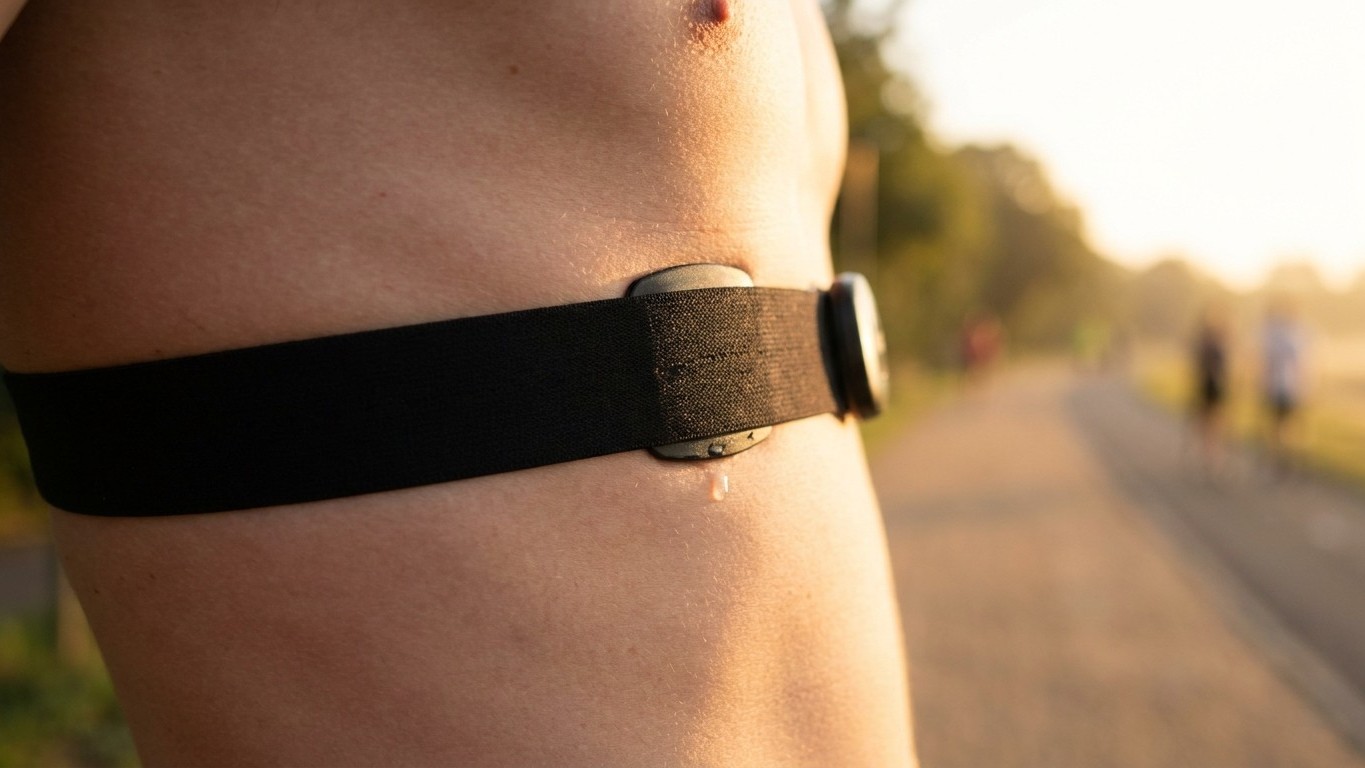
Your legs feel fine, your breathing is steady, you’re barely working harder than a brisk walk, and then your watch screams that Your Heart Rate has jumped from 140 to 170 in a matter of seconds. No dizziness, no chest tightness, nothing that feels remotely alarming in your body. Just a number on a screen that suddenly doesn’t match how you feel. The good news, according to sports scientists and monitor manufacturers alike, is that in the vast majority of cases the culprit sits between your skin and the strap, not inside your chest.
Key takeaways
- Your chest strap isn’t measuring your heart—it’s struggling to read electrical signals through dry skin
- These mystery spikes follow a predictable pattern tied to specific conditions, not medical emergencies
- One simple 30-second pre-run fix eliminates the problem for most runners
The real cause is usually electrical contact, not your heart
Chest straps don’t guess your heart rate the way optical wrist sensors do. Compared with wrist or optical sensors, chest straps measure your heart’s electrical signals directly, just like an ECG. That precision is exactly why they’re the preferred choice for serious training, but it also means they’re vulnerable to the same problems that trip up hospital ECG machines: a shaky electrical connection between the electrodes and your skin.
Polar, one of the pioneers of chest strap technology, is blunt about the leading cause of erratic readings. Contact between the skin and the electrodes of the chest strap is not constant, and moistening the electrode area thoroughly under tap water before training helps, because at the beginning of a session your skin may be dry. Once you actually start sweating, the problem tends to resolve itself, because when you start to sweat the contact will improve, since the salt in the sweat conducts electrical signals very well. That’s precisely why a calm, cool run, one where you haven’t broken a proper sweat yet, is the classic setting for these phantom spikes.
Garmin’s own community forums describe the same pattern almost word for word. The most common fault with chest straps is a high spike at the start of a run that returns to a normal rate over 5-10 minutes, basically caused by poor electrical contact between the chest strap and skin, most common in cold and dry conditions, that resolves as you begin to sweat. Technical fabrics can make matters worse too: the technical fabrics in some running tops can cause more static than others, and regular washing can help dissolve the accumulation of salts.
Fit, hygiene and hardware all play a part
A strap that’s too loose is the second biggest troublemaker. Elite HRV’s technical support notes that if the monitor shifts across your skin while you breathe or swing your arms, you should ensure the strap is as tight as comfortably possible, then gently press two fingers into the monitor towards the chest and move it slightly left and right to remove any slack. Ironically, going too far the other way with conductive gel causes its own version of the same problem. As one long-time runner and blogger put it after years of troubleshooting her own strap, too much of a good thing is a bad thing, because when gel starts oozing off the electrodes and onto the belt it can cause the monitor to read inaccurately and can also cause the strap to slip and lose signal.
Old straps deserve some suspicion too. Salt residue from dried sweat builds up in the fabric over weeks of training and gradually degrades the signal, which is why Polar recommends washing the strap in a washing machine at 40°C to remove dirt or dried sweat on a regular basis. A weak battery matters as well, since a low battery in the heart rate sensor reduces transmission range, which may cause errors in heart rate readings.
Then there’s interference from the world around you. This is the one people rarely suspect. Fluorescent lighting, other nearby electronics and even certain gym equipment can inject noise into the signal your strap is trying to read. Fluorescent lighting can interfere with heart rate monitors according to the American College of Sports Medicine, and standing underneath such lighting brings a chance of erratic, spontaneously changing readings. Clinical ECG teams see the identical issue under a different name: electrical interference is predominantly 50 or 60 Hz alternating current or radiofrequency waves from power lines, electrical equipment, mobile phones and fluorescent lights. Running past a substation, a row of shop windows, or even certain treadmill consoles at the gym can be enough to trigger a brief, meaningless spike.
How to tell noise from a genuine warning sign
None of this means every spike should be waved away without a second thought. The distinction that actually matters is whether the number matches how your body feels and whether the trace is continuous or jagged. Data from a peer-reviewed comparison of chest straps and vest-style monitors found chest straps to be remarkably reliable overall, with an average error of just 0.76% for heart rate during sports, and 99.21% of beats detected being real heart beats, versus a noticeably higher error rate for vest sensors. when a chest strap is working properly, isolated glitches stand out precisely because they’re rare.
A useful rule of thumb from sports science writers: a single heart rate spike that resolves on its own and has an obvious trigger, such as a stressful thought or standing up too fast, is rarely a sign of something serious. What should prompt a conversation with your GP is different: readings that climb and stay elevated for several minutes without dropping back, spikes accompanied by dizziness, chest discomfort or breathlessness that’s disproportionate to your effort, or a pattern that repeats itself run after run regardless of strap, fit or weather. That consistency is the detail that separates a hardware quirk from something worth a proper medical check.
Next time it happens, before assuming the worst, try the simplest fix first: run a wet finger over the two electrode pads, tighten the strap by one notch, and finish washing it properly once a week. Runners who do this consistently report the mystery spikes practically disappear, and it costs nothing but thirty seconds before you head out the door.
Sources : ncbi.nlm.nih.gov | dcrainmaker.com