
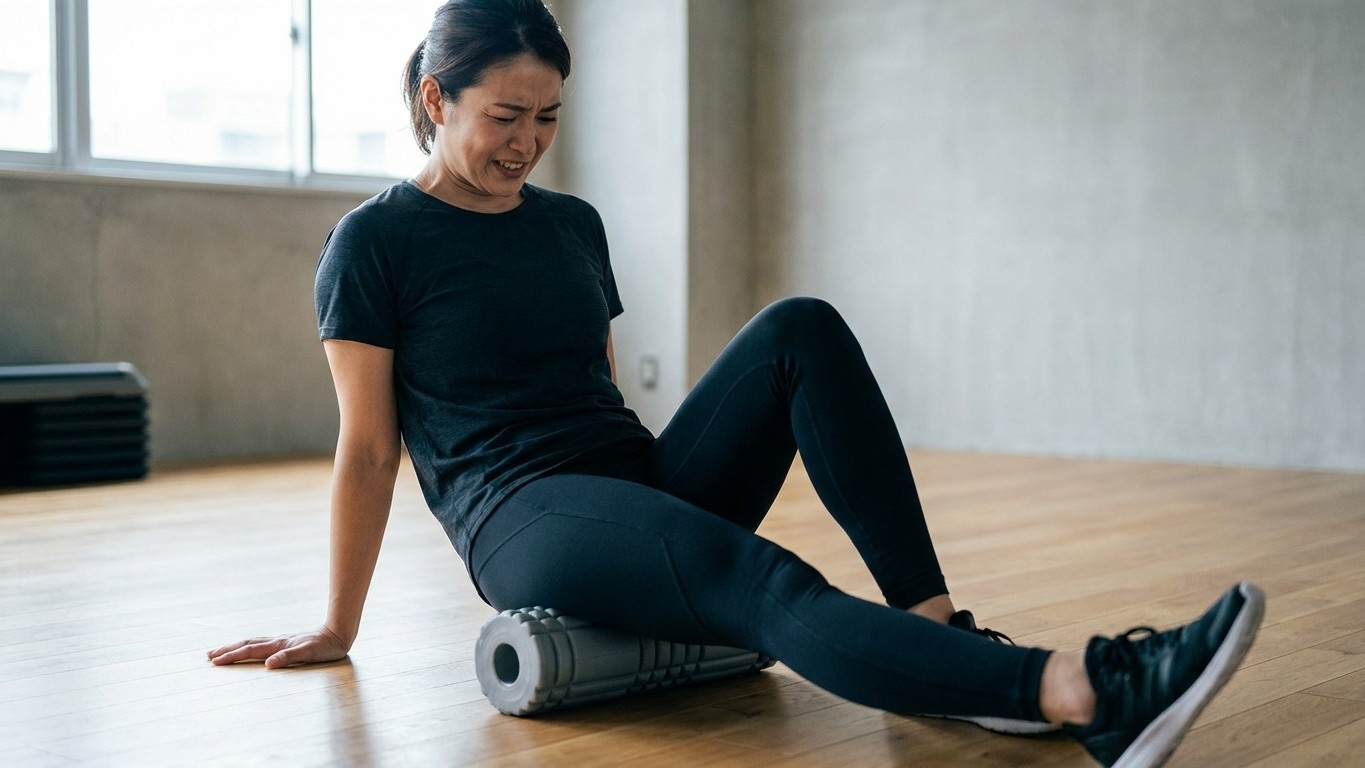
Rolling your outer thigh until you wince, believing you’re “breaking up” a tight IT band, does almost nothing for the tissue itself. The sharp, teeth-gritting pain you feel is your body’s response to squashing a dense, unyielding structure against bone, not a sign that anything is loosening or releasing.
The iliotibial band is one of the toughest pieces of connective tissue in the body, and that’s precisely the problem when it comes to foam rolling it directly. It simply wasn’t built to stretch or “give” under pressure the way a muscle does.
Key takeaways
- What feels like ‘breaking up’ tightness is actually just neurological pain masking—the tissue never changes
- The old friction theory has been replaced: IT band pain comes from compression of a nerve-rich fat pad, not stiffness
- Runners with diagnosed IT band syndrome often have zero tightness—so rolling the band directly misses the real problem
Why the band refuses to budge under a roller
The IT band isn’t muscle. It’s a thick, fibrous piece of connective tissue, or fascia, that runs from your hip down to the outside of your knee, and unlike muscle tissue, fascia doesn’t stretch or adapt the way muscles do. Physiotherapists who’ve handled this tissue in cadaver training describe it in blunt terms: cadaver dissections during physical therapy training showed just how tough and dense this tissue is.
The numbers behind this are striking. Research published in the Journal of Biomechanics found that it would take roughly 9,000 newtons of force, about 2,000 pounds, to produce even a 1% change in IT band length. No amount of body weight leaning through a foam roller comes close to that. A 2010 study in the International Journal of Sports Physical Therapy confirmed that common Stretching and foam rolling techniques produce negligible changes in IT band length. What you’re actually doing when you grind away at that spot is straightforward: you are not “breaking up adhesions” or “releasing” anything when you foam roll, you are just compressing tissue against bone.
That doesn’t mean rolling feels pointless in the moment. Some people feel better after foam rolling, and that is real, but the mechanism is neurological pain modulation, essentially overriding the pain signal with pressure, similar to rubbing a bruise. The tissue itself has not changed. It’s a genuine sensation, just not the mechanical fix people assume they’re getting.
The pain probably isn’t even about tightness
Here’s where the story gets more interesting, and where a lot of long-standing advice starts to look shaky. The old explanation for IT band syndrome was friction, the idea that the band physically slides back and forth over a bony bump near the knee with every stride, rubbing itself raw. That model has largely fallen apart under scrutiny.
New studies suggest ITBS results from tissue compression, not friction, and the IT band is a complex, anchored structure that doesn’t simply “roll over” the femur. Anatomists have found something else sitting beneath the band. Histologic examinations of cadaveric specimens show a highly innervated fat pad deep to the distal IT band, and compression of this fat pad is implicated as the source of the lateral knee pain. One research team studying this put it plainly, describing the sensation of the band moving across the bone as an illusion, since the perception of movement of the ITB across the epicondyle is an illusion.
Even the assumption that a “tight” band is what causes trouble in the first place doesn’t hold up well. A group of researchers testing runners with diagnosed IT band friction syndrome found something unexpected: all the athletes with iliotibial band friction syndrome had a negative bilateral Ober test, meaning their IT bands were not tight. Commentary on this research is careful not to overstate a small sample, but the broader point stands: it’s not safe to assume that a tight ITB matters.
So what’s actually happening for most sufferers is closer to an overuse and loading problem than a stiffness problem. The pain is better understood as compression plus poor load management, and the compression gets worse in some people usually because of a mix of movement pattern and training error. Weak hip muscles are frequently part of that picture. The current theory is that this condition is likely caused by compression of the innervated local adipose tissue, and it is often concomitant with underlying weakness of hip abductor muscles.
Where to actually put the pressure
If the band itself won’t respond to rolling, the muscles feeding into it will. The muscles to target when you want to reduce strain on the IT band are the ones that attach onto it, including glute max, glute med, tensor fasciae latae (TFL), and the lateral quad. The TFL, a small muscle sitting just below the hip bone on the outer side, deserves particular attention since it has a direct pulling relationship with the band.
Technique Matters More Than most people realise. Physiotherapy guidance on self-myofascial release generally recommends longitudinal strokes along the muscle belly for about 2 minutes per leg, or sustained pressure on a painful point for between 30 and 60 seconds, with the pressure kept “comfortably uncomfortable” rather than painful. That last point is worth repeating, because grinding through genuine pain is counterproductive: if a massage is too painful, it actually has the opposite effect.
Beyond rolling, addressing the mechanics that overload the band tends to matter far more long-term. Strengthening the hip abductors, working on running or cycling form, and easing off sudden increases in training volume all target the actual load problem rather than chasing a “tightness” that may never have been the real issue. Given how variable individual cases are, and how much overlap there is with other knee complaints, it’s worth getting a proper assessment from a physiotherapist or your GP if lateral knee or hip pain persists beyond a couple of weeks of sensible rest and loading changes, rather than relying on rolling alone to sort it out.
Sources : cohenhp.com | 321strong.com