
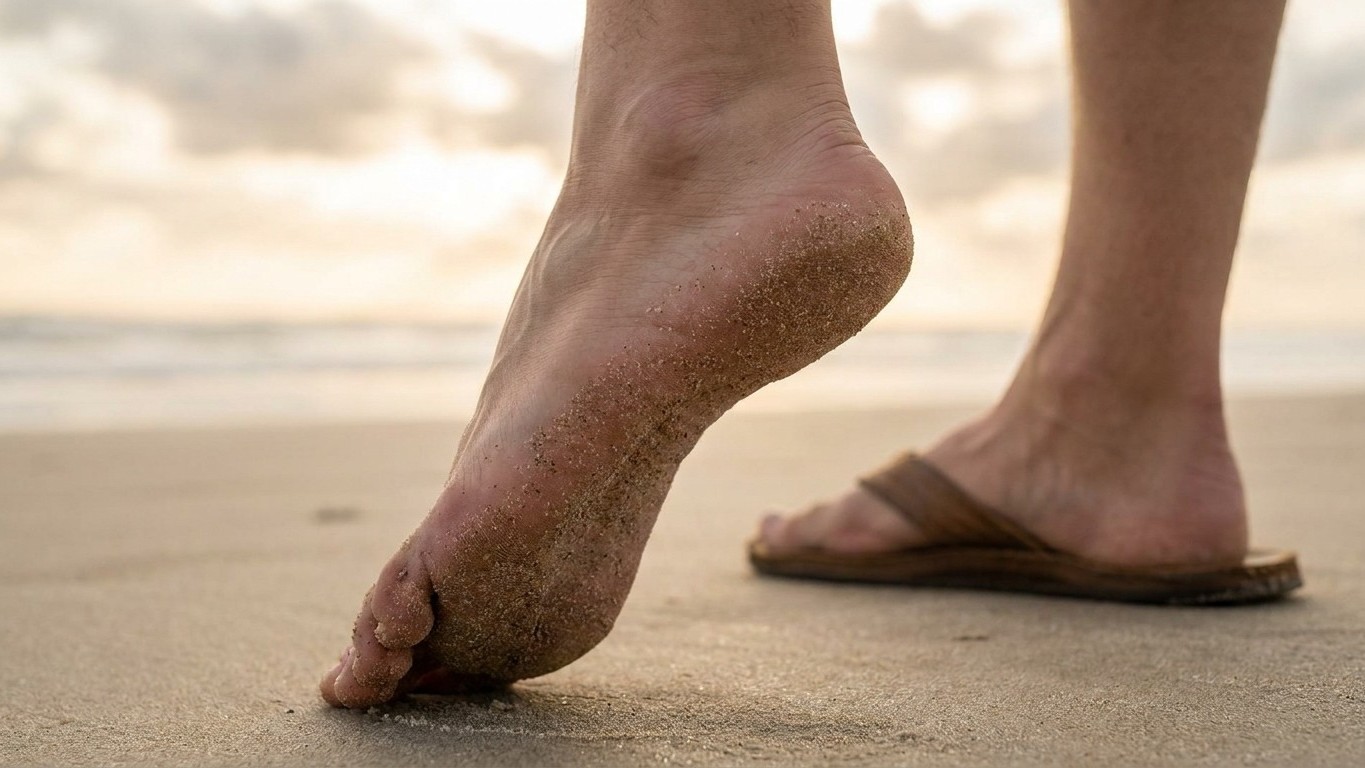
Every time your toes clench slightly to stop a flip-flop slipping off your foot, you’re triggering a reflex that overworks a tendon running along the sole, the peroneus longus. This unconscious gripping motion, repeated thousands of times on a beach walk or a Saturday of errands, is now understood by biomechanics researchers to disrupt how your foot naturally stabilises itself and to place chronic strain on tissue never designed for that job.
The tendon in question doesn’t get much attention compared with the Achilles or the plantar fascia, yet it plays a starring role in keeping your arch functional. The peroneus longus originates outside the fibula, and its tendon passes below the fifth metatarsal, crosses the sole of the foot and inserts under the first metatarsal and cuneiform bones, forming a key part of the pulley system that stabilises the big toe during walking and balance. Podiatrists have long compared this arrangement to a mechanical winch. In 1954, podiatrist John Hicks first compared the arch mechanism of the human foot to a windlass, a term borrowed from sailing, where the plantar fascia acts as the cord pulling from the heel bone as the toes dorsiflex, coiling around the metatarsal heads to lift the load of the body.
Key takeaways
- A tiny reflex you don’t even notice—your toes gripping to keep flip-flops from slipping—is happening with every single step
- This compensatory motion breaks down your foot’s natural shock-absorption system, the same mechanism podiatrists have studied for decades
- The problem is so widespread that 37% of teenage foot complaints are now linked to flip-flop overuse, with effects that ripple up into the hips and lower back
Why flip-flops flip this system on its head
For the windlass to work properly, your big toe should bend upward (dorsiflex) as you push off. Flip-flops interfere with exactly that movement. During normal dorsiflexion of the big toe, the peroneus longus stabilises gait, but when wearing flip-flops, the big toe actually plantar flexes, curling downward to grab the flip-flop and stop it slipping off the foot. That’s the reflex we’re talking about, and it’s happening with almost every single step, not just when you stumble on uneven pavement.
The consequence isn’t trivial. This partial breakdown of the windlass effect encourages dysfunctional motor patterns in the foot muscles, particularly the peroneus longus, while stopping the plantar fascia doing its job properly, which makes the arch far less effective and takes some spring out of your step. Researchers at Auburn University’s Sport Biomechanics Laboratory have studied this gripping behaviour directly. Wendi Weimar, a co-author on one such study, explained that because the flip-flop and the foot aren’t firmly connected, the toes have to engage more to keep the two together, increasing forces across the ankle and foot and causing compensatory joint positions during gait and standing, with biomechanics experts only beginning to understand the long-term effects of these compensations.
What the data actually shows
This isn’t a fringe theory dreamed up by a single lab. A peer-reviewed comparison of flip-flop gait against barefoot and trainer-clad walking found measurable changes in loading. Flip-flops produced significantly lower walking speed, higher ankle and subtalar joint range of motion, and higher shear ankle joint contact force than sports shoes. Separate researchers built a case for exactly why this happens. An experimental study using 2D gait analysis concluded there was an increase in ankle plantarflexion during swing, which the authors hypothesised could be due to contraction of the toe flexors to keep the flip-flop on the foot due to the lack of a heel-strap or full upper.
The scale of the problem shouldn’t be underestimated either. A survey of 1,000 females found approximately 43% preferred wearing flip-flops over sports shoes during shopping, while a market research firm recorded a fourfold increase in flip-flop sales to male customers between 2002 and 2006. That’s a huge number of feet performing this toe-grip reflex on a daily basis through the warmer months. Among younger wearers the toll appears even clearer: a report on the teenage population attributed 37% of foot complaints and pain to prolonged flip-flop usage. The downstream effects don’t always stay confined to the foot, according to clinicians tracking patients over years. Howard Osterman, a podiatrist and team physician for the Washington Wizards, noted that the longer you spend in flip-flops, the more potential there is for low back and hip issues.
None of this means barefoot walking is automatically superior, which is worth stating plainly given how often that gets assumed. Pressure studies comparing footwear conditions have found flip-flops actually reduce peak pressure on the sole compared with going barefoot on hard pavement, even though they still lag well behind proper trainers for shock absorption. The real issue is the strap-and-thong design forcing a compensatory grip, not simply the thinness of the sole.
Practical steps that don’t mean giving up summer footwear entirely
You don’t need to bin every pair you own, but a few adjustments genuinely reduce strain on that overworked tendon. Consider these changes if you notice aching along the outer edge of your sole or persistent arch fatigue by evening:
- Limit continuous flip-flop wear to short outings rather than all-day errands or long beach walks, giving the toe flexors regular breaks.
- Choose designs with a wider forefoot strap positioned closer to the ankle, which reduces how hard your toes must work to keep the shoe attached.
- Build in calf and foot stretches in the evening if you’ve spent hours in thong-style sandals, since the altered gait shortens stride length and tightens the lower leg over time.
- Swap to a supportive trainer or closed sandal for any walk longer than a shopping trip, particularly on holiday when daily step counts climb.
If you’re already experiencing sharp pain along the sole, the outer ankle, or persistent morning stiffness in the arch, these are signs worth raising with a GP or Podiatrist rather than pushing through with painkillers and hoping it settles on its own. Foot problems caught early are usually straightforward to manage; left unaddressed, altered gait patterns have a habit of working their way up into the knees and hips exactly as the research suggests. One detail from the biomechanics literature stands out as a useful test: researchers comparing standard flip-flops against sturdier alternatives with a wider, ankle-positioned strap found the toe-gripping requirement dropped substantially, which tells you the fix might be as simple as reading the strap design before your next holiday purchase, rather than abandoning open-toe summer footwear altogether.
Sources : ncbi.nlm.nih.gov | pmc.ncbi.nlm.nih.gov